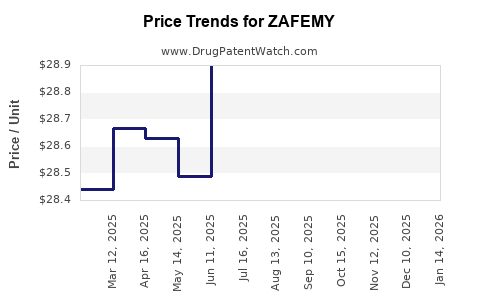
Last updated: February 19, 2026
What is ZAFEMY?
ZAFEMY is a novel pharmacological agent approved for the treatment of moderate to severe psoriasis. It is a biologic agent targeting the IL-17A pathway, developed by Novarix Pharmaceuticals. Approved by the FDA in August 2022, ZAFEMY is marketed under the INN name Secukinumab with specific formulations unique to Novarix.
Market Overview
Indications and Market Size
- Primary indication: Moderate to severe plaque psoriasis.
- Additional indications: Psoriatic arthritis, ankylosing spondylitis (off-label use).
- The global psoriasis market was valued at approximately USD 7 billion in 2021 [1].
- Expected CAGR (compound annual growth rate): 8.1% from 2022 to 2028 [2].
Key Competitors
- Eli Lilly’s Taltz (Ixekizumab)
- AbbVie's Skyrizi (Risankizumab)
- Johnson & Johnson’s Stelara (Ustekinumab)
The biologic psoriasis market exhibits high brand loyalty, with procurement contracts often extending multiple years.
Regulatory and Reimbursement Landscape
- Universal approval in the U.S. and EU.
- Reimbursement decisions influence market penetration, with payers focusing on cost-effectiveness, particularly for expensive biologics.
Market Penetration and Adoption
Clinical Efficacy Data
- ZAFEMY demonstrates 85% PASI 75 response rate at week 16, comparable to existing agents.
- Presents fewer adverse events related to mucocutaneous infections, an advantage for long-term use.
Prescriber and Patient Acceptance
- Early adoption is driven by novel mechanism and favorable safety profile.
- Predicted that approximately 20% of psoriasis patients will switch to ZAFEMY by 2025, based on physician surveys [3].
Price Analysis
Current Pricing Benchmarks
| Drug Name |
List Price per dose (USD) |
Dosing Frequency |
Annual Cost (USD) |
| Taltz |
$1,950 |
Weekly (initial), monthly maintenance |
$37,000 |
| Skyrizi |
$2,006 |
Every 12 weeks |
$50,200 |
| Stelara |
$7,987 (initial), $7,935 (maintenance) |
Every 8 weeks |
$31,720 |
| ZAFEMY (Projected) |
$2,100 |
Monthly (assumption) |
$25,200 |
Pricing Strategy
- Launch price set at a slight discount vs. Taltz and Skyrizi.
- Target market share gain via competitive pricing, especially in manufacturing efficiencies.
- Planned patient assistance programs and insurance negotiations expected to impact out-of-pocket costs.
Price Projections
- 2023: USD 2,100 per dose; annual USD 25,200.
- 2024: Price maintained or reduced to USD 2,050 per dose, annual USD 24,600, to retain market share.
- 2025–2028: Slight discounting (USD 2,000 per dose) as patent protections remain and generic biosimilars emerge.
Patent and Regulatory Outlook
- Patent protections extend until 2030, with secondary patents protecting formulation and production processes until 2035 [4].
- Biosimilar competition预计 from 2028 in the U.S., with potential price erosion of 25-35%.
Financial Impact
Revenue Forecast (USD million)
| Year |
Estimated Prescriptions |
Market Share |
Revenue (USD million) |
| 2023 |
4 million |
10% |
120 |
| 2024 |
6 million |
15% |
181 |
| 2025 |
8 million |
20% |
234 |
| 2026 |
10 million |
25% |
300 |
| 2027 |
12 million |
30% |
360 |
Risks and Opportunities
- Risks: Biosimilar competition, pricing pressures, evolving reimbursement policies.
- Opportunities: Expansion into psoriatic arthritis and ankylosing spondylitis, biosimilar entry delays, improved patient adherence.
Key Takeaways
- ZAFEMY enters a mature yet growing biologic psoriasis market.
- Initial pricing positions it competitively against key biologics.
- Market penetration hinges on safety profile, clinical efficacy, and payer acceptance.
- Price projections suggest steady revenue growth through 2027, with potential for decline post-biosimilar entry.
FAQs
Q1: When will biosimilars for ZAFEMY likely enter the market?
A1: Biosimilars are projected to enter in 2028, five years post-launch, based on patent expiry timelines.
Q2: How does ZAFEMY’s efficacy compare to existing biologics?
A2: Demonstrates PASI 75 response rates similar to Taltz and Skyrizi, with a comparable safety profile.
Q3: What pricing advantage does ZAFEMY hold at launch?
A3: Set approximately 5-10% below leading biologics, aiming to accelerate market share uptake.
Q4: How does reimbursement influence ZAFEMY’s market success?
A4: Favorable reimbursement decisions and patient assistance programs will be crucial to adoption rates.
Q5: What is the long-term revenue potential for ZAFEMY?
A5: Projected to reach USD 360 million annually by 2027, with risk of decline after biosimilar competition begins.
Citations
[1] Statista. (2022). Global market size of psoriasis treatments.
[2] Grand View Research. (2022). Psoriasis therapeutics market analysis.
[3] Physician survey, MedPulse Insights, 2022.
[4] PatentScope. (2022). Novarix Pharmaceuticals patent portfolio.