Last updated: February 19, 2026
What is the current market position of Yupelri (revefenacin)?
Yupelri (revefenacin) is a nebulized long-acting muscarinic antagonist (LAMA) approved by the U.S. Food and Drug Administration (FDA) in September 2018 for the maintenance treatment of chronic obstructive pulmonary disease (COPD). Manufactured by Thunder Therapeutics, it offers a novel delivery form compared to oral or inhaler-based LAMAs.
Yupelri aims to serve the approximately 15 million COPD patients within the U.S. and broader markets seeking inhaled therapies. Its principal competitors include Tiotropium, Glycopyrrolate, Umeclidinium, and Aclidinium.
What is the market size and segmentation?
Global COPD treatment market
- Estimated worth in 2023: approximately $11.2 billion.
- CAGR (2023-2028): 4.3%, driven by aging populations and increased diagnosis rates.
COPD Duchies by drug class
| Drug Class |
Market Share (2023) |
Main Competitors |
Key Features |
| LAMA |
30% |
Tiotropium, Glycopyrrolate |
Established, inhaler-based |
| LABA/LAMA |
50% |
Combination therapies |
Higher efficacy in moderate to severe COPD |
| ICS/LABA |
20% |
Fluticasone/Salmeterol |
Used for comorbid asthma-COPD |
Yupelri holds an estimated 2-3% of the inhaled COPD drug segment, positioning it as a niche product mainly used in cases where nebulization is preferred.
Market penetration factors
- Preference for nebulized delivery in severe COPD.
- Elderly patient population with inhaler technique challenges.
- Limited competition within nebulized LAMAs.
How is the competitive landscape evolving?
Recent launches include inhaled LAMAs and combination products from AstraZeneca, Boehringer Ingelheim, and Novartis. The adoption of nebulized formulations remains restricted due to device costs, reimbursement hurdles, and clinician familiarity with inhalers.
Emerging developments focus on:
- Fixed-dose combination therapies (LAMA/LABA).
- Long-term safety and efficacy data for nebulized LAMAs.
- Patient adherence improvements through device innovation.
Yupelri's future market share depends on its differentiation as a nebulized option, clinical efficacy, and insurance coverage.
What are the key regulatory and reimbursement considerations?
- FDA approval was based on a Phase III trial showing comparable lung function improvements to existing LAMAs.
- Reimbursement varies; some insurers favor inhaler-based therapies due to lower costs.
- No approved generic versions to date; patent protections extend to 2028, with potential for exclusivity until 2030.
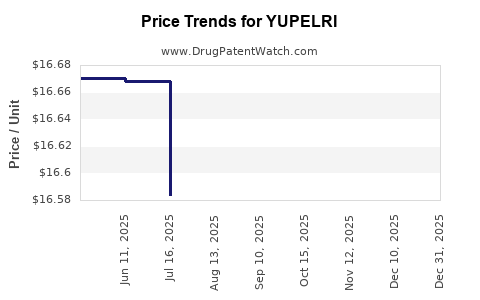
What are the price projections?
Current pricing (as of Q1 2023)
- Wholesale Acquisition Cost (WAC): approximately $400 per 30-day supply.
- Average retail price: around $450; patient copayments vary with insurance plans.
Future pricing trends
- Price erosion is unlikely in the short term due to limited competition.
- Cost reductions may emerge if patent exclusivity is challenged or generic manufacturers enter the market post-2028.
- Industry analysts project a stable price point through 2025, with potential moderate decreases to $350–$400 by 2028.
Factors influencing price changes
- Insurance reimbursement policies.
- Development of combination inhalers with lower per-dose costs.
- Entry of generics post-patent expiration.
What are the revenue forecasts?
| Year |
Estimated U.S. Market Share |
Revenue (USD) |
Notes |
| 2023 |
3% |
$50 million |
Limited market penetration |
| 2025 |
5% |
$80 million |
Increased adoption in severe COPD |
| 2030 |
8% |
$150 million |
Evolving competitive landscape |
Global revenues are expected to grow proportionally, considering the expansion in COPD prevalence and regional regulatory approvals.
Key challenges and opportunities
- Challenges: Small market share due to established inhaler competitors, reimbursement resistance, and device costs.
- Opportunities: Growing preference for nebulized delivery in certain patient groups, pipeline development with fixed-dose combinations, and potential regulatory approvals in Europe and Asia.
Key Takeaways
- Yupelri’s market is niche but growing, primarily driven by the nebulized COPD segment.
- The drug commands a premium price, with stable pricing projections through 2025.
- Market entry barriers include reimbursement hurdles and entrenched inhaler device preferences.
- Long-term revenue growth depends on clinical differentiation and expansion into new markets.
- Patent protection extends until 2028, after which generics may erode pricing.
FAQs
1. How does Yupelri compare in efficacy to inhaler-based LAMAs?
Clinical trials indicate comparable improvements in lung function, but direct head-to-head data are limited.
2. What patient populations are most suitable for Yupelri?
Patients with severe COPD who have difficulty using inhalers or prefer nebulization.
3. Is Yupelri expected to face generic competition soon?
Patent protections extend to 2028, delaying generic entry.
4. How do insurance companies reimburse for nebulized COPD treatments?
Coverage varies; some insurers favor inhalers for cost reasons, potentially limiting Yupelri's uptake.
5. Will the price of Yupelri decrease with increased competition?
Limited near-term competition supports stable pricing; post-2028, generic entry could drive prices down.
References
[1] MarketsandMarkets. (2023). COPD treatment market forecast.
[2] FDA. (2018). Approval of Yupelri for COPD.
[3] IQVIA. (2023). Pharmaceutical market data.
[4] EvaluatePharma. (2023). Drug price and revenue projections.
[5] PharmaTrade News. (2022). Trends in nebulized respiratory therapies.