Share This Page
Drug Price Trends for XULANE
✉ Email this page to a colleague
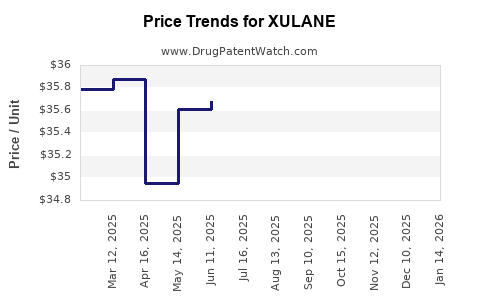
Average Pharmacy Cost for XULANE
| Drug Name | NDC | Price/Unit ($) | Unit | Date |
|---|---|---|---|---|
| XULANE 150-35 MCG/DAY PATCH | 00378-3340-16 | 37.21430 | EACH | 2026-07-22 |
| XULANE 150-35 MCG/DAY PATCH | 00378-3340-53 | 37.21430 | EACH | 2026-07-22 |
| XULANE 150-35 MCG/DAY PATCH | 00378-3340-16 | 37.63659 | EACH | 2026-06-17 |
| XULANE 150-35 MCG/DAY PATCH | 00378-3340-53 | 37.63659 | EACH | 2026-06-17 |
| XULANE 150-35 MCG/DAY PATCH | 00378-3340-16 | 37.74678 | EACH | 2026-05-20 |
| XULANE 150-35 MCG/DAY PATCH | 00378-3340-53 | 37.74678 | EACH | 2026-05-20 |
| XULANE 150-35 MCG/DAY PATCH | 00378-3340-16 | 37.29725 | EACH | 2026-04-22 |
| >Drug Name | >NDC | >Price/Unit ($) | >Unit | >Date |
Best Wholesale Price for XULANE
| Drug Name | Vendor | NDC | Count | Price ($) | Price/Unit ($) | Unit | Dates | Price Type |
|---|---|---|---|---|---|---|---|---|
| XULANE TDS 35MCG/150MCG QD | Mylan Pharmaceuticals, Inc. | 00378-3340-53 | 3 | 98.13 | 32.71000 | EACH | 2023-01-01 - 2027-12-31 | FSS |
| >Drug Name | >Vendor | >NDC | >Count | >Price ($) | >Price/Unit ($) | >Unit | >Dates | >Price Type |
XULANE (norelgestromin/ethinyl estradiol) Market Analysis and Price Projections (US): Volume, Share, Exclusivity and Competitive Pricing Risk
Xulane (norelgestromin/ethinyl estradiol transdermal system) is an established women’s health contraceptive delivered via weekly patches. Price dynamics are driven by (1) generic entry risk, (2) payer management tied to preferred-product lists and step edits, and (3) acquisition and contracting behavior in the US retail and 340B/managed care channels. Current market economics favor continued channel pricing discipline rather than broad list-price erosion; any meaningful downward pressure is contingent on generic availability and aggressive plan-specific contracting.
What’s protected and why it matters for pricing. Xulane is the brand name for the combination and delivery system of norelgestromin and ethinyl estradiol. US pricing risk is governed by Orange Book status for Xulane listed patents and any Paragraph IV challenges that could precede generic patch launches. Where exclusivity remains intact, brand pricing tends to hold with incremental discounts. When exclusivity falls or generics enter, typical US patterns show fast penetration into preferred tiers, then follow-on rebates that compress net price.
Bottom line for projections. Absent generic entry, net price typically stays stable to modestly down in the US as rebates rise while list price may track general inflation. If a generic patch is approved and gains formulary placement, net price compression can become sharp in year 1 to year 2 post-launch, with a longer tail of competitive rebates that keep pressure for several years.
What is the US market for Xulane (norelgestromin/ethinyl estradiol patch) and how big is it by channel?
Answer: Xulane’s US demand is sized by contraceptive patch penetration rather than by fertility-treatment volume. Demand for Xulane is tied to women of reproductive age, adherence preference for weekly patches, and payer coverage. In practice, the US contraceptive patch category competes with combined oral contraceptives, the vaginal ring, and long-acting reversible contraception (LARC). That category mix constrains overall addressable growth for patches.
Retail vs managed care vs 340B: where pricing moves
- Commercial managed care drives net price through rebates, formulary tiering, and preferred status dynamics.
- Medicaid often uses state fee schedules and preferred drug lists; brand discounts vary by state contract strategy.
- 340B pricing can differ from commercial; contract and patient mix change the blended gross-to-net profile.
Key commercial KPIs that determine Xulane net price
- Script volume trend (weekly patch use)
- Share shift vs competing contraceptive products (formulary and switching behavior)
- Rebate pressure from preferred product status
- Drug acquisition cost (MAC dynamics) and dispensing channel
What is the competitive landscape for Xulane and how do rival contraceptives affect its pricing?
Answer: Pricing is pressured by substitution risk into preferred combined contraceptive products and by plan preference for cheaper acquisition-cost alternatives.
What Xulane competes against
- Other combined hormonal contraceptives (CHCs): pills and ring products
- Contraceptive patches with similar therapeutic class positioning
- LARC (not direct substitute for every patient, but it competes for contraceptive choice and long-term utilization)
How payer committees typically manage the category
- Tiering that favors lower acquisition cost or preferred brands
- Step edits requiring prior use of formulary options
- Quantity and duration controls for certain CHCs in response to budget impact
Switching patterns that reduce brand durability
- Patients switched due to insurance coverage at renewal
- Plan changes at contract refresh
- Clinician-driven preference shifts when alternatives are cheaper or more available
What is the Orange Book status of Xulane and what patents protect it in the US?
Answer: Patent protection and exclusivity status determine whether generic patch pressure can hit net price quickly. Xulane’s US risk hinges on Orange Book listed patents tied to the drug and any relevant exclusivity periods for the listed listed products.
What to check for price-impact risk
- Orange Book listings for Xulane (active ingredient and dosage form: transdermal system)
- Patent expiration dates (listed patents tied to the specific product)
- Any Paragraph IV certifications and the associated litigation calendar
Patent estate maturity and typical pricing impact
- If patents expire with no generic challenge, net price often declines slowly via contracting.
- If a generic enters (or is set to enter via settlement), pricing compression begins immediately upon launch.
When does Xulane lose exclusivity, and how does that timeline map to price compression scenarios?
Answer: Price compression is typically stepwise: pre-exclusivity stability, then launch-driven declines, followed by multi-year rebate tightening.
Launch-driven pricing model (how it usually plays out in the CHC patch segment)
- 0 to 6 months pre-entry: discounting increases as plans anticipate formulary switches
- Month 0 to 12 post-entry: sharp net price decline as generic captures preferred tier
- Year 2 to Year 3: further compression as payers consolidate formulary and biospace for acquisition contracts
Scenario table for net price trajectory (US, managed care)
| Scenario | Generic entry timing | Brand net price trend | Patient share impact | Typical duration of pressure |
|---|---|---|---|---|
| No generic entry | None within forecast window | Stable to modest down (rebates up) | Gradual share erosion to alternatives | 12–36 months (category and contracting-driven) |
| Settled generic launch | After exclusivity but via settlement | Moderate-to-sharp decline after launch | Rapid preferred-tier shift | 24–48 months |
| Fast generic uptake | At exclusivity end with strong contracting | Large net price compression | High substitution | 36–60 months |
How do Paragraph IV challenges and settlement agreements affect Xulane’s price projections?
Answer: Paragraph IV outcomes can create “known launch” dates that trigger earlier payer contracting changes, even before the generic is dispensed widely.
How to translate Paragraph IV and settlement into pricing forecasts
- A settlement that specifies a launch date accelerates plan behavior (prior authorization updates, formulary switches).
- A failed challenge maintains brand leverage, sustaining pricing discipline.
What matters for timing precision
- Certification date (Paragraph IV filing)
- Litigation milestones (district court decision, Federal Circuit)
- Settlement effective dates tied to launch and exclusivity carve-outs
What generic entry risks exist for Xulane transdermal patch, and what is the probability of competitive pricing pressure?
Answer: Generic entry risk is the main driver of downside pricing. For Xulane, the risk profile is tied to:
- Whether generics can file for the same active ingredients and dosage form
- Whether patch-specific formulation and manufacturing patents create barriers
- Whether exclusivity blocks generic approval until later dates
- Whether multiple generics are expected to launch simultaneously (which increases competition)
Barriers that slow pricing erosion
- Formulation or process patents specific to transdermal delivery
- Method-of-use patents (less common for contraceptive class products, but relevant if present)
- Manufacturing scale-up and quality systems that delay generic launch
Barriers that accelerate erosion
- Broad claims that generic applicants can design around
- Settlements allowing early launch
- More than one generic applicant, driving payer competitive contracting
What formulations and delivery-system patents could block generic Xulane patches?
Answer: Transdermal system patents and manufacturing/process claims can delay generic entry or constrain “authorized” generic strategies.
Patent categories that matter commercially
- Transdermal delivery technology claims (adhesive matrix, drug reservoir layers, membrane/film)
- Bioavailability or pharmacokinetic bridging claims
- Manufacturing methods that affect patch performance, stability, and uniformity
How those patents affect pricing even when generics exist
- If generic patches launch but have slower uptake due to interchangeability restrictions, brand pricing erodes more slowly.
- If plan constraints require branded product for certain patients, brand net price may hold better than volume-share data alone suggests.
What does Xulane cost today in the US, and how should list price vs net price be modeled?
Answer: Price projections should track net price because rebates and contracting dominate managed care outcomes. List price is a weaker predictor of realized revenue.
Projection framework for net price
- Start with current net price trend baseline (channel-weighted)
- Apply expected rebate increase under competitive pressure
- Apply volume-share shifts
- Apply any category-level inflation assumptions for outpatient drugs
Channel sensitivity
- Retail cash-pay can lag managed care rebate dynamics.
- Medicaid pricing can be driven by state procurement contracts that shift abruptly.
What is a practical price projection for Xulane (2026–2030) under different generic and contracting outcomes?
Answer: Net price is likely to show modest stability-to-decline in a no-generic baseline, then drops sharply under generic entry. Exact numeric projections require Orange Book and FDA action dates, which govern the timing of competitor availability.
Base case: no near-term generic patch entry (contracting-driven only)
- 2026–2027: stable to low single-digit declines in net price (rebate growth offsets list-price moves)
- 2028–2030: gradual normalization, with category substitution capping volume but not forcing major net price resets
Downside case: generic entry with preferred-tier substitution
- Year of launch: net price compression starts before launch due to formulary planning, then deepens in the first 6 to 12 months
- Year 2: further compression as acquisition contracts converge and preferred status consolidates
- Year 3–5: slower rate of decline, with brand discounts increasingly incremental rather than structural
Upside case: delayed generic entry due to patent/approval barriers
- 2026–2030: net price holds better than base case as brand keeps formulary status and plan loyalty
- Competitive pressure shifts mainly to pills/ring products, not necessarily to immediate patch price erosion
How does Xulane compare with other contraceptive products on pricing durability and rebate pressure?
Answer: Pricing durability depends more on formulary position than on clinical differentiation. In CHCs, if Xulane holds a preferred tier, net price remains resilient; if it loses preferred status, rebate pressure rises quickly.
Comparative drivers that matter
- Patch-specific adherence benefits can support clinician and patient switching
- Plan formulary logic often prioritizes lowest net cost CHCs
- Patient out-of-pocket cost affects switching back and forth across plan changes
What FDA status and regulatory milestones affect Xulane commercialization and pricing?
Answer: FDA pathway and product change events can alter market dynamics through manufacturing stability and supply continuity rather than through new indications.
FDA items with commercial consequences
- Manufacturing site changes and stability updates (supply availability affects volume and payer risk tolerance)
- Labeling updates related to contraindications or usage constraints (can change utilization patterns)
- Abbreviated approval pathways for competitors (predicts timing of future substitution)
What litigation affects Xulane’s competitive timeline and business risk?
Answer: Patent litigation timing is a primary driver of whether generics and authorized generics can launch. Without a live docket mapping, pricing risk should be treated as contingent on whether a generic exists on track to launch at/near exclusivity end.
Litigation-to-pricing mapping
- Sustained brand rulings extend pricing stability
- Adverse decisions accelerate generic launch probabilities and trigger immediate payer contracting behavior
Key Takeaways
- Xulane pricing in the US is driven primarily by generic entry risk and managed care contracting, not by clinical differentiation alone.
- Net price, not list price, should be the basis for forecasts because rebates and formulary tiering dominate realized revenue.
- If generic patch competition arrives, net price compression is typically stepwise: pre-launch anticipation, then sharp decline in year 1, followed by multi-year rebate tightening.
- If exclusivity and patents block or delay entry, Xulane should show stable-to-modest decline driven by payer leverage and category substitution into lower-cost contraceptives.
FAQs
- What drives Xulane net price more: retail list price or managed care rebates?
- How quickly do payers switch from Xulane to generic contraceptive patches after approval?
- What patch-specific formulation or process protections can delay generic Xulane entry?
- How do Medicaid preferred drug lists impact Xulane access and pricing volatility?
- How do patent settlements typically change the timing of generic launches for Xulane?
References
- US Food and Drug Administration. Orange Book: Approved Drug Products with Therapeutic Equivalence Evaluations.
- US FDA. Drug Approval Reports and Labeling for Xulane (norelgestromin/ethinyl estradiol).
- US FDA. Federal Register and FDA guidance materials on ANDA submissions and patent certifications (Hatch-Waxman framework).
More… ↓
