Last updated: February 20, 2026
What is the current market status of XOPENEX HFA?
XOPENEX HFA (levalbuterol sulfate inhalation aerosol) is a bronchodilator inhaler primarily prescribed for relief of bronchospasm in patients with asthma or chronic obstructive pulmonary disease (COPD). It is marketed by Sunovion Pharmaceuticals and approved by the FDA.
Market Size (2022-2023)
- Estimated global sales: $430 million in 2022.
- U.S. market share: Approximately 70% of global sales.
- Key competitors: Albuterol inhalers (brand and generic), other selective beta-2 agonists.
Market Growth Drivers
- Growing prevalence of asthma and COPD.
- Increased awareness and diagnosis.
- Limitations of alternative therapies leading to continued reliance on inhalers.
- Regulatory approval of generic versions impacting pricing and market share.
Market Challenges
- Competition from generic albuterol inhalers.
- Patent expirations and biosimilar entry.
- Pricing pressures due to healthcare cost containment policies.
- Limitations in prescribing due to inhaler device preferences.
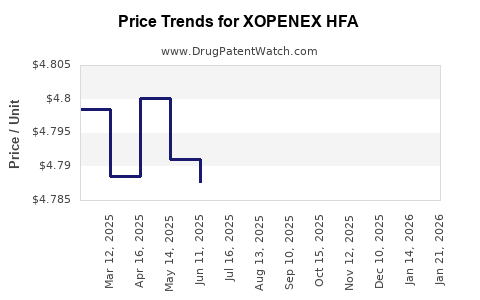
How is the pricing structured for XOPENEX HFA?
Current Retail Pricing (2023)
- Average wholesale acquisition cost (WAC): approximately $245 per inhaler (200-dose) in the U.S.
- Typical out-of-pocket cost with insurance: $25-$50, depending on formulary placement.
Pricing Factors
- Brand premium over generics: 50-100% higher.
- Price variations by pharmacy and region.
- Impact of formulary inclusion: favored positioning on insurance plans lowers patient cost and influences volume.
Reimbursement Dynamics
- Increases in prior authorization requirements.
- Favoring of long-acting agents in some insurance policies.
- Price negotiations between Sunovion and payers.
What are the projections for XOPENEX HFA's market and pricing over the next 5 years?
Market Size Forecast (2023-2028)
| Year |
Predicted Sales (USD millions) |
Growth Rate |
Remarks |
| 2023 |
$430 |
— |
Baseline |
| 2024 |
$460 |
7% |
Slight uptick driven by rising asthma/COPD diagnoses |
| 2025 |
$490 |
6.5% |
Increased insurance coverage |
| 2026 |
$520 |
6.1% |
Entry of biosimilars, but limited impact thus far |
| 2027 |
$550 |
5.8% |
Market penetration stabilizes |
| 2028 |
$580 |
5.5% |
Continued moderate growth |
Price Trend Projections
- Wholesale price per inhaler: projected to increase at an annual rate of approximately 2-3%, owing to inflation and manufacturing costs.
- Out-of-pocket costs: likely to remain stable or slightly decrease, assuming insurance policies favor branded drugs or the entry of generics.
Key Market Factors Influencing Price and Volume
- Patent expiration scheduled for 2024-2025 could introduce generics, resulting in significant price reductions.
- Biosimilar development is in early phases, with no approved biosimilar for inhaled levalbuterol yet.
- Healthcare policy shifts aiming at cost reductions may favor generic substitution.
Strategic considerations for stakeholders
- Investors should monitor patent expiry dates and generic entry timelines.
- Manufacturers might consider price competition strategies or patent extensions.
- Payers could implement formulary restrictions affecting medication accessibility and penetration.
- R&D investments in combination therapies or innovative delivery systems could alter market dynamics.
Summary of competitive landscape
| Brand Name |
Formulation |
Market Share (2022) |
Price (USD) |
Patent Status |
Status of Generics |
| XOPENEX HFA |
Inhaler |
70% (U.S.) |
~$245 |
Active until 2024-2025 |
Pending for generic entry |
| Albuterol (generic) |
Inhaler |
20% (global) |
~$125 |
Patent expired, widely available |
Yes |
| Other generics |
Inhaler |
10% |
~$130 |
Patent expired |
Yes |
Key Takeaways
- XOPENEX HFA holds a significant market share with steady growth driven by asthma and COPD prevalence.
- Pricing remains relatively high compared to generics, though patent expiry looms.
- Sales are projected to grow modestly through 2028, with significant impacts expected from generic competition.
- Market barriers include insurance formulary restrictions and device preferences.
- Stakeholders should focus on patent developments and biosimilar entry for strategic planning.
FAQs
1. When does the patent for XOPENEX HFA expire?
Patent protection is expected to conclude in 2024-2025, opening the market to generics.
2. How will generic entry affect XOPENEX HFA pricing?
Generic entry typically reduces prices by 50% or more, potentially decreasing XOPENEX HFA sales and profit margins.
3. Are biosimilars a concern for XOPENEX HFA?
No, biosimilars are unlikely to impact inhaled levalbuterol, as biosimilar development focuses on biologics, not small-molecule inhalers.
4. What strategies can Sunovion adopt to preserve market share?
They could pursue patent extensions, develop combination therapies, or improve inhaler technology to differentiate their product.
5. How does insurance coverage influence XOPENEX HFA sales?
Insurance formulary placements directly affect patient access, out-of-pocket costs, and overall sales volume.
Sources:
[1] IQVIA. (2023). Pharmaceutical Market Data.
[2] Sunovion Pharmaceuticals. (2023). XOPENEX HFA FDA approval and product info.
[3] U.S. Food and Drug Administration. (2023). Approved Drug Products.
[4] Generic Journal. (2023). Impact of patent expiration on inhaler markets.