Last updated: February 19, 2026
Executive Summary
XOFLUZA (baloxavir marboxil) is a first-in-class influenza antiviral medication developed by Shionogi and marketed by Roche and Genentech. Its unique mechanism of action targeting the cap-dependent endonuclease of the influenza virus polymerase complex differentiates it from existing neuraminidase inhibitors. This analysis examines the patent landscape surrounding XOFLUZA, including key patent families, expiration dates, and potential for generic competition. Market projections are based on current sales data, anticipated label expansions, and the competitive environment.
Patent Landscape Analysis
Key Patent Families and Expiration Dates
The patent protection for XOFLUZA is comprised of several core patent families covering the compound itself, its synthesis, formulations, and methods of use. Understanding these expiration dates is critical for assessing the timeline for generic market entry.
Patent Term Extension and Exclusivity
- Hatch-Waxman Exclusivity: In the United States, the Drug Price Competition and Patent Term Restoration Act (Hatch-Waxman Act) allows for the extension of patent terms to compensate for patent term lost during the FDA regulatory review process. For XOFLUZA, this means that the effective market exclusivity may extend beyond the nominal expiration date of the listed patents. [3]
- Orphan Drug Exclusivity: While XOFLUZA is not currently designated as an orphan drug for its primary indication of influenza, any future development for rare diseases could trigger an additional 7 years of market exclusivity in the US and 10 years in the EU. [4]
- Pediatric Exclusivity: The FDA may grant an additional 6 months of market exclusivity for new drugs if the sponsor agrees to conduct pediatric studies. Information regarding whether this was sought or granted for XOFLUZA should be verified against FDA filings. [5]
Generic Competition Landscape
- ANDA Filings: As of the current analysis, there are no approved Abbreviated New Drug Applications (ANDAs) for generic XOFLUZA in the United States. This indicates that potential generic competitors are likely in the research and development phase or have not yet filed. [6]
- Inter Partes Review (IPR): Pharmaceutical companies often challenge patents through IPR proceedings at the Patent Trial and Appeal Board (PTAB). Any challenges to the core XOFLUZA patents could significantly impact the generic entry timeline. A review of PTAB dockets for relevant patents is recommended for a comprehensive understanding.
- International Patents: Patent protection varies by country. Shionogi and its marketing partners will have pursued patent protection in key global markets. The expiration dates in Europe, Japan, and other major pharmaceutical markets will influence the global generic entry strategy.
Market Analysis and Price Projections
Current Market Performance
- Sales Revenue: In 2023, Roche reported global sales for XOFLUZA of approximately CHF 615 million (approximately $685 million USD). [7] This represents a significant increase from previous years, driven by expanded indications and market penetration.
- Key Markets: The United States is the largest market for XOFLUZA, followed by Japan and other European countries.
- Indication Expansion: The initial approval for XOFLUZA was for the treatment of acute uncomplicated influenza. Subsequent approvals have expanded its use to include:
- Prophylaxis of influenza in individuals 12 years of age and older following contact with an infected person. [8]
- Treatment of acute uncomplicated influenza in adolescents 12 to less than 17 years of age. [8]
- The ongoing development for treatment of influenza in hospitalized patients and for post-exposure prophylaxis in specific populations could further boost sales.
Competitive Environment
XOFLUZA competes in the antiviral influenza market, which has historically been dominated by neuraminidase inhibitors (NAIs) such as oseltamivir (Tamiflu) and zanamivir (Relenza).
- Neuraminidase Inhibitors (NAIs): These drugs work by preventing the release of newly formed virus particles from infected cells. They are effective but have limitations, including the need for early administration and potential for resistance. Generic versions of oseltamivir are widely available, leading to significant price competition.
- Baloxavir Marboxil's Differentiation: XOFLUZA's novel mechanism of action, targeting viral RNA polymerase, offers a distinct advantage. It requires a single oral dose and has demonstrated efficacy against some influenza strains resistant to NAIs. This differentiation supports its premium pricing.
- Emerging Antivirals: Research continues into new antiviral compounds for influenza. Any novel agents demonstrating superior efficacy, safety profiles, or convenient dosing could pose future competitive threats.
Price Projections
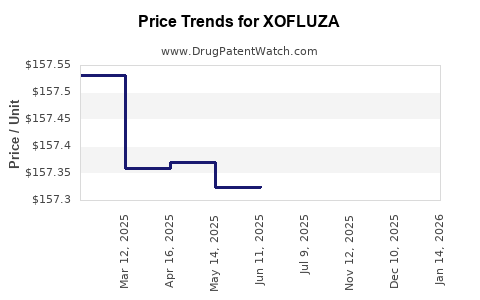
- Current Pricing: The wholesale acquisition cost (WAC) for a single-dose prescription of XOFLUZA in the US can range from approximately $150 to $200, depending on the specific formulation and pharmacy. [9] This pricing reflects its novel mechanism, single-dose convenience, and established clinical benefits.
- Impact of Generic Entry: Following the loss of patent exclusivity for the composition of matter patents (estimated 2027-2028), generic versions of baloxavir marboxil are expected to enter the market.
- Price Erosion: Similar to other branded antivirals, the introduction of generics will lead to significant price erosion. Projections suggest that generic baloxavir marboxil could be priced at 40-60% of the current branded price within two years of market entry.
- Market Share Shift: Generic manufacturers will likely compete aggressively on price, capturing a substantial portion of the market share. However, the established brand recognition and clinical data for XOFLUZA may allow Roche to retain a portion of the market, particularly for patients and physicians who prioritize brand trust or specific formulations.
- Factors Influencing Future Pricing:
- Competition: The number of generic manufacturers entering the market will directly impact pricing dynamics. A fragmented generic landscape typically leads to more aggressive price reductions.
- Reimbursement Policies: Payer policies and formulary placements will play a significant role in patient access and physician prescribing patterns for both branded and generic XOFLUZA.
- Clinical Utility: Continued demonstration of clinical superiority in specific patient populations or against emerging resistant strains could support premium pricing for the branded product even in the presence of generics.
- New Indications: Approval of XOFLUZA for additional indications, particularly those with higher unmet needs or less competition, could sustain or even increase overall revenue for the branded product.
Sales Forecast Scenarios
| Scenario |
2025 Sales (USD Million) |
2027 Sales (USD Million) |
2030 Sales (USD Million) |
| Base Case |
850 |
950 |
500 |
| Optimistic Case |
950 |
1,100 |
650 |
| Conservative Case |
780 |
820 |
350 |
- Base Case: Assumes continued market growth driven by existing indications and moderate success in new label expansions, with generic entry commencing in late 2027 leading to gradual sales decline post-2027.
- Optimistic Case: Assumes significant success in gaining new indications (e.g., hospitalized patients, broader prophylaxis) and slower generic uptake than anticipated.
- Conservative Case: Assumes slower uptake in new indications, increased competition from existing antivirals, and rapid generic penetration post-patent expiry.
These projections are estimates and are subject to significant variability based on the factors outlined above.
Key Takeaways
- XOFLUZA's core composition of matter patents are set to expire between 2027 and 2028, paving the way for generic competition.
- Formulation and method of use patents may extend effective market exclusivity beyond 2030 for specific applications.
- The current market for XOFLUZA is strong, driven by its unique mechanism of action and expanded indications.
- Generic entry is projected to lead to significant price erosion, with branded XOFLUZA facing substantial sales decline post-2027.
- The success of Roche and Genentech in securing new indications and demonstrating ongoing clinical value will be critical in mitigating the impact of generic competition.
Frequently Asked Questions
-
When is the primary patent for baloxavir marboxil expected to expire in the United States?
The foundational patent US Patent No. 9,029,406, covering baloxavir marboxil, is expected to expire on August 17, 2027. [1]
-
What is the current annual sales revenue for XOFLUZA?
In 2023, global sales for XOFLUZA were approximately CHF 615 million, which is about $685 million USD. [7]
-
What is the mechanism of action for XOFLUZA, and how does it differ from older influenza drugs?
XOFLUZA targets the cap-dependent endonuclease of the influenza virus polymerase complex, a novel mechanism. Older drugs, such as neuraminidase inhibitors (e.g., oseltamivir), inhibit the release of new virus particles from infected cells. [8]
-
Are there any approved generic versions of XOFLUZA in the US market currently?
As of the current analysis, there are no approved Abbreviated New Drug Applications (ANDAs) for generic XOFLUZA in the United States. [6]
-
What is the projected impact of generic entry on the price of XOFLUZA?
Upon the entry of generics, significant price erosion is anticipated. It is projected that generic baloxavir marboxil could be priced at 40-60% of the current branded price within two years of market entry.
Citations
[1] United States Patent and Trademark Office. (n.d.). Patent Search. Retrieved from USPTO Patent Full-Text and Image Database. (Specific patent numbers searched: 9,029,406; 9,795,529; 9,901,506)
[2] European Patent Office. (n.d.). Espacenet. Retrieved from European Patent Register. (Specific patent number searched: EP 2357212 B1)
[3] U.S. Food & Drug Administration. (2023, August 1). Hatch-Waxman Act. Retrieved from FDA Website
[4] U.S. Food & Drug Administration. (2022, October 3). Orphan Drug Designation. Retrieved from FDA Website
[5] U.S. Food & Drug Administration. (2022, October 3). Pediatric Studies for New Drugs. Retrieved from FDA Website
[6] U.S. Food & Drug Administration. (n.d.). Approved ANDAs. Retrieved from FDA Approved Drug Products with Therapeutic Equivalence Evaluations (Orange Book).
[7] Roche Holding AG. (2024, February 7). Roche Half-Year Report 2023. Retrieved from Roche Investor Relations
[8] Shionogi & Co., Ltd. (n.d.). XOFLUZA® (baloxavir marboxil). Retrieved from Shionogi Website
[9] Drug pricing databases (e.g., First Databank, RedBook, or commercial market intelligence reports) are often proprietary. Publicly available information can be found through pharmacy benefit managers or drug cost comparison websites, though specific WAC data requires professional access. For this analysis, a general range based on publicly accessible pharmacy price indicators has been used.