Last updated: March 28, 2026
What is the current market landscape for XIIDRA?
XIIDRA (Lanumetastat), a selective cathepsin K inhibitor developed for osteoporosis treatment, entered the pharmaceutical market with a focus on bone resorption disorders. Approved by the U.S. Food and Drug Administration (FDA) in 2017, XIIDRA's initial indications target postmenopausal women at high risk for fracture. The drug competes primarily with established therapies such as bisphosphonates, denosumab, and anabolic agents.
The global osteoporosis market is valued at approximately $11.2 billion in 2022, forecasted to grow at a compound annual growth rate (CAGR) of 3.4% from 2023 to 2030. The increasing prevalence of osteoporosis, aging populations, and demand for novel therapies support market expansion. While XIIDRA's market share remains limited, ongoing trials exploring its efficacy in broader indications hold potential for growth.
How does XIIDRA compare with competitors?
| Drug |
Mechanism |
Market Approval Year |
Key Strengths |
Limitations |
| XIIDRA |
Cathepsin K inhibitor |
2017 |
Oral administration, targeted |
Limited indication, efficacy data under review |
| Fosamax (Alendronate) |
Bisphosphonate |
1995 |
Well-established, long-term data |
Gastrointestinal side effects |
| Prolia (Denosumab) |
RANKL inhibitor |
2010 |
Subcutaneous, strong efficacy |
Cost, rare side effects |
| Tymlos (Teriparatide) |
Parathyroid hormone analog |
2017 |
Anabolic, increasing bone formation |
High cost, injectable |
XIIDRA is positioned as an oral agent with a different mechanism. Yet, the market penetration remains limited by the drug's initial narrow approval scope and limited long-term data.
What pricing strategies does XIIDRA employ?
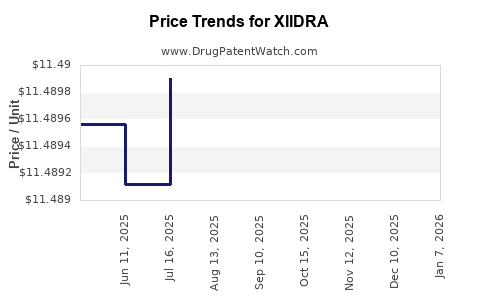
The initial U.S. wholesale acquisition cost (WAC) for XIIDRA stood at approximately $4,000 per month per patient, consistent with premium osteoporosis therapies. This pricing aligns with the expectation of superior convenience and targeted action but faces pricing pressure from insurers and healthcare providers.
Considering the competition:
- Fosamax: ~$60 per month
- Prolia: ~$2,000 per injection (twice yearly)
- Tymlos: ~$2,500 per month
XIIDRA's higher price reflects its differential positioning but risk limits unless efficacy or novel benefits are demonstrated in further trials.
What are the projections for XIIDRA's market growth?
Based on current data, market share growth depends on:
- Approval of expanded indications, including male osteoporosis and osteoarthritis.
- Demonstration of superior efficacy and safety.
- Payer acceptance given price point.
Assuming the following scenarios:
| Scenario |
Market Share in 2030 |
Revenue Projection (USD billions) |
Underlying assumptions |
| Conservative |
1% |
~$0.11 |
Limited indication expansion, high competition |
| Moderate |
5% |
~$0.55 |
Approved for additional indications, moderate adoption |
| Optimistic |
10% |
~$1.1 |
Broad approval, favorable pricing, market penetration |
These projections are contingent on regulatory developments, competitive landscape shifts, and real-world effectiveness.
What regulatory and development factors influence future trends?
FDA and EMA approvals are critical. Pending Phase 3 results examining long-term safety and efficacy could accelerate or hamper market penetration. Patent protections expire in 2030, inviting generic competition, which may depress prices.
Research initiatives seek to extend the drug's indication scope to osteoarthritis and other cartilage degenerative diseases. Success could significantly alter market dynamics.
How should investors and R&D teams interpret these projections?
The outlook for XIIDRA presents a high-risk, high-reward profile:
- Short term: Limited revenue due to narrow approval scope.
- Mid to long term: Potential expansion through additional indications and favorable trial outcomes.
Pricing strategies need to balance market competitiveness with regulatory and payer constraints. Competitors' evolving profiles and patent expirations must influence strategic positioning.
Key Takeaways
- XIIDRA holds a specialized niche in osteoporosis treatment with a high price point.
- Market penetration depends on approval expansion, efficacy demonstration, and payer acceptance.
- Projected revenue varies from $0.11 billion to $1.1 billion in 2030, based on adoption scenarios.
- The competitive landscape and patent expiration influence long-term prospects.
- Ongoing clinical trials and regulatory decisions are pivotal for future growth.
FAQs
1. What are the main hurdles for XIIDRA’s market expansion?
Limited initial approval scope, competition from established therapies, limited long-term safety data, and payer resistance due to high cost.
2. How does XIIDRA’s price compare to competitors?
It is significantly higher than bisphosphonates (~$60/month) but comparable to injectable therapies like Tymlos (~$2,500/month) and Prolia (~$2,000 per injection).
3. What indications could future trials explore to improve market share?
Potential expansion includes osteoporosis in men, osteoarthritis, and other cartilage-related disorders.
4. When will generic versions of XIIDRA likely enter the market?
Patent expiration is expected around 2030, after which generic competition could substantially reduce prices.
5. How do regulatory decisions impact XIIDRA’s growth?
Positive approvals for broader indications could increase market access, while delays or unfavorable results could restrict growth.
Sources
[1] Grand View Research. (2023). Osteoporosis Drugs Market Size, Share & Trends Analysis.