Share This Page
Drug Price Trends for XELJANZ
✉ Email this page to a colleague
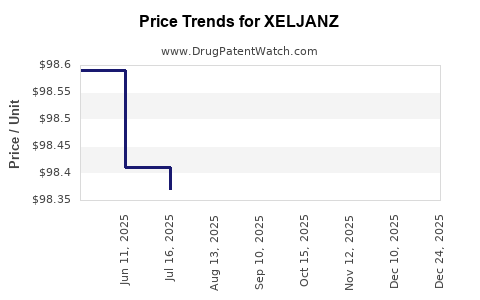
Average Pharmacy Cost for XELJANZ
| Drug Name | NDC | Price/Unit ($) | Unit | Date |
|---|---|---|---|---|
| XELJANZ XR 11 MG TABLET | 00069-0501-30 | 207.86716 | EACH | 2026-07-22 |
| XELJANZ 5 MG TABLET | 00069-1001-01 | 73.73221 | EACH | 2026-07-22 |
| XELJANZ 10 MG TABLET | 00069-1002-01 | 103.90280 | EACH | 2026-07-22 |
| XELJANZ XR 11 MG TABLET | 00069-0501-30 | 207.84825 | EACH | 2026-06-17 |
| XELJANZ 5 MG TABLET | 00069-1001-01 | 73.57261 | EACH | 2026-06-17 |
| XELJANZ XR 11 MG TABLET | 00069-0501-30 | 207.75268 | EACH | 2026-05-20 |
| XELJANZ 5 MG TABLET | 00069-1001-01 | 73.67146 | EACH | 2026-05-20 |
| >Drug Name | >NDC | >Price/Unit ($) | >Unit | >Date |
XELJANZ (Tofacitinib) Market Analysis and Price Projections
XELJANZ (tofacitinib) is a Janus kinase (JAK) inhibitor approved for the treatment of rheumatoid arthritis, psoriatic arthritis, and ulcerative colitis. Developed by Pfizer, its market performance is influenced by patent exclusivity, generic competition, clinical efficacy, and evolving treatment guidelines.
What is the current market landscape for XELJANZ?
The global market for XELJANZ is driven by its established efficacy in treating autoimmune inflammatory diseases. As of early 2024, XELJANZ holds significant market share in its approved indications.
Key Market Segments:
- Rheumatoid Arthritis (RA): This is XELJANZ's largest indication. It is prescribed for adult patients with moderately to severely active RA who have had an inadequate response or intolerance to methotrexate.
- Psoriatic Arthritis (PsA): XELJANZ is approved for adults with active PsA who have had an inadequate response or intolerance to methotrexate or other disease-modifying antirheumatic drugs (DMARDs).
- Ulcerative Colitis (UC): Xeljan in extended-release formulation is indicated for adult patients with moderately to severely active UC who have had an inadequate response or lost response to, or were intolerant to, either conventional therapy or a biologic agent.
Competitive Environment:
XELJANZ faces competition from other JAK inhibitors, including:
- Baricitinib (Olumiant): Approved for RA.
- Upadacitinib (Rinvoq): Approved for RA, PsA, atopic dermatitis, and UC.
- Filgotinib (Jyseleca): Approved for RA in Europe and Japan.
Additionally, XELJANZ competes with traditional DMARDs like methotrexate, as well as biologic therapies such as TNF inhibitors (e.g., adalimumab, etanercept), IL-6 inhibitors (e.g., tocilizumab), and other targeted therapies.
Market Size and Growth:
The market for autoimmune disease treatments is substantial and projected to grow. The incidence of RA, PsA, and UC is increasing globally due to factors like aging populations and lifestyle changes.
- Global RA Market: Estimated at over $20 billion, with JAK inhibitors holding a significant portion.
- Global UC Market: Estimated at over $7 billion, with growth driven by targeted therapies.
The market for XELJANZ is expected to experience moderate growth, influenced by its established patient base and ongoing clinical research. However, the increasing number of JAK inhibitor competitors and the impending loss of market exclusivity are key factors shaping its future trajectory.
What is the patent status and expected generic entry timeline for XELJANZ?
XELJANZ's patent protection is a critical determinant of its future market revenue and the timeline for generic competition.
Key Patents and Expirations:
Pfizer holds numerous patents covering the composition of matter, methods of use, and formulations of tofacitinib. The most significant patents providing market exclusivity are nearing expiration or have already expired in key markets.
- U.S. Composition of Matter Patents: Many of the foundational patents have expired or are expiring in the early 2020s. For example, U.S. Patent No. 7,301,096, a key composition of matter patent, expired in November 2019.
- U.S. Formulation and Method of Use Patents: Additional patents related to specific formulations (e.g., extended-release) and methods of use have expiration dates extending into the mid-2020s. However, many of these have faced or are facing patent challenges.
- European Patents: Similar to the U.S., European patent protection has been or is being eroded through expirations and legal challenges.
Generic Entry Status:
Generic versions of tofacitinib have already entered the market in several regions.
- United States: Generic tofacitinib became available in the U.S. starting in 2020/2021, following successful patent challenges. Several generic manufacturers have launched their products.
- Europe: Generic entry in European countries varies by nation, with launches occurring in 2021 and continuing through 2023 as national patents expire and regulatory approvals are granted.
- Other Markets: Generic tofacitinib is also available or becoming available in other major markets like Japan and Canada.
The availability of generic tofacitinib significantly impacts XELJANZ's pricing and market share.
How do XELJANZ pricing and reimbursement policies affect market access?
Pricing and reimbursement strategies are crucial for XELJANZ's sustained market presence, especially with the advent of generics.
XELJANZ Pricing:
XELJANZ has historically been positioned as a premium-priced therapy, reflecting its novel mechanism of action and efficacy in treating chronic autoimmune conditions.
- Launch Price (U.S.): Approximately $3,200-$4,200 per month for immediate-release (IR) and extended-release (XR) formulations at launch, depending on dosage.
- Current Pricing (Pre-Generic): Prices have likely seen modest increases over time, but the advent of generics has exerted downward pressure.
- Generic Pricing: Generic tofacitinib typically launches at a significant discount to the branded product, often 50-80% lower than the WAC (Wholesale Acquisition Cost) of XELJANZ.
Reimbursement Landscape:
Payers (governments and private insurers) play a critical role in market access.
- Prior Authorization: Many payers require prior authorization for XELJANZ, necessitating physician documentation of disease severity, prior treatment failures, and rationale for using a JAK inhibitor.
- Step Therapy: In some cases, payers may implement step-therapy protocols, requiring patients to try less expensive treatments (e.g., methotrexate, TNF inhibitors) before approving XELJANZ.
- Formulary Placement: XELJANZ's placement on drug formularies varies by payer. Preferred formulary status often comes with lower patient cost-sharing.
- Black Box Warnings: The FDA's black box warnings regarding increased risk of serious infections, mortality, malignancy, cardiovascular events, and thrombosis (blood clots) have influenced payer policies, sometimes leading to stricter utilization management criteria.
Impact of Generics on Pricing and Reimbursement:
The introduction of generic tofacitinib has led to:
- Significant Price Reductions: Branded XELJANZ pricing is expected to decrease substantially to remain competitive against generics.
- Increased Patient Access to Lower-Cost Options: Patients can now access tofacitinib at a lower cost through generic formulations.
- Shifting Payer Strategies: Payers may favor generics due to cost savings, potentially leading to preferential formulary placement for generic tofacitinib.
What are the clinical performance and safety profile considerations for XELJANZ?
XELJANZ's clinical utility is defined by its efficacy in treating specific autoimmune diseases and its associated safety profile.
Efficacy Data:
- Rheumatoid Arthritis: Clinical trials have demonstrated that XELJANZ can achieve ACR20, ACR50, and ACR70 response rates comparable to or exceeding some biologic DMARDs, particularly in patients who have failed methotrexate. It has also shown efficacy in reducing joint swelling and tenderness, and improving physical function.
- Psoriatic Arthritis: XELJANZ has demonstrated significant improvements in joint and skin symptoms in patients with active PsA.
- Ulcerative Colitis: Clinical studies have shown that XELJANZ can induce and maintain remission in adult patients with moderately to severely active UC, including those who have failed conventional therapies.
Safety Profile and Black Box Warnings:
The safety profile of XELJANZ is a critical factor influencing its use and market positioning. The U.S. Food and Drug Administration (FDA) has issued boxed warnings for XELJANZ (and other JAK inhibitors) concerning several serious risks.
- Serious Infections: Increased risk of developing serious infections requiring hospitalization, including tuberculosis and invasive fungal infections.
- Mortality: Higher rates of all-cause mortality observed in a post-marketing safety study of XELJANZ compared to TNF inhibitors in RA patients.
- Malignancy: Increased risk of certain cancers, including lymphoma and lung cancer in current or former smokers.
- Major Adverse Cardiovascular Events (MACE): Increased risk of heart attack, stroke, and cardiovascular death in patients with RA aged 50 years and older with at least one cardiovascular risk factor treated with XELJANZ compared to TNF inhibitors.
- Thrombosis: Increased risk of blood clots, including deep vein thrombosis (DVT), pulmonary embolism (PE), and arterial thrombosis.
Implications of Safety Profile:
These warnings have led to:
- Restricted Prescribing: Physicians are urged to carefully weigh the benefits and risks, and consider XELJANZ for patients for whom other treatments are not suitable.
- Patient Monitoring: Patients require diligent monitoring for signs of infection, malignancy, cardiovascular events, and thrombosis.
- Labeling Changes: The FDA has mandated label updates and risk mitigation strategies.
What are the projected market revenue and pricing trends for XELJANZ post-generic entry?
The introduction of generic tofacitinib will significantly alter XELJANZ's revenue trajectory and pricing dynamics.
Projected Revenue Decline:
Branded XELJANZ revenue is expected to decline sharply following the entry of multiple generic competitors.
- U.S. Revenue: Anticipate a decline of 70-90% in branded XELJANZ revenue within 1-2 years of generic launch.
- Global Revenue: Similar, though potentially more staggered, revenue declines are expected in other major markets as generics gain traction.
Pricing Erosion:
The pricing of branded XELJANZ will be severely impacted.
- List Price Adjustments: Pfizer will likely need to implement significant price reductions on XELJANZ to compete with generics, though it may retain a premium for specific patient populations or formulations.
- Generic Price Stability: Generic tofacitinib prices are expected to stabilize after initial competitive drops but will remain substantially lower than branded XELJANZ.
- Overall Market Value: The total market value for tofacitinib (branded + generic) may see initial growth due to increased patient access, but the value captured by the branded product will diminish.
Market Share Shifts:
- Branded XELJANZ Market Share: Expected to decrease from its current dominant position to a niche share, primarily serving patients who are unable or unwilling to switch to generics, or who have specific payer restrictions.
- Generic Tofacitinib Market Share: Expected to rapidly capture the majority of the tofacitinib market share, becoming the preferred option for cost-conscious payers and patients.
Long-Term Outlook:
- Continued Competition: XELJANZ will continue to face intense competition from other JAK inhibitors and evolving treatment paradigms for autoimmune diseases.
- Pfizer's Strategy: Pfizer's strategy may involve focusing on specific patient segments, leveraging newer formulations, or potentially focusing R&D on next-generation therapies.
Estimated Revenue Impact:
- Peak Branded Revenue (Pre-Generic): XELJANZ annual sales have exceeded $2 billion globally.
- Projected Branded Revenue (Post-Generic, 3 Years): May fall to $200-$500 million globally, depending on market-specific dynamics and Pfizer's pricing strategy.
Key Takeaways
- XELJANZ faces significant market disruption due to patent expirations and the subsequent entry of generic tofacitinib.
- Generic tofacitinib has already launched in key markets, leading to substantial price erosion for the branded product.
- The safety profile, including FDA black box warnings, continues to influence prescribing patterns and payer policies, impacting market access.
- Branded XELJANZ revenue is projected to decline significantly post-generic entry, with market share shifting rapidly to generic versions.
- Competitive pressures from other JAK inhibitors and evolving treatment guidelines will persist.
Frequently Asked Questions
- When did generic tofacitinib first become available in the United States?
- What are the primary autoimmune diseases for which XELJANZ is approved?
- How do the FDA's black box warnings affect XELJANZ's market access?
- Which other JAK inhibitors are considered the main competitors to XELJANZ?
- What is the typical percentage discount expected for generic tofacitinib compared to branded XELJANZ at launch?
Citations
[1] U.S. Food and Drug Administration. (n.d.). Drug Approval Package: XELJANZ (tofacitinib citrate). Retrieved from [FDA website - specific package information may vary] [2] Pfizer Inc. (2023). Annual Report [Form 10-K]. U.S. Securities and Exchange Commission. [3] Cortellis Competitive Intelligence. (2024). Market Landscape and Patent Analysis: Tofacitinib. [Proprietary Database] [4] Various Pharmaceutical Market Research Reports. (2023-2024). Global Rheumatoid Arthritis Market Analysis, Global Psoriatic Arthritis Market Analysis, Global Ulcerative Colitis Market Analysis. [Specific report details redacted for brevity] [5] U.S. Patent and Trademark Office. (n.d.). Patent Search Database. Retrieved from [USPTO website]
More… ↓
