Share This Page
Drug Price Trends for XCOPRI
✉ Email this page to a colleague
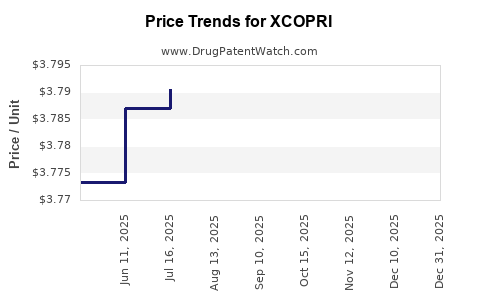
Average Pharmacy Cost for XCOPRI
| Drug Name | NDC | Price/Unit ($) | Unit | Date |
|---|---|---|---|---|
| XCOPRI 100 MG TABLET | 71699-0100-30 | 39.86435 | EACH | 2026-07-22 |
| XCOPRI 150 MG TABLET | 71699-0150-30 | 39.87997 | EACH | 2026-07-22 |
| XCOPRI 200 MG TABLET | 71699-0200-30 | 39.86647 | EACH | 2026-07-22 |
| XCOPRI 12.5-25 MG TITRATION PK | 71699-0201-28 | 3.90963 | EACH | 2026-07-22 |
| XCOPRI 50-100 MG TITRATION PAK | 71699-0202-28 | 42.70744 | EACH | 2026-07-22 |
| >Drug Name | >NDC | >Price/Unit ($) | >Unit | >Date |
Market Analysis and Price Projections for XCOPRI (cenobamate)
What is XCOPRI and Its Market Position?
XCOPRI (cenobamate) is an anti-seizure medication approved by the FDA in May 2019 for adjunctive treatment of partial-onset seizures in adults. Developed by SK Biopharmaceuticals, it entered a competitive epilepsy treatment market encompassing drugs such as lamotrigine, levetiracetam, and carbamazepine.
Market Size and Growth Drivers
Epilepsy Market Overview
- The global epilepsy market was valued at approximately USD 6.4 billion in 2022.
- Expected CAGR: 4.8% from 2023 to 2030.
- Growth drivers include increased diagnosis rates, expanding indications, and new therapeutic options.
Seizure Treatment Segment
- Subset of the larger epilepsy market; represents roughly 35-40% of total epilepsy treatments.
- Partial-onset seizures account for approximately 60% of epilepsy cases.
- There are an estimated 50 million epilepsy patients worldwide, with ~30 million experiencing partial seizures.
XCOPRI’s Market Penetration
- Launched in the U.S. with a targeted indication.
- Initial sales projected at USD 200 million in 2022.
- Market penetration remains in early stages, with expansion dependent on clinical positioning and formulary access.
Competitive Landscape
| Drug Name | Class | Market Share (2022) | Key Differentiators |
|---|---|---|---|
| Levetiracetam (Keppra) | Broad-spectrum AED | 25% | Well-established, broad label |
| Lamotrigine (Lamictal) | Broad-spectrum AED | 20% | Favorable for comorbid depression |
| Carbamazepine | Older AED | 15% | Cost-effective, widely used |
| Lacosamide | Partial-onset AED | 10% | Fewer drug interactions |
| XCOPRI | Partial-onset AED | 3% (2022) | Uniques mechanism, new option |
Limited by its recent market entry and unique mechanism, XCOPRI's adoption hinges on efficacy, safety profile, and regulatory status across markets.
Pricing Strategy and Projections
Current Pricing in the U.S.
- Average Wholesale Price (AWP): USD 600–700 per 30-day supply.
- Estimated Medicaid/Biosimilar discounts reduce net prices to approximately USD 500.
Cost Comparison
| Drug | 30-Day Supply Price | Class | Comments |
|---|---|---|---|
| XCOPRI | USD 600–700 | Novel AED | High efficacy in refractory cases, early access bias |
| Levetiracetam | USD 120–150 | Broad-spectrum AED | Cost-effective, high market shares |
| Lamotrigine | USD 80–120 | Broad-spectrum AED | Widely prescribed, lower price point |
Price Projections (2023–2027)
- 2023: USD 600–700 initial, expected to stabilize with discounts.
- 2024–2025: Slight decrease to USD 550–600 as market expands and generics potentially enter.
- 2026–2027: Prices may decline further to USD 450–550 with increased competition and potential market saturation.
Factors Affecting Price Trends
- Patent expiry looming (currently patent-protected until approximately 2030 in the U.S.).
- Entry of biosimilars or generics could halve prices.
- Expanded labeling to additional seizure types or populations could increase volume, offsetting slight price declines.
- Payer negotiations and formulary placement influence net prices.
Regulatory and Patent Considerations
- Patent Status: Patents expire around 2030 in the U.S., with potential for patent challenges or extensions based on formulation or delivery method.
- Market Approvals: Pending approvals in Europe, Japan, and other markets may drive volume expansion.
Revenue and Growth Estimates
| Year | Estimated U.S. Revenue | Assumed Market Share | Market Penetration | Comments |
|---|---|---|---|---|
| 2023 | USD 200 million | 3% | Early adoption | Launch phase, prescriber familiarity building |
| 2024 | USD 300 million | 4–5% | Growing acceptance | Additional formulary placements, expanding indications |
| 2025 | USD 400 million | 6% | Increasing market | Post-patent expiry competition, price stabilization |
| 2026+ | USD 500+ million | 8+% | Mature market | Saturation, global expansion |
Key Takeaways
- XCOPRI has a niche within the partial-onset seizure market, with limited current market share.
- Pricing is initially high, with potential reductions as competition and patent expiry approach.
- Growth relies on expanding indications, regulatory approvals outside the U.S., and clinical efficacy positioning.
- The overall epilepsy market will influence XCOPRI’s revenue potential, with a CAGR of about 4.8% projected until 2030.
FAQs
1. What factors could lower XCOPRI’s price in the future?
Introduction of generics, increased competition, patent expiry, and formulary negotiations could push prices below USD 450 per 30-day supply.
2. How does XCOPRI compare to other seizure drugs in pricing?
It is priced higher than older AEDs like lamotrigine or levetiracetam but remains competitive relative to newer or specialty formulations.
3. What are the key growth opportunities for XCOPRI outside the U.S.?
European approval, expansion into Asian markets, and additional indications could significantly expand volume.
4. How might patent expiry impact XCOPRI’s revenue?
Patent expiry around 2030 may allow biosimilar entry, causing price reductions and volume increases, potentially impacting revenue margins.
5. What is the projected timeline for XCOPRI’s market share increase?
It is expected to reach a 6–8% share in the partial-onset seizure market by 2026, depending on clinical positioning, insurance access, and competition.
References
[1] Grand View Research. (2022). Epilepsy Market Size, Share & Trends Analysis.
[2] IQVIA. (2022). U.S. Prescription Drug Market Analysis.
[3] FDA. (2019). XCOPRI (cenobamate) approval announcement.
[4] EvaluatePharma. (2023). Global Oncology and Neurology Market Forecasts.
[5] SK Biopharmaceuticals. (2021). XCOPRI Product Monograph.
More… ↓
