Share This Page
Drug Price Trends for XARELTO
✉ Email this page to a colleague
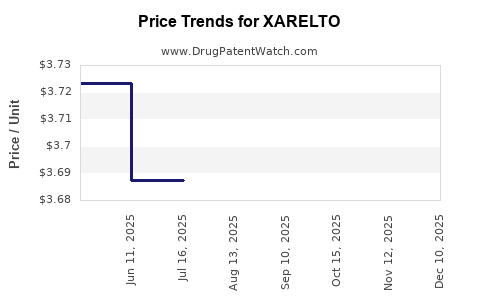
Average Pharmacy Cost for XARELTO
| Drug Name | NDC | Price/Unit ($) | Unit | Date |
|---|---|---|---|---|
| XARELTO 1 MG/ML SUSPENSION | 50458-0575-01 | 3.77587 | ML | 2026-07-22 |
| XARELTO 10 MG TABLET | 50458-0580-01 | 19.52573 | EACH | 2026-07-22 |
| XARELTO 10 MG TABLET | 50458-0580-10 | 19.52573 | EACH | 2026-07-22 |
| XARELTO 10 MG TABLET | 50458-0580-30 | 19.52573 | EACH | 2026-07-22 |
| XARELTO 10 MG TABLET | 50458-0580-90 | 19.52573 | EACH | 2026-07-22 |
| >Drug Name | >NDC | >Price/Unit ($) | >Unit | >Date |
Market Analysis and Price Projections for XARELTO
What is the current market landscape for XARELTO?
XARELTO (rivaroxaban), developed by Bayer and Janssen Pharmaceuticals, is a direct oral anticoagulant (DOAC) approved for conditions including atrial fibrillation, deep vein thrombosis (DVT), and pulmonary embolism (PE). As of 2023, it is the leading DOAC globally, with estimated sales over $6 billion annually.
How does XARELTO compare to its competitors?
| Drug | Market Share (2022) | Approved Indications | Pricing (per month) | Patent Status |
|---|---|---|---|---|
| XARELLO (rivoraxaban) | 45% | Atrial fibrillation, DVT, PE, postoperative VTE | $550–$700 | Patent until 2028; biosimilar in development |
| Eliquis (apixaban) | 40% | Similar indications, preferred for some uses | $500–$650 | Patent until 2026; biosimilar in US release |
| Pradaxa (dabigatran) | 10% | Stroke prevention in atrial fibrillation | $600–$750 | Patent until 2027 |
| Savaysa (edoxaban) | 5% | Limited to specific indications | $500–$700 | Patent until 2029 |
XARELTO maintains leading market share due to broader indication approvals, physician familiarity, and manufacturing capacity.
What are the factors influencing XARELTO's market penetration?
- Regulatory approvals: Expanded indications in Europe, Asia, and the US increase potential patient populations.
- Pricing strategies: Competitive pricing compared to tradional anticoagulants maintains its attractiveness.
- Generic entry timelines: Patent expiration in 2028 may impact sales, with biosimilar development underway.
- Clinical trial data: Proven efficacy and safety enhance healthcare provider adoption.
- Reimbursement policies: Favorable coverage in major markets supports utilization rates.
What are the projected sales and pricing trends?
Sales projections (2023–2027)
| Year | Estimated Global Sales (USD billion) | Compound Annual Growth Rate (CAGR) |
|---|---|---|
| 2023 | 6.4 | -- |
| 2024 | 6.8 | 6.25% |
| 2025 | 7.2 | 5.88% |
| 2026 | 7.6 | 5.56% |
| 2027 | 8.0 | 5.26% |
Price trend expectations
- Short-term (next 2 years): Prices are likely to remain stable with minor fluctuations driven by negotiations with payers.
- Post-patent expiry (after 2028): Introduction of biosimilars and generics may halve the current pricing, potentially reducing monthly costs to $250–$350.
What are the implications of patent expiration?
Patent expiry in 2028 opens the market to biosimilars, which are expected to compete primarily on price. Industry estimates suggest biosimilars could capture 60–80% of the market share within three years post-entry, leading to significant price erosion.
How do regulatory and policy shifts affect XARELTO's market and price?
Changes in reimbursement policies, especially in the US and EU, can influence sales volume and pricing. Increasing emphasis on cost-effective therapy fosters shifts toward biosimilars and generics. Regulatory approvals for expanded indications can extend revenue streams.
What are possible future developments?
- Accelerated approvals for new indications, such as stroke prevention in additional patient cohorts.
- Entry of biosimilars post-2028 leading to price reductions.
- New competition from novel oral anticoagulants with improved safety profiles.
Key Takeaways
- XARELTO leads the DOAC class with over $6 billion in annual sales.
- Market share remains strong due to approved indications and clinical data; however, patent expiration in 2028 risks intensifying competition.
- Prices are expected to stabilize until patent expiry, after which biosimilar entry could reduce costs by more than 50%.
- Growth driven by expanding indications and geographic market penetration, with sales projected to grow at ~5–6% annually to 2027.
- Industry focus shifts toward biosimiarly competition and cost containment policies affecting future revenues.
FAQs
-
When will biosimilars for XARELTO enter the market? Biosimilar versions are expected to enter after patent expiry in 2028, with initial launches in Europe and the US potentially in 2029–2030.
-
How does XARELTO's price compare with Eliquis? Currently, XARELTO averages $550–$700 per month, whereas Eliquis ranges from $500–$650. Prices vary based on formulary negotiations and region.
-
Which indications are driving future sales? Stroke prevention in atrial fibrillation and treatment of DVT/PE remain core, with expansion into postoperative thromboprophylaxis and off-label uses influencing volume.
-
What impact does patent expiry have on pricing? Biosimilar entry typically causes prices to decline by 50–70%, significantly reducing revenue per patient but potentially increasing overall market volume.
-
Are there ongoing efforts to extend XARELTO's patent protection? Patent challenges and formulations modifications are being assessed in legal and regulatory channels, but no definitive extensions are publicly planned beyond existing protections.
References
[1] IQVIA. (2023). Pharmaceutical Market Data.
[2] Bayer. (2023). XARELTO Prescribing Information.
[3] FDA. (2022). Regulatory approvals and indication updates.
[4] EvaluatePharma. (2023). World Market Forecasts.
[5] Statista. (2023). Global Anticoagulant Market Analysis.
More… ↓
