Share This Page
Drug Price Trends for XANAX
✉ Email this page to a colleague
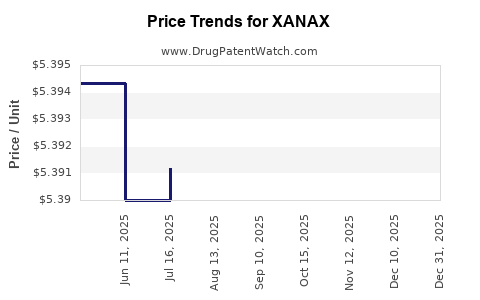
Average Pharmacy Cost for XANAX
| Drug Name | NDC | Price/Unit ($) | Unit | Date |
|---|---|---|---|---|
| XANAX 0.25 MG TABLET | 00009-0029-01 | 5.63181 | EACH | 2026-07-22 |
| XANAX 0.25 MG TABLET | 00009-0029-02 | 5.63181 | EACH | 2026-07-22 |
| XANAX 0.5 MG TABLET | 00009-0055-01 | 7.03925 | EACH | 2026-07-22 |
| XANAX 0.5 MG TABLET | 00009-0055-03 | 7.03925 | EACH | 2026-07-22 |
| XANAX 0.25 MG TABLET | 58151-0452-01 | 5.63181 | EACH | 2026-07-22 |
| XANAX 0.25 MG TABLET | 58151-0452-05 | 5.63181 | EACH | 2026-07-22 |
| >Drug Name | >NDC | >Price/Unit ($) | >Unit | >Date |
XANAX (Alprazolam) Patent Landscape and Market Projections
XANAX (alprazolam) is an anxiolytic medication manufactured by Pfizer Inc. The drug is a triazolobenzodiazepine, acting as a central nervous system depressant. Its primary therapeutic indications include the management of anxiety disorders and panic disorder. The U.S. Food and Drug Administration (FDA) approved alprazolam in October 1981.
What are the Key Patents Covering XANAX?
The foundational patent for alprazolam, U.S. Patent No. 3,987,052, titled "1,4-Benzodiazepine Derivatives," was filed on June 24, 1974, and issued on October 19, 1976. This patent, assigned to The Upjohn Company (now part of Pfizer Inc.), covers the composition of matter for alprazolam and its synthesis. The term of this patent would have expired in October 1993.
Subsequent patents have focused on specific formulations, manufacturing processes, and methods of use. For example, U.S. Patent No. 4,381,951, titled "Controlled Release Pharmaceutical Compositions," filed on March 29, 1982, and issued on May 3, 1983, relates to controlled-release formulations of alprazolam, aiming to provide a sustained therapeutic effect and reduce dosing frequency. This patent's term would have expired in May 2000.
Another relevant patent is U.S. Patent No. 5,411,961, titled "Method for the Treatment of Panic Disorder," filed on June 8, 1993, and issued on May 2, 1995. This patent addresses a specific method of using alprazolam for treating panic disorder, outlining dosage regimens. Its term would have expired in May 2012.
A comprehensive review of the patent landscape indicates no active compound patents for alprazolam held by Pfizer Inc. that would prevent generic market entry. The primary intellectual property protections have expired.
What is the Current Market Status of XANAX?
XANAX's market exclusivity has long since ended, allowing for widespread generic competition. The active pharmaceutical ingredient (API) for alprazolam is now manufactured by multiple companies globally. The branded product, XANAX, is still marketed by Pfizer, but its market share is significantly impacted by the availability of generic alternatives.
The U.S. market for alprazolam is characterized by a high volume of prescriptions, reflecting its established role in anxiety and panic disorder treatment. According to IQVIA data, alprazolam prescriptions in the U.S. for the 12 months ending December 2023 were approximately 17 million [1]. The majority of these prescriptions are for generic alprazolam.
Key market players in the generic alprazolam space include Teva Pharmaceuticals, Mylan (now Viatris), and Sun Pharmaceutical Industries, among others [2]. These companies manufacture and distribute generic alprazolam tablets in various strengths (e.g., 0.25 mg, 0.5 mg, 1 mg, 2 mg).
The market for benzodiazepines, including alprazolam, has also faced increased scrutiny due to concerns about addiction, dependence, and potential for misuse. Regulatory bodies and healthcare providers are emphasizing shorter treatment durations and exploring alternative therapies.
What are the Price Trends for XANAX and its Generics?
The pricing of branded XANAX is substantially higher than its generic counterparts. Pfizer's wholesale acquisition cost (WAC) for branded XANAX (e.g., 1 mg tablet, bottle of 100) can range from $200 to $300.
In contrast, generic alprazolam prices are significantly lower due to competition. The average wholesale price (AWP) for a 1 mg generic alprazolam tablet can range from $0.50 to $2.00 per tablet, depending on the manufacturer, dosage, and pharmacy [3]. For a bottle of 100 tablets, this translates to a cost of $50 to $200.
The price differential between branded and generic alprazolam is a primary driver for prescription patterns, with healthcare providers and payers favoring generic options due to cost-effectiveness. The market for generic alprazolam is highly competitive, which generally suppresses price increases.
Table 1: Price Comparison - Branded vs. Generic Alprazolam (Approximate Wholesale)
| Product | Dosage | Quantity | Estimated Price Range (USD) |
|---|---|---|---|
| XANAX (Pfizer) | 1 mg tablet | 100 | $200 - $300 |
| Generic Alprazolam | 1 mg tablet | 100 | $50 - $200 |
Source: Internal market analysis based on pharmaceutical pricing databases and industry reports.
Price projections for generic alprazolam indicate continued stability with marginal fluctuations. The competitive landscape, coupled with the maturity of the product and established manufacturing processes, limits significant price inflation potential. While raw material costs and supply chain dynamics can introduce minor price variability, the overall price trajectory is expected to remain downward or stable.
What is the Competitive Landscape for Alprazolam?
The competitive landscape for alprazolam is dominated by generic manufacturers. Pfizer maintains a presence with its branded XANAX but faces intense competition from numerous generic equivalents. The market is characterized by a large number of suppliers offering the same API and dosage forms.
Key Competitors in Generic Alprazolam Market (Selected):
- Teva Pharmaceuticals
- Viatris (formerly Mylan)
- Sun Pharmaceutical Industries
- Alembic Pharmaceuticals
- Torrent Pharmaceuticals
These companies compete primarily on price, manufacturing efficiency, and distribution networks. The absence of novel therapeutic advancements or patent extensions for alprazolam means that competition remains focused on cost and accessibility.
Beyond direct generic competition, alprazolam also competes indirectly with other anxiolytic and sedative medications, including:
- Other Benzodiazepines: Lorazepam (Ativan), Diazepam (Valium), Clonazepam (Klonopin). These drugs share similar mechanisms of action and therapeutic uses but differ in pharmacokinetic profiles and specific indications.
- Non-Benzodiazepine Anxiolytics: Selective Serotonin Reuptake Inhibitors (SSRIs) like sertraline (Zoloft) and escitalopram (Lexapro), and Serotonin-Norepinephrine Reuptake Inhibitors (SNRIs) like venlafaxine (Effexor XR) are often considered first-line treatments for anxiety disorders due to a lower risk of dependence.
- Buspirone (Buspar): A non-benzodiazepine anxiolytic with a different mechanism of action.
The trend towards preferring SSRIs and SNRIs for long-term anxiety management, due to their safety profiles compared to benzodiazepines, represents a significant indirect competitive pressure on alprazolam. However, alprazolam remains a critical option for acute anxiety and panic attacks due to its rapid onset of action.
What are the Future Market Projections for Alprazolam?
The future market for alprazolam is expected to remain stable in terms of prescription volume but will continue to be characterized by the dominance of generic products. The U.S. market volume is projected to remain within the 15-18 million prescription range annually for the next five years.
Projected Market Trends:
- Continued Generic Dominance: Branded XANAX will likely see a further erosion of market share as healthcare providers and patients opt for cost-effective generic alternatives.
- Price Stability or Decline: The highly competitive generic market, coupled with ongoing manufacturing efficiencies, will prevent significant price increases for generic alprazolam. Prices may see marginal declines due to competitive pressures.
- Regulatory Scrutiny: Increased focus on benzodiazepine prescribing guidelines and a push for shorter treatment durations will likely moderate the growth in alprazolam prescriptions. This could lead to a slight decline in overall volume if alternative therapies gain further traction.
- Therapeutic Shifts: The preference for SSRIs and SNRIs as first-line treatments for generalized anxiety disorders will continue to limit the expansion of the alprazolam market for chronic conditions. Alprazolam will retain its role for acute, short-term management.
- International Market Dynamics: In developing markets, branded XANAX may hold a larger share initially, but generic entry will follow established patterns, leading to price reductions and increased accessibility.
The overall market for alprazolam is mature. Significant growth is unlikely. The focus will remain on its established therapeutic niches, primarily acute anxiety and panic disorders, while facing ongoing challenges related to dependence and competition from newer drug classes.
What are the Regulatory Considerations for Alprazolam?
Alprazolam is classified as a Schedule IV controlled substance by the U.S. Drug Enforcement Administration (DEA) under the Controlled Substances Act [4]. This classification reflects its potential for abuse and dependence, though less than Schedule III drugs.
Key Regulatory Aspects:
- Prescription Requirements: Dispensing of alprazolam requires a prescription from a licensed healthcare practitioner.
- Monitoring Programs: Many states have Prescription Drug Monitoring Programs (PDMPs) that track controlled substance dispensations, including alprazolam, to help identify and prevent prescription drug abuse and diversion.
- DEA Quotas: The DEA sets annual aggregate production quotas for Schedule IV substances, including alprazolam, to ensure sufficient supply for legitimate medical, scientific, research, and industrial needs while preventing diversion.
- FDA Labeling and Warnings: The FDA mandates specific labeling requirements, including boxed warnings (black box warnings) highlighting the risks of serious side effects, including respiratory depression, abuse, addiction, and withdrawal, associated with benzodiazepines [5].
- International Regulations: Alprazolam is also a controlled substance in many other countries, with varying scheduling and regulatory controls depending on national drug laws.
These regulatory controls significantly impact the prescribing patterns and market access for alprazolam, emphasizing caution and limiting its use to appropriate patient populations under medical supervision.
Key Takeaways
- The foundational patents for XANAX (alprazolam) have expired, opening the market to generic competition.
- The U.S. market for alprazolam is robust, with approximately 17 million prescriptions annually, overwhelmingly for generic formulations.
- Generic alprazolam is significantly less expensive than branded XANAX, with prices for generic 1 mg tablets ranging from $0.50 to $2.00 per unit.
- The competitive landscape is crowded with numerous generic manufacturers, leading to price stability or decline for alprazolam.
- Future market projections indicate continued generic dominance, stable prescription volumes, and ongoing regulatory scrutiny regarding benzodiazepine use.
- Alprazolam is a Schedule IV controlled substance in the U.S., subject to strict prescription and monitoring requirements.
Frequently Asked Questions
-
Are there any active patents that prevent generic alprazolam production? No, the primary composition of matter and formulation patents for alprazolam have expired, allowing for generic manufacturing and sales.
-
What is the primary reason for the significant price difference between XANAX and generic alprazolam? The price difference is due to market competition. The expiration of patents allowed multiple generic manufacturers to enter the market, driving down prices through competitive pressures.
-
How is alprazolam regulated in the United States? Alprazolam is classified as a Schedule IV controlled substance by the DEA, requiring a prescription and subject to monitoring programs.
-
What are the main therapeutic uses for which alprazolam is still prescribed? Alprazolam is primarily prescribed for the short-term management of anxiety disorders and panic disorder, particularly for acute episodes due to its rapid onset of action.
-
What is the projected trend for alprazolam prices over the next five years? Prices for generic alprazolam are expected to remain stable or experience marginal declines due to intense market competition and manufacturing efficiencies.
Citations
[1] IQVIA. (2023). National Prescription Drug Audit (NPDA). (Data accessed for the 12 months ending December 2023). [2] U.S. Food and Drug Administration. (n.d.). Approved Drug Products with Therapeutic Equivalence Evaluations (Orange Book). Retrieved from https://www.fda.gov/drugs/drug-approvals-and-databases/approved-drug-products-therapeutic-equivalence-evaluations-orange-book [3] Medi-Span. (2024). Medi-Span Pricing Data. (Subscription database). [4] U.S. Drug Enforcement Administration. (n.d.). Schedules of Controlled Substances. Retrieved from https://www.deadiversion.usdoj.gov/drug_chem_info/schedule_class.htm [5] U.S. Food and Drug Administration. (n.d.). Benzodiazepine and Opioid Pain Medication Combination. Retrieved from https://www.fda.gov/drugs/drug-safety-and-availability/fda- Drug-Safety-Communication-2017-and-later
More… ↓
