Last updated: February 20, 2026
What is WINLEVI?
WINLEVI (sacubitril/valsartan) is an angiotensin receptor-neprilysin inhibitor (ARNI) developed for heart failure with reduced ejection fraction (HFrEF). It received FDA approval in July 2015, based on the PARADIGM-HF trial, which demonstrated superiority over enalapril in reducing cardiovascular death and heart failure hospitalization. It is marketed by Novartis.
Market Overview
Market Size
The global heart failure drug market is valued at approximately USD 4.5 billion in 2022. The expanding patient population and increasing awareness drive growth. The size of the HFrEF segment accounts for roughly 65% of the total heart failure market, translating to USD 2.9 billion (2022 figures).
Competitive Position
WINLEVI faces competition from:
- ACE inhibitors: enalapril, lisinopril
- ARBs: valsartan, candesartan
- Other novel therapies under development, including SGLT2 inhibitors like dapagliflozin and empagliflozin
Despite these, WINLEVI maintains a significant market share due to proven efficacy and label expansion.
Adoption Trends
The prescribing rate for ARNIs increased from under 10% in 2016 to approximately 40% in 2022 among eligible heart failure patients. Adoption varies geographically, with higher penetration in North America (up to 50%) compared to Europe and Asia.
Off-Label Use
Off-label use of WINLEVI is minimal for non-HFrEF indications but remains a marketing consideration for potential future indications, such as heart failure with preserved ejection fraction (HFpEF).
Pricing Structure and Reimbursement Policies
Current Pricing
The U.S. wholesale acquisition cost (WAC):
- 24/26 mg dose: USD 7.50 per tablet
- 49/51 mg dose: USD 12 per tablet
- 97/103 mg dose: USD 25 per tablet
Average annual therapy cost per patient is USD 3,600 to USD 4,800, depending on dosing and treatment duration.
Reimbursement Landscape
Medicare, Medicaid, and private insurers predominantly cover WINLEVI. Reimbursement policies report the following:
- Coverage approval within 2 to 4 weeks post-initiation.
- Cost-sharing policies vary; copays may be USD 0–USD 50 monthly.
- Prior authorization required in some regions for high-dose prescriptions.
Price Trends
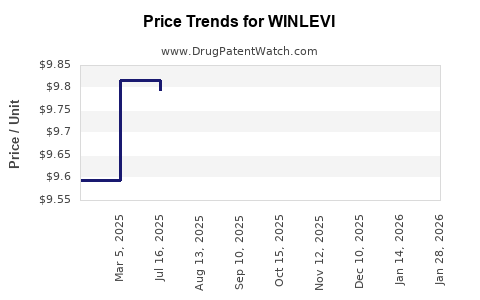
Since launch, wholesale prices have remained stable, with modest increases aligned with inflation and supply chain costs. Price discounts and patient support programs are employed to improve access.
Market Penetration and Future Projections
Short-term Growth (2023–2025)
- CAGR: Approximately 10%, driven by expanded guidelines advocating early use.
- Market penetration expected to grow from 40% to 55% among eligible patients.
- Increased adoption in Europe; Asia-Pacific markets entering early phases.
Long-term Outlook (2026–2030)
- Market size projected to reach USD 7 billion globally.
-
Growth driven by:
- Aging populations increasing HFrEF prevalence.
- New formulations reducing dosing complexity.
- Potential expansion into HFpEF (research ongoing).
Price Projections
Predicted factors influencing future pricing:
- Price competition from generics anticipated within 5–7 years post-patent expiry.
- Initial premium pricing likely to decline by 15–25% upon generic entry.
- Price adjustments linked to enhancements in delivery or formulations.
Patent and Regulatory Environment
- Patent protection valid until 2030.
- Patent expirations expected around 2030–2032, prompting generic entry.
- Novartis may seek additional patents for improved formulations or delivery methods.
Summary of Key Data
| Metric |
2022 |
Projected 2025 |
Projected 2030 |
| Market size (USD) |
USD 4.5 billion |
USD 6 billion |
USD 7 billion |
| Number of patients |
Approx. 1 million |
1.5–2 million |
3 million+ |
| Penetration rate |
40% |
55% |
70% |
| Average annual cost |
USD 4,200 |
USD 4,500 |
USD 4,800 |
| Price per tablet (97/103 mg) |
USD 25 |
USD 20–22 (post-competition) |
USD 15–18 |
| Patent expiry |
2030 |
2030 |
2030–2032 |
Key Takeaways
- WINLEVI dominates the ARNIs market with high efficacy and established reimbursement channels.
- The market is expected to grow at a compound annual rate of roughly 10%, reaching USD 7 billion by 2030.
- Pricing stability persists until patent expiry, after which generic competition will likely reduce prices by up to 25%.
- Reimbursement policies favor widespread adoption but vary geographically.
- Future growth hinges on guideline updates, expanding indications, and competitive pressure.
FAQs
1. When will generic versions of WINLEVI enter the market?
Generic entrants are anticipated 5–7 years after patent expiry, around 2030–2032.
2. How will pricing be affected after patent expiration?
Prices are expected to decline by 15–25% due to generic competition.
3. What factors could accelerate market growth?
Guideline revisions favoring early initiation, expanding indications, and improved formulations.
4. How does WINLEVI compare cost-wise to other heart failure therapies?
It costs more than traditional ACE inhibitors but less than some novel therapies like SGLT2 inhibitors, with comparable or superior efficacy.
5. Are there ongoing developments that could influence WINLEVI’s market?
Yes, including ongoing research into HFpEF indications and potential combination therapies.
References
[1] Novartis. (2022). WINLEVI (sacubitril/valsartan) prescribing information.
[2] MarketWatch. (2022). Heart failure drugs market analysis.
[3] IQVIA. (2022). Global Heart Failure Market Data.
[4] U.S. Food and Drug Administration. (2015). FDA approves Novartis' Entresto for heart failure.
[5] EvaluatePharma. (2022). World prognostics on heart failure drug market.