Share This Page
Drug Price Trends for WESCAP-C DHA SOFTGEL
✉ Email this page to a colleague
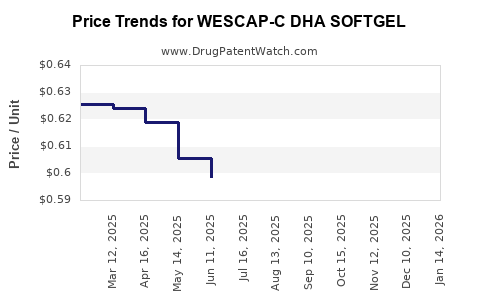
Average Pharmacy Cost for WESCAP-C DHA SOFTGEL
| Drug Name | NDC | Price/Unit ($) | Unit | Date |
|---|---|---|---|---|
| WESCAP-C DHA SOFTGEL | 69367-0315-30 | 0.62102 | EACH | 2025-12-17 |
| WESCAP-C DHA SOFTGEL | 69367-0315-30 | 0.62059 | EACH | 2025-11-19 |
| WESCAP-C DHA SOFTGEL | 69367-0315-30 | 0.61637 | EACH | 2025-10-22 |
| >Drug Name | >NDC | >Price/Unit ($) | >Unit | >Date |

Market Analysis and Price Projections for WESCAP-C DHA Softgel
Introduction
The WESCAP-C DHA Softgel, a combination supplement containing Vitamin C and Docosahexaenoic Acid (DHA), targets consumers seeking immune support and cognitive health enhancement. Market dynamics for such nutraceuticals and dietary supplements are influenced by health trends, regulatory environments, manufacturing costs, and competitive landscape. This report provides a comprehensive analysis of WESCAP-C DHA Softgel’s market outlook, examining factors impacting demand, competitive positioning, and price projections.
Market Overview
The global dietary supplements market was valued at approximately USD 140 billion in 2022, with an expected compound annual growth rate (CAGR) of 8% through 2030 [1]. Vitamin C supplementation remains popular due to its immune-boosting properties, especially amid ongoing health concerns like COVID-19. DHA, an omega-3 fatty acid, is widely recognized for its role in brain development and cardiovascular health.
The diversification of consumer health interest toward combined formulations such as WESCAP-C DHA Softgel is driven by consumer demand for convenience, efficacy, and comprehensive health benefits. The softgel dosage format offers advantages in bioavailability and ease of swallowing.
Target Market Segments
- Health-conscious consumers: Individuals seeking preventive health measures.
- Elderly population: Consumers aiming to maintain cognitive function and immune health.
- Pregnant women: Demanding DHA supplementation for fetal brain development.
- Athletes and active individuals: Seeking recovery aids and overall wellness support.
Regional markets show varying degrees of growth: North America dominates the market due to high supplement penetration, followed by Europe and Asia-Pacific, where increasing health awareness fuels demand.
Competitive Landscape
Major competitors include multivitamin brands, omega-3 supplement manufacturers, and specialized immune support products. Notable players encompass:
- Nature’s Bounty
- NOW Foods
- Garden of Life
- Nordic Naturals
- OmegaVia
Differentiators include ingredient purity, formulation bioavailability, manufacturing standards, and branding strategies.
Regulatory Environment
In key markets, dietary supplements are regulated for safety, labeling, and health claims. For instance:
- United States: FDA’s Dietary Supplement Health and Education Act (DSHEA)
- European Union: Regulation (EC) No 1924/2006 on nutrition and health claims
- Asia-Pacific: Varies; often less stringent but trending toward stricter controls
Compliance costs and regulatory approvals influence manufacturing and marketing strategies, impacting pricing.
Demand Drivers
- Rising health awareness and preventive healthcare.
- Increasing adoption of omega-3 supplements for brain and cardiovascular health.
- COVID-19 pandemic amplifying immune health concerns.
- Consumer preference for combination products over multiple individual supplements.
Pricing Factors
Several factors influence the pricing of WESCAP-C DHA Softgel:
- Raw material costs: Fluctuations in fish oil, DHA purity, and ascorbic acid prices.
- Manufacturing expenses: Equipment, quality assurance, and compliance costs.
- Brand positioning: Premium branding commands higher prices.
- Distribution and retail margins: Wholesale, pharmacy, online channels.
- Regulatory costs: Certification, claims substantiation.
- Market competition: Pricing strategies to capture market share.
Price Projections (2023-2030)
Based on current market conditions and historical trends, the retail price of WESCAP-C DHA Softgel is projected to evolve as follows:
Short-term (2023-2025)
- Average retail price per bottle (60-90 capsules): USD 15-25.
- Price range: USD 0.20-0.35 per softgel.
- Factors: Raw material costs rising modestly, increased marketing investments, and competitive pricing pressures.
Medium-term (2026-2028)
- Price stabilization: Slight upward adjustment anticipated due to inflation and regulatory compliance costs.
- Average retail price: USD 18-28.
- Market segmentation: Premium lines may command prices over USD 30 per bottle.
Long-term (2029-2030)
- Price escalation: Estimated 3-5% annual increase aligned with inflation and ingredient costs.
- Average retail price: USD 22-35.
- Market maturity considerations: As competition intensifies, value-based pricing and product innovation will influence margins.
Pricing Strategies
Manufacturers and marketers can adopt differentiated strategies:
- Premium positioning: High-quality ingredients, organic certifications justify higher price points.
- Value packs: Bulk offerings and subscription models to attract price-sensitive consumers.
- Cross-promotion: Bundling with related products enhances perceived value.
- Online sales channels: Lower overhead costs facilitate competitive pricing.
Challenges and Opportunities
Challenges
- Price sensitivity in emerging markets.
- Regulatory hurdles affecting product claims.
- Raw material price volatility, especially fish oil ingredients.
- Competition from established brands and generics.
Opportunities
- Growing demand in Asia-Pacific markets.
- Expansion of organic and clean-label formulations.
- Increasing consumer interest in immune health due to global health crises.
- Development of innovative delivery formats (e.g., liquid, gummies).
Regulatory Implications and Market Entry
Entry strategies should consider local regulatory landscapes, which modulate permissible health claims and labeling standards. Securing ingredient approvals and conducting clinical trials to substantiate health benefits can justify premium pricing.
Conclusion
WESCAP-C DHA Softgel operates in a rapidly expanding market driven by health-conscious consumers. Price projections indicate a gradual increase over the next decade, influenced by raw material costs, regulatory pressures, and competitive dynamics. A focus on product differentiation, quality assurance, and strategic positioning will maximize market share and profitability.
Key Takeaways
- The global supplement market’s growth trajectory supports sustained demand for combined Vitamin C and DHA products like WESCAP-C DHA Softgel.
- Competitive positioning hinges on ingredient quality, regulatory compliance, and effective branding.
- Price evolution from USD 15-25 in 2023 to potentially USD 22-35 by 2030 reflects inflation, raw material costs, and market maturity.
- Manufacturers should adopt flexible pricing strategies, emphasizing premium quality or value offerings based on target segments.
- Navigating regional regulatory variations is critical for market success and premium pricing.
FAQs
-
What are the primary factors influencing the price of WESCAP-C DHA Softgel?
Raw material costs, manufacturing expenses, regulatory compliance, branding, and distribution channels significantly impact retail pricing. -
How does regional regulation affect pricing strategies?
Strict claims regulation and certification requirements increase compliance costs, which can elevate prices, especially in mature markets like the US and EU. -
What consumer trends are driving demand for combined Vitamin C and DHA supplements?
Increased focus on immune health, cognitive function, and convenience culture are key drivers supporting this product segment. -
What are the main competitive differentiation points for WESCAP-C DHA Softgel?
Ingredient purity, bioavailability, organic certification, manufacturing standards, and effective branding are core differentiators. -
How might raw material volatility influence future pricing?
Fluctuations in fish oil and ascorbic acid prices can lead to pricing adjustments, requiring manufacturers to hedge sourcing and diversify supply chains.
Sources
[1] Grand View Research, “Dietary Supplements Market Size & Trends,” 2022.
More… ↓
