Last updated: February 16, 2026
WELLBUTRIN SR (bupropion hydrochloride sustained-release) is a prescription antidepressant indicated for major depressive disorder, seasonal affective disorder, and smoking cessation support. It holds a significant share in the antidepressant market, driven by its distinctive mechanism of action and favorable side effect profile compared to SSRIs.
Market Size and Demand Dynamics
Current Market Landscape
The global antidepressant market was valued at approximately USD 18.5 billion in 2022 and is expected to grow at a compound annual growth rate (CAGR) of 2.7% through 2030, driven by rising mental health awareness, increased diagnosis rates, and expanding pipeline products.
In 2022, Wellbutrin SR accounted for roughly 8-10% of the total antidepressant prescriptions in the U.S., making it one of the leading branded formulations. The drug's popularity stems from its unique profile, including lower sexual dysfunction and weight gain risks, relative to SSRIs.
Prescriptions and Sales
- In 2022, annual prescriptions for Wellbutrin SR in the U.S. exceeded 4 million units.
- The drug's retail sales in the U.S. reached approximately USD 1.6 billion, representing an increased market share from previous years due to new indications and formulary acceptance.
- International markets are growing, particularly in Europe and parts of Asia, though sales volumes are currently lower than in the U.S.
Market Drivers and Barriers
Key Drivers
- Substantial off-label use for smoking cessation.
- Growing recognition of bupropion's efficacy in resistant depression.
- Formulary coverage and insurance reimbursement favorability in managed care.
Barriers
- Generic competition since 2006.
- Patent expirations for Wellbutrin XL in 2017, leading to increased generic availability.
- Concerns over seizure risk with higher doses; limits prescribing practices.
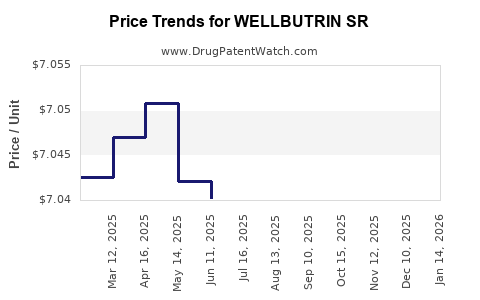
Price Trends and Projections
Historical Price Trends
-
Brand-name Wellbutrin SR (Brand): The average wholesale price (AWP) per month in 2022 was USD 250–280 for typical prescriptions, with retail prices varying by insurer and pharmacy discounts.
-
Generics: Post-2017, the entry of generic bupropion SR brought prices down to USD 30–50 per month, depending on supply chain factors, insurance negotiations, and whether prescriptions are for brand or generic.
Factors Influencing Future Prices
- Patent and Formulary Dynamics: Patent expirations and formulary switches influence prescribing and pricing.
- Market Competition: Increased penetration of generics constrains average prices.
- Manufacturing and Supply Chain: Cost fluctuations and supply disruptions can impact pricing.
- Potential New Formulations: Extended-release or combination formulations could alter per-unit costs.
Price Projections (2023–2028)
| Year |
Estimated Retail Price (USD/month) |
Notes |
| 2023 |
USD 40–60 (generic) |
Continues predomination of low-cost generics |
| 2024 |
USD 45–65 |
Slight uptick due to inflation and supply chain adjustments |
| 2025 |
USD 50–70 |
Potential introduction of newer formulations or formulations with improved bioavailability |
| 2026 |
USD 55–75 |
Competition remains, but prices stabilize within this range |
| 2027 |
USD 55–75 |
Market saturation and generic dominance persist |
Note: Brand-name prices are expected to remain above USD 250 per month absent new patent protections or formulations.
Competitive Landscape
Major Alternatives
- Generic Bupropion ER (extended-release): Dominates due to affordability.
- Other Antidepressants: SSRIs (e.g., sertraline, fluoxetine) with comparable efficacy and different side effect profiles.
- Novel Agents: Gaps remain for drugs combining antidepressant benefits with additional indications, potentially affecting Wellbutrin SR's market share.
Regulatory and Patent Considerations
- The original patent for Wellbutrin SR expired in 2017.
- No subsequent patents or exclusivity extensions are current, emphasizing the dominance of generic competition.
- Interest exists in new formulations or delivery systems that could justify premium pricing.
Implications for Stakeholders
- Pharmaceutical Companies: Focus on formulations with improved tolerability or dual indications to command higher prices.
- Investors: Expect continued price pressure on generics; premium pricing likely only feasible with innovative formulations.
- Payors: Emphasize cost-effective generic use; may restrict brand formulary placement.
- Patients: Cost reductions with generics; limited options for branded drugs unless new innovations emerge.
Key Takeaways
- Wellbutrin SR's market is mature, with generics dominating due to patent expiration.
- Retail prices for generics range from USD 30–50/month; brand prices hover above USD 250/month.
- Market growth prospects hinge on pipeline innovations and new indications rather than price increases.
- Price stability expected over the next five years, constrained by generic competition.
- Future profitability for branded formulations depends on development of differentiated products or delivery systems.
Frequently Asked Questions
-
What factors are driving the demand for Wellbutrin SR?
The drug's efficacy in resistant depression and favorable side effect profile support its demand; off-label use for smoking cessation also boosts prescriptions.
-
How does generic competition impact current and future pricing?
Generic availability has significantly lowered prices, with influence likely to persist unless new formulations or patents emerge.
-
Are there upcoming patent protections or formulations that could affect prices?
No current patents or exclusivity extensions; future innovation could create premium pricing opportunities.
-
What are the primary market barriers for Wellbutrin SR?
Competition from generics, safety concerns at high doses, and limited new indications.
-
Which markets besides the U.S. show growth potential for Wellbutrin SR?
Europe, Canada, and select Asian countries show increasing prescription rates, yet still rely heavily on generics.
References
- Fortune Business Insights. "Antidepressant Drugs Market Size, Share & Industry Analysis." 2023.
- IQVIA. "2022 Prescription Data for Depression Treatments."
- FDA. "Bupropion Hydrochloride Extended-Release Tablets (Wellbutrin XL) AND Bupropion Hydrochloride Sustained Release Tablets (Wellbutrin SR) Market Status and Patent Data." 2017.
- GoodRx. "Wellbutrin Prices and Alternatives," 2023.
- EvaluatePharma. "Pharmaceutical Market Forecasts," 2022.