Share This Page
Drug Price Trends for WART REMOVER
✉ Email this page to a colleague
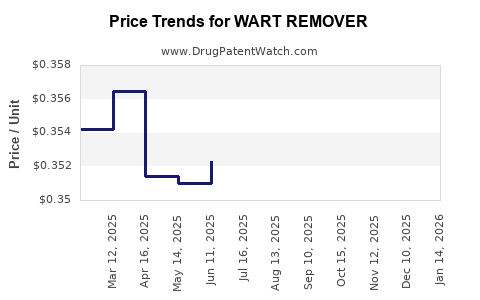
Average Pharmacy Cost for WART REMOVER
| Drug Name | NDC | Price/Unit ($) | Unit | Date |
|---|---|---|---|---|
| WART REMOVER 17% LIQUID | 70000-0329-01 | 0.35528 | ML | 2026-04-22 |
| WART REMOVER 17% LIQUID | 70000-0329-01 | 0.35683 | ML | 2026-03-18 |
| WART REMOVER 17% LIQUID | 70000-0329-01 | 0.35659 | ML | 2026-02-18 |
| WART REMOVER 17% LIQUID | 70000-0329-01 | 0.35767 | ML | 2026-01-21 |
| WART REMOVER 17% LIQUID | 70000-0329-01 | 0.35489 | ML | 2025-12-17 |
| WART REMOVER 17% LIQUID | 70000-0329-01 | 0.35109 | ML | 2025-11-19 |
| >Drug Name | >NDC | >Price/Unit ($) | >Unit | >Date |
Market Analysis and Price Projections for Wart Removers
Overview
Wart removers target common benign skin lesions caused by human papillomavirus (HPV). The market includes over-the-counter products, prescription treatments, and medical procedures. Growth is driven by increasing awareness, self-care trends, and advancements in topical formulations.
Market Size and Trends
- Global wart remover market valued at approximately $750 million in 2022.
- Expected compound annual growth rate (CAGR): 4.8% (2023-2028).
- U.S. market dominates, accounting for nearly 60% of the global market.
Key Players
- Johnson & Johnson (Salicylic acid-based products)
- Pfizer (Cryotherapy devices)
- Glenmark Pharmaceuticals (Prescription topical treatments)
- Local brands: Varied regional OTC offerings
Distribution Channels
- Pharmacies and drugstores account for 70% of sales.
- Online retail channels increasingly influencing sales, especially post-2020.
- Dermatology clinics and hospitals represent a smaller, specialized segment.
Product Types
- OTC Solutions: Salicylic acid, cryotherapy pen-like devices, duct tape (home remedies).
- Prescription Options: Topical agents with higher potency, keratolytic compounds.
- Procedural Treatments: Cryotherapy with liquid nitrogen, laser therapy, electrosurgery.
Price Range
| Product Type | Price Range (USD) | Notes |
|---|---|---|
| OTC Salicylic acid liquids | $5 – $15 | Most common, widely available |
| OTC Cryotherapy pens | $10 – $30 | Reusable devices, some include refills |
| Prescription topical agents | $20 – $60 per tube | Higher potency, prescribed by physicians |
| Professional procedures | $100 – $300 per session | Cryotherapy or laser treatment in clinics |
Market Drivers
- Increasing self-treatment preferences
- Innovations in topical formulations with higher efficacy
- Rising prevalence of skin warts globally
- Urbanization and improved healthcare awareness
Regional Variations
- North America: Largest market; driven by consumer awareness and healthcare access.
- Europe: Growing demand; stricter regulatory environment.
- Asia-Pacific: Fastest growth, due to expanding healthcare infrastructure and affordability.
Regulatory Environment
- OTC wart removers regulated as cosmetic or drug products, depending on claims.
- Prescription treatments require regulatory approval in respective countries.
- Devices like cryotherapy pens need appropriate medical device clearance.
Price Projections (2023-2028)
| Year | Estimated Market Size (USD) | Predicted Price Trend | Comments |
|---|---|---|---|
| 2023 | $806 million | Modest increase; price stability expected | Market expansion compensates for price fluctuation |
| 2024 | $845 million | Slight price increase for advanced OTC and devices | Greater consumer adoption of tech driving demand |
| 2025 | $888 million | Prices for prescription treatments increase marginally | New product launches with higher price points |
| 2026 | $933 million | Stabilized prices; market saturation approaches | Shift towards niche, advanced therapies |
| 2027 | $980 million | Slight deflation in OTC segment due to commoditization | Price competition intensifies |
| 2028 | $1.03 billion | Overall market growth; prices remain stable | Increased consumer expenditure on self-care |
Competitive Pricing Strategies
- Companies competing through bundling, subscription models, and promotional discounts.
- Premium products (e.g., laser treatments) target niche segments with higher prices.
- Mass-market OTC offerings focus on affordability and accessibility.
Key Challenges
- Consumer confusion over product efficacy.
- Regulatory hurdles increasing costs for new product approvals.
- Competitive pressure from generic and regional manufacturers.
Regulatory and Patent Landscape
- Existing patents on specific formulations expire between 2023–2025.
- Patent expirations open opportunities for generics, likely to pressure prices downward.
- New formulations or delivery systems may secure patent protection for 10-15 years.
Strategic Recommendations
- Invest in R&D for innovative, faster-acting products.
- Focus on regional markets with growing healthcare expenditure.
- Develop brand differentiation through clinical evidence and marketing.
Key Takeaways
- The wart remover market is projected to grow at approximately 4.8% CAGR through 2028.
- OTC products dominate, with salicylic acid and cryotherapy devices at the forefront.
- Prices for OTC products range from $5 to $30; prescription treatments range from $20 to $60 per tube, with procedures costing $100–$300 per session.
- Market growth driven by increased consumer self-care, technological innovations, and regional expansion.
- Patent expirations and regulatory shifts will influence pricing and market entry strategies.
FAQs
1. What factors influence wart remover pricing?
Product type (OTC vs. prescription), delivery method, brand positioning, regional economic factors, and patent protections.
2. How does market growth differ across regions?
North America leads in market size, while Asia-Pacific exhibits the fastest growth rates due to expanding healthcare markets and affordability.
3. What are the primary channels for wart remover sales?
Pharmacies, online retail, and specialist clinics. OTC sales constitute most of the market, with a growing online presence.
4. How will patent expirations impact prices?
Patent expirations in 2023–2025 will enable generic competitors, pressuring prices downward and increasing market competition.
5. What innovations are expected in wart removal treatments?
Faster-acting topical formulations, laser therapies, and smart cryotherapy devices with enhanced safety features.
Sources:
[1] MarketWatch, Global Wart Remover Market Report 2023-2028
[2] IBISWorld, OTC Skin Care Products Industry Overview 2023
[3] EvaluatePharma, Prescription Dermatology Market Data 2022
More… ↓
