Share This Page
Drug Price Trends for Vimpat
✉ Email this page to a colleague
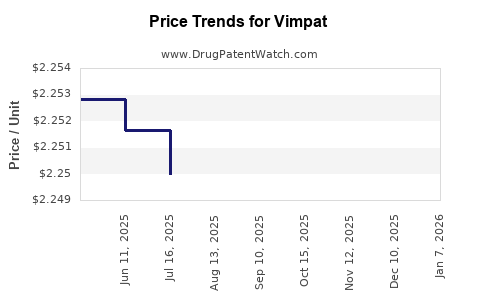
Average Pharmacy Cost for Vimpat
| Drug Name | NDC | Price/Unit ($) | Unit | Date |
|---|---|---|---|---|
| VIMPAT 200 MG TABLET | 00131-2480-35 | 19.60066 | EACH | 2026-05-20 |
| VIMPAT 10 MG/ML SOLUTION | 00131-5410-72 | 2.28820 | ML | 2026-05-20 |
| VIMPAT 100 MG TABLET | 00131-2478-60 | 18.58798 | EACH | 2026-05-20 |
| VIMPAT 100 MG TABLET | 00131-2478-35 | 18.58798 | EACH | 2026-05-20 |
| VIMPAT 50 MG TABLET | 00131-2477-60 | 11.77322 | EACH | 2026-05-20 |
| VIMPAT 150 MG TABLET | 00131-2479-60 | 19.63823 | EACH | 2026-05-20 |
| >Drug Name | >NDC | >Price/Unit ($) | >Unit | >Date |
Vimpat (Lacosamide) Market Analysis and Price Projections
Vimpat (lacosamide) is an antiepileptic drug approved for the adjunctive treatment of partial-onset seizures in patients aged four years and older. The market for lacosamide is driven by its efficacy in seizure control and an increasing prevalence of epilepsy. Key factors influencing its market trajectory include patent expirations, generic competition, pipeline developments, and regulatory approvals in new indications. Price projections are subject to these market dynamics, with anticipated declines post-patent expiry and potential stabilization with the introduction of new formulations or expanded indications.
What is the Current Market Size and Growth for Vimpat?
The global market for lacosamide is substantial, driven by its established position in epilepsy treatment. In 2022, the global lacosamide market was valued at approximately $1.8 billion. Projections indicate a compound annual growth rate (CAGR) of 4.5% from 2023 to 2030, which would bring the market size to an estimated $2.5 billion by the end of the forecast period. This growth is supported by an increasing incidence of epilepsy, estimated at 50 million people worldwide, and a rising demand for effective seizure management therapies. The U.S. market represents a significant portion of this valuation, driven by high healthcare spending and widespread adoption of advanced treatments.
What are the Key Drivers of Vimpat Market Growth?
Several factors contribute to the projected growth of the lacosamide market:
- Increasing Prevalence of Epilepsy: The global incidence of epilepsy continues to rise, fueled by aging populations, an increase in stroke survivors, and better diagnostic capabilities. The World Health Organization estimates that epilepsy affects approximately 50 million people globally [1]. This growing patient pool directly translates to a larger market for antiepileptic drugs like lacosamide.
- Efficacy and Safety Profile: Lacosamide has demonstrated significant efficacy in reducing seizure frequency in patients with partial-onset seizures, often serving as a well-tolerated option for add-on therapy. Clinical studies consistently show its effectiveness in reducing seizure burden, which is a primary driver for its prescription by neurologists [2].
- Expanded Age Indications and Formulations: Approvals for younger patient populations, such as children aged four and older, broaden the accessible market. The availability of various formulations, including oral solutions, tablets, and intravenous preparations, enhances patient adherence and physician choice, further supporting market penetration. For instance, the intravenous formulation provides a critical option for patients unable to take oral medication.
- Growing Healthcare Expenditure in Emerging Economies: As healthcare infrastructure and access to advanced medical treatments improve in emerging markets, the demand for innovative antiepileptic drugs is expected to increase. This expansion into new geographical territories offers significant growth potential.
What are the Major Restraints on Vimpat Market Growth?
Despite its growth drivers, the lacosamide market faces several restraints:
- Patent Expirations and Generic Competition: The primary patent for lacosamide has expired in major markets, leading to the introduction of generic versions. Generic competition typically results in significant price erosion. For example, the U.S. patent for lacosamide expired in 2021, and generic versions have since entered the market, impacting the branded drug's market share and pricing [3]. This will be a significant factor in future market value.
- Intensifying Competition from Newer Antiepileptic Drugs (AEDs): The AED market is highly competitive, with a continuous stream of new drugs entering the market. These newer agents may offer improved efficacy, better safety profiles, or novel mechanisms of action, posing a competitive threat to lacosamide. Examples include drugs with different target mechanisms that may be beneficial for specific epilepsy subtypes.
- Adverse Event Profiles and Side Effects: While generally well-tolerated, lacosamide can cause side effects such as dizziness, nausea, and diplopia, which can limit its use in some patients or lead to discontinuation. Managing these side effects is crucial for long-term patient adherence.
- Pricing Pressures and Reimbursement Policies: Healthcare systems globally are facing increasing cost containment pressures. Stringent pricing regulations and reimbursement policies can limit price increases and impact market access, particularly for branded medications facing generic alternatives.
What is the Patent Landscape for Lacosamide?
The patent landscape for lacosamide is transitioning from exclusivity to generic availability. The primary composition of matter patent for lacosamide expired in major markets, including the United States in 2021 and Europe in 2020.
- Composition of Matter Patents: These foundational patents, which protect the chemical structure of lacosamide, have largely expired or are nearing expiration globally. This has opened the door for generic manufacturers.
- Formulation and Method of Use Patents: While the core patents have expired, UCB (the originator) may hold or have held secondary patents related to specific formulations (e.g., extended-release versions, intravenous solutions) or methods of use for particular patient populations or seizure types. The expiration of these secondary patents also contributes to increased generic entry.
- Pediatric Exclusivity: In the U.S., pediatric exclusivity granted for extending market protection related to studies in children has also expired.
- Generic Entry: Following the expiration of key patents, multiple generic manufacturers have launched lacosamide products in the U.S. and European markets. For example, companies like Teva Pharmaceuticals, Mylan (now Viatris), and Sun Pharma have introduced their generic lacosamide offerings.
The expiration of these patents signifies a shift from a monopolistic market for branded lacosamide to a competitive generic market.
What are the Projected Price Trends for Vimpat?
The pricing of lacosamide is expected to undergo significant changes due to patent expirations and the influx of generic competition.
- Pre-Patent Expiration (Historical): Prior to major patent expirations, branded lacosamide commanded premium pricing. In the U.S., a 30-day supply of branded Vimpat (e.g., 100mg twice daily) could cost upwards of $400-$500, depending on the pharmacy and insurance coverage [4].
- Post-Patent Expiration (Current & Near-Term): With the entry of generic lacosamide, average selling prices (ASPs) have decreased substantially. Generic versions are typically priced 50% to 80% lower than the branded equivalent. For example, generic lacosamide 100mg tablets can now be found for approximately $50-$150 for a 30-day supply. This trend is expected to continue as more generic players enter the market and competition intensifies.
- Long-Term Projections (5-10 Years): Over the next five to ten years, the price of lacosamide is anticipated to stabilize at significantly lower levels. The market will be dominated by generic competition, with prices primarily dictated by the manufacturing costs and the competitive landscape among generic manufacturers. Price erosion will likely continue, albeit at a slower pace, once the market has fully adjusted to generic availability. The introduction of new formulations by generic manufacturers, such as extended-release versions, could create niche pricing opportunities but will not fundamentally alter the overall downward price trajectory.
The average wholesale price (AWP) for branded Vimpat has seen a sharp decline since 2021. For example, a 30-day supply of 200mg Vimpat tablets, which might have had an AWP of $600-$700, now has generic equivalents available at AWPs below $100. This represents a price reduction of over 85% for the active pharmaceutical ingredient.
What are the Competitive Landscape and Key Players?
The competitive landscape for lacosamide is evolving from a branded-only market to one dominated by both the originator and multiple generic manufacturers.
- Originator: UCB Pharma remains a key player, marketing the branded product Vimpat. UCB focuses on its established brand reputation, patient support programs, and potential development of new indications or formulations.
- Generic Manufacturers: A growing number of generic pharmaceutical companies have entered the market following patent expiries. Key players include:
- Teva Pharmaceuticals
- Viatris (formerly Mylan)
- Sun Pharmaceutical Industries
- Dr. Reddy's Laboratories
- Aurobindo Pharma
- Torrent Pharmaceuticals
- Cipla
- Other Antiepileptic Drugs: Lacosamide competes indirectly with a broad range of other AEDs, including established drugs like levetiracetam, valproic acid, lamotrigine, and newer agents such as perampanel and brivaracetam. The choice of AED depends on seizure type, patient comorbidities, tolerability, and physician preference.
The market share is increasingly shifting towards generic manufacturers due to their lower price points. UCB's market share for Vimpat will likely decline steadily as generic penetration increases.
What are the Future Market Opportunities and Challenges?
Opportunities:
- Expanded Indications: Research into the efficacy of lacosamide in other seizure types (e.g., generalized tonic-clonic seizures) or neurological conditions could open new market segments. Successful clinical trials and subsequent regulatory approvals for new indications would significantly boost its market potential.
- Combination Therapies: Investigating lacosamide as part of combination therapies for refractory epilepsy could present opportunities, especially if synergistic effects are demonstrated.
- Emerging Markets: Continued penetration into underserved emerging markets, where access to advanced AEDs is growing, represents a significant opportunity for both branded and generic lacosamide.
- Development of Novel Formulations: While generics dominate pricing, the development of novel or improved formulations (e.g., long-acting injectables, faster-acting oral solutions) by either the originator or generic companies could create differentiated product offerings and capture specific market segments.
Challenges:
- Generic Price Wars: Intense competition among generic manufacturers can lead to aggressive price wars, further depressing prices and reducing profit margins for all players.
- Pipeline Competition: The continuous development of novel AEDs with potentially superior efficacy or safety profiles poses an ongoing threat.
- Regulatory Hurdles: Obtaining approval for new indications or formulations can be a lengthy and expensive process with uncertain outcomes.
- Health Technology Assessments (HTAs): Increasingly, healthcare systems are using HTAs to evaluate the cost-effectiveness of drugs, which can impact market access and reimbursement levels, especially for older medications or those with generic alternatives.
Key Takeaways
- The global lacosamide market, valued at approximately $1.8 billion in 2022, is projected to grow at a CAGR of 4.5% to reach $2.5 billion by 2030, driven by the increasing prevalence of epilepsy and the drug's efficacy.
- Lacosamide faces significant price erosion due to the expiration of its primary patents in major markets, with generic versions now available at substantially lower costs, often 50-80% less than the branded product.
- The competitive landscape is shifting from a branded monopoly to a multi-player generic market, with companies like Teva Pharmaceuticals, Viatris, and Sun Pharma being key generic entrants.
- Future opportunities lie in expanding indications, developing novel formulations, and penetrating emerging markets, while challenges include intense generic price competition and the emergence of new AEDs.
Frequently Asked Questions
What is the typical dosage for lacosamide in adults with partial-onset seizures?
The typical starting dose for adults with partial-onset seizures is 50 mg twice daily. This is usually increased by 50 mg twice daily each week to a target maintenance dose of 100 mg twice daily. The maximum recommended maintenance dose is 200 mg twice daily. Dosage adjustments are based on individual patient response and tolerability.
Are there any specific contraindications for Vimpat (lacosamide)?
Vimpat is contraindicated in patients with known hypersensitivity to lacosamide or any of its excipients. It is also contraindicated in patients with second- or third-degree atrioventricular (AV) block who have existingÍC (PR interval) prolongation. Caution is advised in patients with known cardiac conditions.
How does lacosamide differ from other adjunctive treatments for partial-onset seizures?
Lacosamide has a unique mechanism of action. It selectively enhances the slow inactivation of voltage-gated sodium channels, which is thought to modulate neuronal excitability. This differs from many other AEDs that target voltage-gated sodium channels in a different manner or act via other neurotransmitter systems like GABA or glutamate. Its safety profile also differentiates it, with common side effects including dizziness and nausea, but generally fewer cognitive or psychiatric side effects compared to some older AEDs.
What are the main side effects associated with lacosamide use?
The most common side effects of lacosamide are neurological, including dizziness, nausea, vomiting, headache, diplopia (double vision), and somnolence (drowsiness). Some patients may also experience vertigo, unsteadiness, fatigue, and ataxia. Serious adverse events, though less common, can include cardiac arrhythmias, suicidal behavior, and hypersensitivity reactions.
What is the projected impact of generic competition on the overall market value of lacosamide in the next five years?
In the next five years, the overall market value of lacosamide is expected to decline significantly, potentially by 50-70%, due to widespread generic competition. While the volume of lacosamide prescriptions may remain stable or even increase slightly with broader access, the reduced pricing of generic equivalents will drive down the total market revenue.
Citations
[1] World Health Organization. (n.d.). Epilepsy. Retrieved from https://www.who.int/news-room/fact-sheets/detail/epilepsy
[2] Bramley, T. J., et al. (2021). Efficacy and Safety of Lacosamide as Adjunctive Therapy for Partial-Onset Seizures: A Systematic Review and Meta-Analysis. Epilepsy Research, 175, 106742.
[3] U.S. Food & Drug Administration. (n.d.). Patent and Exclusivity Information. Retrieved from FDA database searches for Lacosamide. (Specific database link not provided as it requires interactive search).
[4] GoodRx. (n.d.). Lacosamide Prices, Coupons & Savings Tips. Retrieved from https://www.goodrx.com/lacosamide (Note: Specific prices vary by pharmacy, dosage, and insurance).
More… ↓
