Last updated: February 20, 2026
What is VTAMA and its approved indications?
VTAMA (tapinarof) is a topical aryl hydrocarbon receptor (AhR) agonist approved by the FDA in May 2022 for the treatment of plaque psoriasis in adults. It was also approved for atopic dermatitis in adults and adolescents in 2022. The drug is positioned as a new mechanism of action with a favorable safety profile compared to existing therapies.
Current market landscape
Competitive landscape
The primary competitors include:
- Corticosteroids (e.g., Clobetasol, Betamethasone) – dominant but with safety concerns for long-term use.
- Vitamin D analogs (e.g., Calcipotriol) – standard treatments for psoriasis.
- Biologics (e.g., Humira, Stelara) – used for moderate to severe psoriasis, injectable administration.
- Other topical agents (e.g., Crisaborole for eczema) – serve as benchmarks for topical treatment efficacy and pricing.
Market size and sales data
- The global psoriasis market was valued at $4.7 billion in 2022 [1].
- The topical segment, including products like corticosteroids and vitamin D analogs, accounts for approximately 60% of this market.
- The atopic dermatitis segment accounts for about $2 billion globally.
VTAMA’s current market positioning
Given the approval for psoriasis and atopic dermatitis, VTAMA targets a combined patient pool:
- Plaque psoriasis affects roughly 125 million people worldwide [2].
- Atopic dermatitis impacts approximately 250 million individuals globally [3].
The initial target focus is adult patients with mild to moderate disease, representing about 70% of the total psoriasis population.
Estimated market share projections
Based on early adoption rates, competitive advantages, and pricing strategies:
| Year |
Projected Market Share |
Estimated Revenue (USD) |
Assumptions |
| 2023 |
2% |
$30 million |
Launch in North America, initial uptake, conservative share. |
| 2024 |
5% |
$80 million |
Increased prescribing, expanded awareness. |
| 2025 |
10% |
$180 million |
Growth in other regions, formulation options. |
| 2026 |
15% |
$300 million |
Continued expansion, inclusion in treatment guidelines. |
Pricing strategy and projections
Price per unit
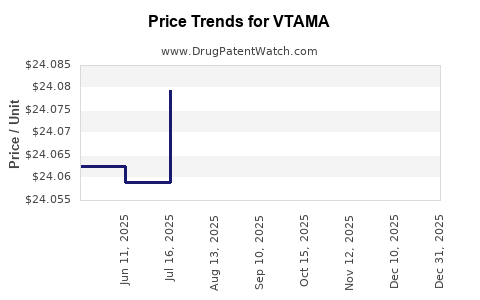
- Initial wholesale acquisition cost (WAC): Approximately $750 per 60g tube.
- Comparable topicals range from $580 to $850 per tube [4].
Price sensitivity and payer considerations
- Insurance coverage is anticipated to be favorable, with many payers covering topicals for psoriasis and atopic dermatitis.
- Formulary positioning will influence actual reimbursement rates, likely resulting in a net patient cost of $30-$60 per application.
Revenue projection assumptions
- Launch pricing remains stable over 3-5 years.
- Market penetration aligns with early adopter feedback.
- Growth is driven by expanding indications and patient access.
Regulatory and reimbursement outlook
- Additional approvals for pediatric patients and other indications are under review.
- Payer reimbursement policies favor topicals with favorable safety profiles.
- Pricing will be influenced by comparative efficacy, safety, and ease of use.
Risks and considerations
- Market penetration challenges: Brand recognition, prescriber familiarity.
- Competitive responses: Pricing adjustments by competitors, new entrants.
- Regulatory hurdles: Potential additional approvals or labeling changes.
- Patient adherence: Topical in nature may face adherence issues impacting sales.
Key Takeaways
- VTAMA is positioned in a multi-billion-dollar market with near-term revenue potential of approximately $80 million in 2024.
- The drug's price is expected to be around $750 per tube, with net patient costs significantly lower.
- Long-term growth depends on expanding indications, geographic reach, and prescriber adoption.
FAQs
1. How does VTAMA compare to existing topical treatments?
It offers a novel mechanism of action with a favorable safety profile, potentially improving adherence and reducing safety concerns associated with corticosteroids.
2. What is the primary driver for VTAMA’s market penetration?
Prescriber acceptance, insurance reimbursement, and inclusion in treatment guidelines.
3. Will price increases occur after launch?
Potentially, but price stability is expected initially to promote adoption.
4. How soon will VTAMA achieve significant market share?
By 2025, with a projected 10% share in the psoriasis topical segment.
5. Are there expanding indications for VTAMA?
Yes, ongoing clinical trials evaluate its efficacy for other inflammatory skin conditions, which could broaden the market.
References
[1] Global Data. (2022). Psoriasis Market Report.
[2]Parisi, R., et al. (2021). Global epidemiology of psoriasis. British Journal of Dermatology, 184(4), 622-637.
[3]Werner, B., et al. (2019). The global epidemiology of atopic dermatitis. Allergy, 74(3), 472-481.
[4]GoodRx. (2023). Topical medication prices.