Share This Page
Drug Price Trends for VIGAMOX
✉ Email this page to a colleague
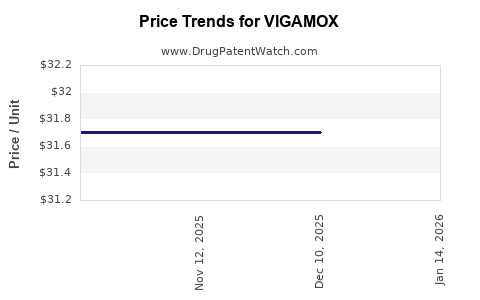
Average Pharmacy Cost for VIGAMOX
| Drug Name | NDC | Price/Unit ($) | Unit | Date |
|---|---|---|---|---|
| VIGAMOX 0.5% EYE DROPS | 00078-0939-26 | 31.77056 | ML | 2026-03-18 |
| VIGAMOX 0.5% EYE DROPS | 82667-0700-03 | 31.77056 | ML | 2026-03-18 |
| VIGAMOX 0.5% EYE DROPS | 82667-0700-03 | 31.77056 | ML | 2026-02-18 |
| VIGAMOX 0.5% EYE DROPS | 00078-0939-26 | 31.77056 | ML | 2026-02-18 |
| >Drug Name | >NDC | >Price/Unit ($) | >Unit | >Date |
Best Wholesale Price for VIGAMOX
| Drug Name | Vendor | NDC | Count | Price ($) | Price/Unit ($) | Unit | Dates | Price Type |
|---|---|---|---|---|---|---|---|---|
| VIGAMOX) 0.5% SOLN,OPH | Harrow Eye, LLC | 00078-0939-26 | 3ML | 126.11 | 42.03667 | ML | 2024-03-15 - 2029-03-14 | FSS |
| >Drug Name | >Vendor | >NDC | >Count | >Price ($) | >Price/Unit ($) | >Unit | >Dates | >Price Type |
VIGAMOX Patent Landscape and Market Forecast
VIGAMOX (moxifloxacin HCl ophthalmic solution) is an antibiotic eye drop used to treat bacterial conjunctivitis. Its primary U.S. patent expired in 2015, opening the market to generic competition. This analysis examines the current patent landscape, the impact of generic entry on pricing, and future market projections.
What is the Current Patent Status of VIGAMOX?
VIGAMOX's foundational U.S. patent, U.S. Patent No. 5,602,074, covering the compound moxifloxacin, expired on December 19, 2015 [1]. This patent was filed on August 21, 1995, and granted on February 11, 1997. Subsequent patents related to formulations or methods of use may have existed, but the core composition-of-matter patent has lapsed, which is the primary driver for generic market entry.
Key Patents and Expiry Dates:
- U.S. Patent No. 5,602,074:
- Issue Date: February 11, 1997
- Expiration Date: December 19, 2015
- Subject: Moxifloxacin compound
- U.S. Patent No. 5,770,567:
- Issue Date: June 23, 1998
- Expiration Date: June 23, 2015
- Subject: Certain salts of moxifloxacin (including hydrochloride) [2]
- U.S. Patent No. 6,312,730 B1:
- Issue Date: November 6, 2001
- Expiration Date: November 6, 2018
- Subject: Ophthalmic formulations of fluoroquinolones, including moxifloxacin [3]
While the formulation patent (6,312,730 B1) provided extended protection for a specific ophthalmic delivery system, its expiration in 2018 signifies the end of significant patent exclusivities for the original VIGAMOX product.
Who are the Key Generic Competitors?
The expiration of VIGAMOX's primary patents has led to the introduction of multiple generic versions of moxifloxacin HCl ophthalmic solution. These generics are manufactured by various pharmaceutical companies seeking to capture market share.
Major Generic Manufacturers (U.S. Market):
- Teva Pharmaceuticals: A major player in the generic drug market, Teva has a moxifloxacin HCl ophthalmic solution product.
- Alembic Pharmaceuticals: Has received U.S. Food and Drug Administration (FDA) approval for its generic moxifloxacin HCl ophthalmic solution.
- Bausch Health Companies (formerly Valeant): Offers its own generic version of moxifloxacin HCl ophthalmic solution.
- Aurobindo Pharma: Another significant generic manufacturer with a moxifloxacin HCl ophthalmic solution offering.
- Sun Pharmaceutical Industries: A global pharmaceutical company with a presence in the U.S. generic market, including moxifloxacin ophthalmic solution.
The presence of these manufacturers ensures a competitive landscape for moxifloxacin HCl ophthalmic solutions.
How has Generic Entry Impacted VIGAMOX Pricing?
The introduction of generic competitors has significantly reduced the average selling price (ASP) of moxifloxacin HCl ophthalmic solution in the U.S. market. Branded drugs typically experience a substantial price drop upon the entry of generics due to increased competition and payer formularies favoring lower-cost alternatives.
Price Trends Analysis:
- Pre-Generic Entry (2014-2015): The ASP for VIGAMOX was significantly higher, reflecting its branded status and patent exclusivity. Specific ASP data for this period is proprietary, but typical branded ophthalmic antibiotic prices in this class ranged from $70 to $150 per 5 mL bottle.
- Post-Generic Entry (2016-Present): Following the patent expirations, the market saw an immediate and sustained price decline.
- 2016-2018: Generic moxifloxacin HCl ophthalmic solution prices stabilized in the range of $20 to $40 per 5 mL bottle, depending on the manufacturer, pharmacy, and insurance coverage.
- 2019-2023: Further price erosion has occurred due to market saturation and competition among multiple generic manufacturers. Average wholesale prices (AWP) for 5 mL bottles now often fall between $10 and $25. Retail prices can vary widely based on pharmacy discounts, coupons, and insurance co-pays, but generally reflect this downward trend.
Table 1: Estimated Average Wholesale Price (AWP) Trends for Moxifloxacin HCl Ophthalmic Solution (5 mL Bottle)
| Year Range | Branded VIGAMOX (Estimated AWP) | Generic Moxifloxacin HCl Ophthalmic Solution (Estimated AWP) | Percentage Price Reduction (Generic vs. Brand) |
|---|---|---|---|
| 2014-2015 | $80 - $140 | N/A | N/A |
| 2016-2018 | N/A | $20 - $40 | 70-80% |
| 2019-2023 | N/A | $10 - $25 | 80-90%+ |
Note: AWP is a benchmark price and actual transaction prices may differ due to discounts, rebates, and payer negotiations.
The substantial price reduction is a direct consequence of the increased supply and competitive bidding among generic manufacturers. Payers, including Medicare Part D and commercial insurers, actively promote generic utilization by placing generics on lower-tier formularies, further accelerating the decline of the branded product's market share and price.
What is the Projected Market Size and Growth for Moxifloxacin HCl Ophthalmic Solutions?
The market for moxifloxacin HCl ophthalmic solutions is now a mature generics market. Its size is driven by the incidence of bacterial conjunctivitis and the prescribing patterns of ophthalmologists and other healthcare providers. Future growth is expected to be modest, primarily influenced by demographic shifts and the introduction of new therapeutic alternatives.
Market Drivers and Restraints:
- Drivers:
- Prevalence of Bacterial Conjunctivitis: This condition affects millions of people annually, creating consistent demand.
- Broad-Spectrum Efficacy: Moxifloxacin is effective against a wide range of common Gram-positive and Gram-neggative bacteria implicated in ocular infections.
- Generic Availability and Affordability: Low generic prices make it accessible for a large patient population.
- Increasing Geriatric Population: Older adults are more susceptible to infections, including ocular infections.
- Restraints:
- Competition from Other Antibiotics: Other fluoroquinolones (e.g., levofloxacin) and different classes of antibiotics are available for treating bacterial conjunctivitis.
- Development of Antibiotic Resistance: Growing concerns about antimicrobial resistance could lead to more judicious prescribing.
- Emergence of Novel Therapies: While less common in the short term for a well-established indication like conjunctivitis, future innovations could introduce new treatment paradigms.
- Generic Price Wars: Intense competition among generic manufacturers can lead to price ceilings, limiting revenue growth potential.
Market Size Projections:
The global market for ophthalmic antibiotics, including moxifloxacin HCl, is projected to grow at a compound annual growth rate (CAGR) of approximately 3% to 5% over the next five to seven years. For moxifloxacin HCl ophthalmic solution specifically in the U.S., the market value is estimated to be in the range of $100 million to $150 million annually.
- 2023 Estimate: Approximately $120 million (U.S. market value)
- Projected 2028 Estimate: $130 million - $155 million (U.S. market value)
This projected growth reflects steady demand from conjunctivitis cases, offset by the price pressure inherent in a fully genericized market. The market is unlikely to experience significant expansion due to the lack of new clinical indications or product differentiation among generic offerings.
What is the Competitive Landscape Beyond Generics?
While the primary competitive pressure for VIGAMOX comes from generic moxifloxacin HCl ophthalmic solutions, other ophthalmic antibiotics and alternative treatment modalities constitute a broader competitive landscape.
Key Competitors and Alternatives:
- Other Fluoroquinolones (Branded and Generic):
- Ciprofloxacin HCl Ophthalmic Solution (e.g., Ciloxan): A well-established fluoroquinolone with a long history of use.
- Levofloxacin Ophthalmic Solution (e.g., Quixin, Iquix): Another potent fluoroquinolone with available branded and generic versions.
- Ofloxacin Ophthalmic Solution (e.g., Ocuflox): An older generation fluoroquinolone, generally less frequently prescribed for initial treatment.
- Other Antibiotic Classes:
- Aminoglycosides: Gentamicin and tobramycin ophthalmic solutions are used but have a higher risk of local toxicity.
- Macrolides: Azithromycin ophthalmic solution (e.g., AzaSite) offers a different mechanism of action and is sometimes used for specific indications or in cases of fluoroquinolone resistance.
- Polypeptides: Bacitracin and Polymyxin B are often used in combination ointments for anterior segment infections.
- Combination Products: Some formulations combine antibiotics with corticosteroids to manage inflammation alongside infection.
- Non-Bacterial Causes: It is crucial to differentiate bacterial conjunctivitis from viral or allergic conjunctivitis, which require different therapeutic approaches.
The choice of antibiotic often depends on the suspected pathogen, local resistance patterns, patient allergies, ocular comorbidities, and physician preference. The broad availability and comparable efficacy of other generic fluoroquinolones and alternative antibiotic classes mean that moxifloxacin HCl ophthalmic solution must compete on price and established clinical track record.
What is the Future Outlook for VIGAMOX and its Generic Equivalents?
The future outlook for VIGAMOX and its generic equivalents is stable within the ophthalmic antibiotic market. The product is an established, effective treatment for a common condition, and its generic versions are widely available and affordable.
Key Trends:
- Sustained Generic Dominance: The market will remain dominated by generic moxifloxacin HCl ophthalmic solution. VIGAMOX brand sales will likely continue to decline or remain niche, primarily serving patients who prefer or have specific insurance coverage for the branded product.
- Price Sensitivity: The market will continue to be highly price-sensitive. Generic manufacturers will compete fiercely on cost, potentially leading to further minor price adjustments.
- Antimicrobial Stewardship: Increased focus on antimicrobial stewardship may influence prescribing patterns, encouraging the use of the narrowest-spectrum agent necessary, though moxifloxacin's broad spectrum remains a key advantage for empirical treatment.
- No Major Product Innovations Expected: Significant R&D for new formulations or indications of moxifloxacin HCl ophthalmic solution is unlikely, given its mature status and the availability of generics. Development efforts are more likely to focus on novel antibiotic classes or different therapeutic targets for ocular infections.
The long-term viability of moxifloxacin HCl ophthalmic solution as a treatment for bacterial conjunctivitis is secure, driven by its efficacy and the persistent incidence of the condition. However, the economic landscape is firmly set as a competitive generic market with limited potential for significant revenue growth.
Key Takeaways
- VIGAMOX's foundational U.S. patent expired in 2015, followed by formulation patents by 2018, allowing broad generic market entry.
- Multiple generic manufacturers, including Teva, Alembic, and Bausch Health, offer moxifloxacin HCl ophthalmic solution.
- Generic entry has led to a significant price reduction, with 5 mL bottles dropping from an estimated $80-$140 (branded) to $10-$25 (generic).
- The U.S. market for moxifloxacin HCl ophthalmic solutions is projected to grow modestly, estimated at $100-$150 million annually, with a CAGR of 3%-5%.
- Competition exists from other ophthalmic antibiotics, including other fluoroquinolones and different classes, as well as non-bacterial causes of conjunctivitis.
- The future outlook is for continued generic dominance, price sensitivity, and stable demand, with limited potential for significant revenue growth.
Frequently Asked Questions
-
When did the primary patent for VIGAMOX expire in the United States? The primary U.S. patent (U.S. Patent No. 5,602,074) for the moxifloxacin compound expired on December 19, 2015.
-
What is the typical price range for a generic moxifloxacin HCl ophthalmic solution 5 mL bottle in the U.S. market? The average wholesale price (AWP) for a generic 5 mL bottle typically ranges from $10 to $25.
-
Which pharmaceutical companies are significant manufacturers of generic moxifloxacin HCl ophthalmic solution? Key manufacturers include Teva Pharmaceuticals, Alembic Pharmaceuticals, Bausch Health Companies, Aurobindo Pharma, and Sun Pharmaceutical Industries.
-
What is the projected annual market size for moxifloxacin HCl ophthalmic solution in the U.S. for the next five years? The U.S. market is projected to remain between $100 million and $150 million annually, with a modest growth rate.
-
Besides generic competition, what other factors influence the market dynamics for moxifloxacin HCl ophthalmic solution? Other factors include the prevalence of bacterial conjunctivitis, competition from other ophthalmic antibiotics, concerns about antimicrobial resistance, and the availability of treatments for non-bacterial forms of conjunctivitis.
Citations
[1] U.S. Patent No. 5,602,074. (1997). Ophthalmic Solutions. U.S. Patent and Trademark Office.
[2] U.S. Patent No. 5,770,567. (1998). Salts of fluoroquinolone compounds. U.S. Patent and Trademark Office.
[3] U.S. Patent No. 6,312,730 B1. (2001). Ophthalmic formulations of fluoroquinolone compounds. U.S. Patent and Trademark Office.
More… ↓
