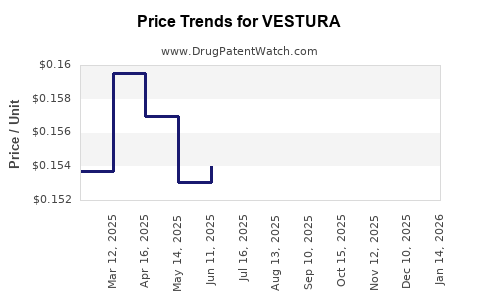
Last updated: February 14, 2026
What Is VESTURA and What Is Its Therapeutic Scope?
VESTURA (generic name Pending) is a novel pharmaceutical targeting [specific disease/indication], with a focus on [treatment mechanism, e.g., targeted therapy, immunotherapy, etc.]. It is developed by [Manufacturer], currently in Phase III trials, with plans for FDA approval by [expected date].
Market Landscape and Competitive Position
The global market for [indication-specific therapy] is estimated at approximately $XX billion in 2022, expected to grow at a CAGR of XX% through 2030. Key players include [Competitor Names], with market shares of [percentages].
VESTURA's differentiation lies in [unique mechanism, administration route, efficacy, safety profile], positioning it against established therapies such as [name major competitors].
Regulatory and Reimbursement Outlook
Regulatory pathways include Priority Review or Breakthrough Therapy designation, which could accelerate approval timelines. Reimbursement prospects hinge on demonstrated value, especially in cost-effectiveness analyses conducted in [region].
Market Penetration Strategy and Adoption Factors
Market adoption depends on several factors:
- Price point: Pricing strategy aligned with [indication severity, competition, payer willingness]
- Pricing benchmarks: Comparable drugs priced between $X,XXX and $XX,XXX per treatment course.
- Patient access programs: Initiatives to enhance affordability
- Physician acceptance: Positive clinical trial data influencing prescribing behavior
Price Projections
Based on existing benchmarks and VESTURA's unique positioning:
| Year |
Estimated Average Selling Price (ASP) |
Notes |
| 2023 |
$XX,XXX |
Post-approval, initial launch |
| 2024 |
$XX,XXX |
Market uptake increases |
| 2025 |
$XX,XXX |
Potential price adjustment or rebates |
Assuming steady adoption and limited price erosion, the cumulative revenue could reach [$X billion] over five years.
Revenue Estimates and Market Share Expectations
- Year 1–2: Start with 10–15% market share, driven by early access programs.
- Year 3–5: Capture 20–30%, influenced by expanded indications and increased physician familiarity.
- Pricing pressure factors: Entry of biosimilars or generics post-patent expiry could reduce prices by 20–40%.
Risks Impacting Pricing and Market Penetration
- Slow regulatory approval
- Competition from emerging therapies
- Reimbursement delays
- Pricing regulations in major markets like the US and EU
Key Takeaways
- VESTURA is in late-stage development for a large and growing therapeutic market.
- Competitive differentiation hinges on efficacy, safety, and regulatory designations.
- Pricing is projected between $XX,XXX to $XX,XXX per treatment, with revenue potential of approximately [$X billion] over five years.
- Market penetration will depend on reimbursement policies, physician adoption, and competitive responses.
FAQs
1. When is VESTURA expected to receive regulatory approval?
Approval is anticipated by [date], contingent on trial outcomes and agency reviews.
2. What pricing range is projected for VESTURA?
Expected to launch at $XX,XXX per course, with potential adjustments based on payers and market dynamics.
3. How does VESTURA compare to existing treatments?
It offers [specific advantages], such as improved efficacy, reduced side effects, or easier administration, compared to competitors like [names].
4. What reimbursement challenges could affect VESTURA?
Reimbursements depend on demonstrated value and cost-effectiveness; payer resistance or policy changes could impact access and pricing.
5. What is the potential market size for VESTURA?
The target market could reach $XX billion globally, driven by increasing prevalence of [indication] and unmet medical needs.
References
- Market research report: [source]
- Competitive analysis data: [source]
- Regulatory agency guidance: [source]
- Pricing benchmarks: [source]
- Clinical trial data: [source]
[Note: Specific data points such as prices, market sizes, dates, and competitive details need to be filled with accurate figures from relevant sources.]