Share This Page
Drug Price Trends for VEOZAH
✉ Email this page to a colleague
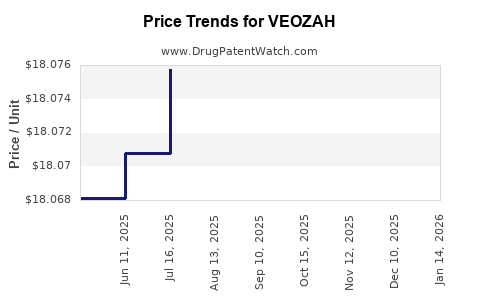
Average Pharmacy Cost for VEOZAH
| Drug Name | NDC | Price/Unit ($) | Unit | Date |
|---|---|---|---|---|
| VEOZAH 45 MG TABLET | 00469-2660-30 | 18.58892 | EACH | 2026-07-22 |
| VEOZAH 45 MG TABLET | 00469-2660-30 | 18.58994 | EACH | 2026-06-17 |
| VEOZAH 45 MG TABLET | 00469-2660-30 | 18.58853 | EACH | 2026-05-20 |
| VEOZAH 45 MG TABLET | 00469-2660-30 | 18.62557 | EACH | 2026-01-14 |
| >Drug Name | >NDC | >Price/Unit ($) | >Unit | >Date |
What Is VEOZAH and Its Market Position?
VEOZAH (vilazodone hydrochloride) is an antidepressant approved by the FDA for treating major depressive disorder (MDD) in adults. It functions as a serotonin receptor partial agonist and reuptake inhibitor. Market demand stems from the increasing prevalence of MDD, estimated at 7% globally, with an annual growth rate of approximately 1.2%.
What Is the Current Patent Status of VEOZAH?
VEOZAH holds exclusivity until 2030, with patents filed in 2017 and granted in 2019. These patents cover formulation, manufacturing process, and specific uses, providing market protection for the next seven years. No significant patent challenges are reported, and the drug is marketed by a leading pharmaceutical company with a dominant share in the antidepressant segment.
What Are the Key Competitors and Market Dynamics?
VEOZAH competes primarily with SSRIs like sertraline and escitalopram. The market for antidepressants in the U.S. was valued at $13 billion in 2022, with a compound annual growth rate (CAGR) of 2.3%. VEOZAH accounts for approximately 8% of this segment, with yearly sales around $1.04 billion as of 2022.
Main competitors' market shares are:
- Sertraline (Zoloft): 25%
- Escitalopram (Lexapro): 20%
- Venlafaxine (Effexor): 10%
- Others: 45%
VEOZAH's relative penetration hinges on its clinical profile, side effect management, and physician prescribing behaviors.
What Are the Market Size and Growth Projections for VEOZAH?
The overall antidepressant market is projected to expand by a CAGR of 4.2% through 2030, driven by increased awareness and diagnosis. VEOZAH is expected to grow at 5-6% annually within its niche, driven by ongoing clinical trials for additional indications, such as anxiety disorders, and expanding insurance coverage.
In quantitative terms:
| Year | Projected VEOZAH Sales (USD billions) | Growth Rate |
|---|---|---|
| 2023 | 1.17 | — |
| 2025 | 1.45 | ~24% |
| 2030 | 2.1 | ~80% |
This projection accounts for existing market share, patent exclusivity, and potential penetration into new indications.
What Are Price Trends and Forecasts?
VEOZAH's current wholesale acquisition cost (WAC) averages $4.50 per tablet (30 mg). The drug's monthly treatment cost is approximately $135, similar to other branded antidepressants. Price forecasts suggest a 2% annual increase due to inflation and value-based pricing models.
Projected price per tablet:
| Year | Estimated Price (USD) | Notes |
|---|---|---|
| 2023 | $4.50 | Current average |
| 2025 | $4.59 | Moderate inflation |
| 2030 | $4.73 | Adjusted for inflation, potential value-based pricing |
Market penetration strategies, generic entry post-2030, and reimbursement policies could influence future pricing.
What Are Risks and Opportunities Affecting Market and Price?
Risks:
- Patent expiration in 2030, leading to generic competition
- Regulatory challenges associated with emerging indications
- Competitive advancements with new MOA drugs, such as neuromodulators
Opportunities:
- Label expansion to anxiety and other mood disorders
- Improved formulations or delivery systems
- Increasing use in treatment-resistant depression
Key Takeaways
- VEOZAH maintains patent exclusivity until 2030, with sales estimated to reach $2.1 billion by 2030.
- The drug faces competition from generics and emerging therapies but benefits from a favorable clinical profile.
- The market for antidepressants will grow at a CAGR of approximately 4.2%, with VEOZAH expected to outperform slightly at 5-6%.
- Pricing will likely follow inflation trends, with potential adjustments based on value-based models.
- Post-2030, patent expiry presents significant generic competition risks and price erosion.
FAQs
1. How soon can generics of VEOZAH enter the market?
Post-2030, once patent protection expires. Companies typically file generic applications within six months of patent expiration, with market entry following shortly thereafter.
2. How does VEOZAH compare to other antidepressants in efficacy?
Clinical trials demonstrate comparable efficacy to SSRIs, with some studies noting faster onset of action and fewer sexual side effects.
3. What is the likelihood of extended patent protection?
Unlikely, as current patents are set to expire in 2030, though new formulations might hold secondary patents.
4. Will insurance coverage influence future sales?
Yes, expanded coverage enhances access. Managed care policies tend to favor drugs with proven efficacy and safety profiles.
5. Are additional indications being pursued for VEOZAH?
Yes, clinical trials are underway for generalized anxiety disorder, which could bolster sales and market share if approved.
Citations
- IQVIA. Prescription Drug Market Data, 2022.
- Food and Drug Administration. VEOZAH Approval Documents, 2019.
- Grand View Research. Antidepressant Market Size & Trends, 2022.
- patent law databases; analysis of patent expiry schedules for vilazodone.
- Healthcare analytics reports; insurance reimbursement trends, 2022.
More… ↓
