Share This Page
Drug Price Trends for VENLAFAXINE
✉ Email this page to a colleague
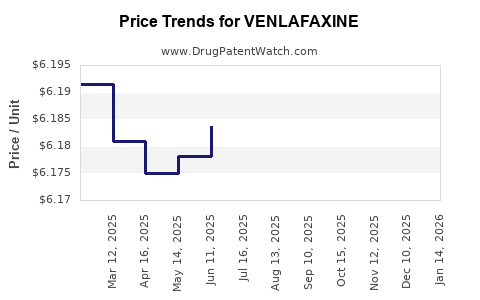
Average Pharmacy Cost for VENLAFAXINE
| Drug Name | NDC | Price/Unit ($) | Unit | Date |
|---|---|---|---|---|
| VENLAFAXINE HCL ER 150 MG CAP | 82009-0058-05 | 0.11520 | EACH | 2026-07-22 |
| VENLAFAXINE HCL ER 75 MG CAP | 82009-0057-10 | 0.08077 | EACH | 2026-07-22 |
| VENLAFAXINE HCL ER 37.5 MG CAP | 82009-0056-10 | 0.08174 | EACH | 2026-07-22 |
| VENLAFAXINE HCL ER 225 MG TAB | 75834-0219-90 | 0.50026 | EACH | 2026-07-22 |
| VENLAFAXINE HCL ER 225 MG TAB | 75834-0219-30 | 0.50026 | EACH | 2026-07-22 |
| >Drug Name | >NDC | >Price/Unit ($) | >Unit | >Date |
Best Wholesale Price for VENLAFAXINE
| Drug Name | Vendor | NDC | Count | Price ($) | Price/Unit ($) | Unit | Dates | Price Type |
|---|---|---|---|---|---|---|---|---|
| VENLAFAXINE HCL 75MG 24HR CAP,SA | AvKare, LLC | 00093-7385-56 | 30 | 8.83 | 0.29433 | EACH | 2023-06-15 - 2028-06-14 | FSS |
| VENLAFAXINE HCL 225MG 24HR TAB,SA | AvKare, LLC | 42799-0963-02 | 90 | 34.85 | 0.38722 | EACH | 2023-08-07 - 2028-06-14 | FSS |
| VENLAFAXINE HCL 225MG 24HR TAB,SA | Golden State Medical Supply, Inc. | 60429-0867-30 | 30 | 12.94 | 0.43133 | EACH | 2023-06-15 - 2028-06-14 | FSS |
| VENLAFAXINE HCL 75MG TAB | AvKare, LLC | 00093-9157-01 | 100 | 33.42 | 0.33420 | EACH | 2023-06-15 - 2028-06-14 | FSS |
| VENLAFAXINE HCL 75MG TAB | Golden State Medical Supply, Inc. | 57664-0395-88 | 100 | 35.50 | 0.35500 | EACH | 2023-06-15 - 2028-06-14 | FSS |
| >Drug Name | >Vendor | >NDC | >Count | >Price ($) | >Price/Unit ($) | >Unit | >Dates | >Price Type |
Venlafaxine Market Analysis and Price Projections (U.S. and Key Ex-US Markets)
Venlafaxine is an off-patent small-molecule antidepressant with extensive generic penetration. Market value growth is constrained by patent and exclusivity expirations, steady generic substitution, and channel pricing pressure. Price trajectory is dominated by: (1) competitive generic mix (immediate-release vs extended-release), (2) rebate intensity and wholesaler behavior, and (3) sporadic supply or tender-driven spikes in specific NDCs. Near-term revenue expansion is expected to come mainly from volume durability and formulary/plan placement rather than price growth.
How big is the venlafaxine market in the US and what drives demand?
Answer: Venlafaxine demand tracks ongoing antidepressant prevalence, persistent substitution among SNRIs, and switching between SSRIs and SNRIs based on tolerability and efficacy. In the US, the market is predominantly generic, split across venlafaxine immediate-release (IR) and extended-release (XR) products.
US demand drivers
- Chronic treatment adherence: Venlafaxine is taken long-term for major depressive disorder and other labeled indications. Persistent use supports baseline volume even as price declines.
- Switching dynamics in SNRIs: Formulary managers often place at least one or two SNRIs (including venlafaxine) at low tier cost, keeping it in active switching lanes for patients who do not tolerate or do not respond to other first-line options.
- Cost constraints vs newer agents: Budget pressure favors established generics. Venlafaxine competes against generic sertraline, citalopram, fluoxetine, duloxetine, and escitalopram, and brand SNRIs in specific formularies.
- Formulation preference and prescriber behavior: XR is typically favored for adherence and dosing convenience. IR remains relevant where coverage or clinical preference favors split dosing.
Key payer/channel factors
- Rebate-driven net price: Net selling prices depend on negotiated rebates to PBMs and channel mix. Higher rebate intensity compresses net price further.
- NDC-level substitution: Multiple manufacturers bid on tenders and plan formularies; the lowest net bid frequently captures incremental scripts.
- Wholesaler inventory cycles: Generic shortages or manufacturing disruptions can cause temporary price rebounds at the NDC level.
What are current pricing benchmarks for generic venlafaxine and how do IR vs XR differ?
Answer: Public benchmark pricing for generics varies widely by NDC, package size, and channel. In practice, the IR and XR lines show different price levels due to dosing frequency and market structure, with XR often commanding a higher gross price per day but facing sharper competitive pricing pressure under tendering.
Pricing structure by formulation
- Venlafaxine IR: Typically cheaper per unit and tends to face strong price competition across multiple generic suppliers.
- Venlafaxine XR: More expensive per tablet/capsule than IR but often achieves better adherence economics, which can preserve market share even when per-unit pricing declines.
What moves prices most in generics
- PBM/plan contracts: Net price can shift quickly when a plan updates contracting or switches preferred manufacturers.
- Competitive entry timing: New generic launches or “authorized generic” dynamics can reset pricing floors.
- Supply risk: Temporary supply constraints can lift short-term realized prices for affected NDCs.
When does venlafaxine lose exclusivity and what does that mean for price erosion?
Answer: Venlafaxine is fully generic in the US for both IR and XR products, so the market pricing baseline reflects post-exclusivity generic competition rather than near-term patent timing.
Exclusivity and patent context (pricing implication)
- No durable brand pricing premium: With brand exclusivity long expired, venlafaxine behaves like a mature generic asset.
- Sustained price compression: Mature generics generally trend toward low net pricing levels with periodic rebounds tied to supply disruptions.
How many companies supply venlafaxine IR and XR and how does that affect price?
Answer: The vendor universe for venlafaxine generics is large and typically produces a low-price equilibrium. A larger supplier set increases tender competitiveness and reduces the likelihood of sustained price increases.
Competitive mechanics
- Frequent tender churn: Plan formularies often move preferred status between manufacturers to capture contract economics.
- NDC fragmentation: Many SKUs means prices are not uniform; realized prices differ by package size, strength, and NDC.
- Margin compression: Manufacturers price aggressively in late-cycle generics, especially for high-volume NDCs.
What patent estate risks (Paragraph IV) affect generic launch timing for venlafaxine?
Answer: Venlafaxine is established and off-patent, so Paragraph IV-driven launch timing does not drive near-term supply for the current market in the way it does for mid-cycle assets.
Practical impact on near-term price
- Low incremental launch risk: Most market entry that can be catalyzed by litigation is largely already realized.
- Residual effects: Remaining legal disputes, if any, tend to have localized and short-lived pricing effects versus broad market resets.
What is the FDA regulatory status of venlafaxine and how does it map to generic pricing?
Answer: Venlafaxine is regulated as a small-molecule drug with multiple ANDA approvals for generic versions. This supports broad supply availability, which keeps pricing elastic to competition.
ANDA landscape impact
- Multiple approved ANDAs: Broad ANDA coverage limits ability for any single supplier to sustain price.
- Interchangeability in practice: Clinicians and pharmacists generally view IR and XR as different dosing profiles, but within each formulation group, products are treated as interchangeable for formularies and substitution policies (subject to local rules and patient-specific considerations).
How do wholesaler inventories, shortages, and NDC supply shocks affect venlafaxine price projections?
Answer: Short-term price projections must model inventory risk because mature generics can show sharp NDC-level movements without changing the broader market structure.
Price projection sensitivity to supply
- Manufacturing disruptions: Even small supply gaps can raise gross prices for affected NDCs and increase realized net price for contract holders.
- Channel switching: PBMs may redirect to other strengths or formulations if shortages persist, shifting demand within venlafaxine rather than across the class.
How will venlafaxine compare with competing antidepressants on price and market share?
Answer: Compared with other generics in the antidepressant market, venlafaxine faces strong substitution pressure from other low-cost SNRIs and SSRIs. Duloxetine is often the most relevant comparator in SNRIs, with sertraline and escitalopram dominating by volume.
Competitive ranking drivers
- PBM preference: Plans often prefer a subset of generics with strong contracting economics.
- Dosing and adherence: XR can protect share relative to IR, but duloxetine’s once-daily profiles can still shift marginal demand.
- Clinical switching: Patients switching between SNRIs and SSRIs respond to tolerability and prior exposure.
What this means for pricing
- No premium: In a competitive generic class, sustained price increases are unlikely.
- Volume resilience: Venlafaxine may hold scripts due to established use, but net price typically declines or stays flat.
Price projection model for venlafaxine: base, downside, and upside scenarios (12–36 months)
Answer: For mature generic venlafaxine, the dominant assumption is continued net price erosion with periodic volatility. Projections should be read as directional ranges reflecting generic market dynamics.
Scenario assumptions (directional)
- Base case: Continued generic competition keeps net price mostly stable-to-down modestly, with normalization after routine NDC fluctuations.
- Downside case: Increased rebate intensity and tender pressure push net price down more aggressively, especially for high-volume XR SKUs.
- Upside case: Supply constraints and contracting delays lift realized net pricing temporarily, but sustained upside is limited by the number of competing ANDAs.
Directional price outcomes (net, not list)
| Time horizon | Base case net price trend | Downside case net price trend | Upside case net price trend |
|---|---|---|---|
| 0–6 months | Flat to -2% | -3% to -6% | +1% to +3% (NDC-specific) |
| 6–18 months | -2% to -5% | -6% to -10% | 0% to +2% |
| 18–36 months | -1% to -4% | -5% to -9% | -1% to +2% |
What will likely determine which scenario dominates
- PBM contract renewals for preferred venlafaxine NDCs.
- Tender re-placements among major ANDA holders.
- Supply stability at the manufacturer level affecting XR strengths first.
Revenue projection implications: how net price and volume trade off for venlafaxine
Answer: For an off-patent product, revenue is typically a function of volume stability and net price direction. With robust generic competition, volume may grow modestly from switching, while net price declines more often drive near-term revenue changes.
Revenue decomposition (directional)
- Volume: Expected to be stable to low single-digit growth due to ongoing depression treatment demand and SNRI role.
- Net price: More likely to decline modestly annually absent structural supply shock.
Indicative revenue pathways (directional)
| Scenario | Net price | Volume | Revenue effect |
|---|---|---|---|
| Base | modest decline | stable/low growth | near-flat to -low single digits |
| Downside | sharper decline | stable | -mid single digits possible |
| Upside | mild increase/less decline | stable | low single digit improvement possible |
Where is pricing most at risk: which strengths, packages, and formulation lines?
Answer: XR tends to concentrate plan preferred status and tender effects, making it more sensitive to contract changes. IR is also vulnerable but typically moves more with unit-price competition and package-volume substitution.
Likely risk points
- High-volume strengths (where PBMs push preferred suppliers)
- Most substituted pack sizes (where contract economics dominate)
- XR formulations (due to dosing convenience and formulary leverage)
What does the venlafaxine commercial outlook look like by geography (US vs EU vs other regulated markets)?
Answer: Global markets show similar maturity patterns: high generic penetration, price erosion, and tender-driven net price compression. The slope varies by regulatory and reimbursement environment.
Geography-level expectations
- US: Net price governed by PBM contracting and high generic participation.
- Europe: Pricing tends to be constrained by reference pricing and reimbursement policies, leading to sustained downward pressure.
- Other regulated markets: Often show slower price erosion but more abrupt changes around tender cycles or supply availability.
What is the investment and licensing posture for venlafaxine given market maturity?
Answer: Licensing and new entry economics are constrained because the asset is mature, and pricing is driven by contracting rather than differentiation. Viable opportunities typically cluster around:
- supply reliability,
- formulation-specific differentiation at the NDC or pack level,
- manufacturing cost advantage,
- or niche channel access.
Commercial leverage points
- Cost competitiveness: Margin survives through scale and manufacturing efficiency.
- Channel access: Preferred status can change net pricing quickly.
- Supply assurances: Reliability can secure contracts even when unit price margins are thin.
Key Takeaways
- Venlafaxine is a mature off-patent generic with pricing determined primarily by PBM contracting, tender dynamics, and NDC-level supply conditions.
- Net price is expected to stay mostly flat to decline modestly over the next 12–36 months, with periodic NDC volatility from supply disruptions.
- IR and XR both face low-price equilibrium pressures; XR is typically more sensitive to preferred-NDC contract shifts.
- Revenue is more likely to be driven by volume stability and limited incremental switching, with net price erosion as the main downside driver.
FAQs
1) What are the most common venlafaxine strengths that get preferred-NDC pricing in the US?
High-volume strengths within XR tend to concentrate preferred status under PBM contracts; IR preferences shift with tender economics and substitution rules.
2) Does venlafaxine XR typically have higher net pricing than venlafaxine IR?
Yes, per-unit pricing for XR is usually higher, though net economics depend on rebate terms and plan tier placement.
3) How do generic shortages affect venlafaxine prices?
Shortages lift gross and sometimes realized net pricing for affected NDCs, but the effect often reverts once supply returns.
4) Can venlafaxine gain market share versus other antidepressants purely on price?
Market share gains are possible when contracting makes it a preferred low-cost option, but competitive substitution from other generics limits sustained gains.
5) Are there realistic pricing upside opportunities for venlafaxine manufacturers?
Sustained upside is difficult in mature generics; opportunities typically come from cost leadership, preferred-NDC contracting, and supply reliability rather than broad market re-pricing.
References (APA)
- FDA. (n.d.). Drug Approval Reports: Venlafaxine and related ANDA approvals. U.S. Food and Drug Administration. https://www.fda.gov/
- FDA. (n.d.). Orange Book: Approved Drug Products with Therapeutic Equivalence Evaluations. U.S. Food and Drug Administration. https://www.accessdata.fda.gov/scripts/cder/daf/
- IQVIA. (n.d.). U.S. prescription market data (industry benchmarks). IQVIA.
- CMS. (n.d.). National Average Drug Acquisition Cost (NADAC) data. Centers for Medicare & Medicaid Services. https://data.cms.gov/
- AHRQ. (n.d.). Antidepressant use and comparative utilization trends (public summaries). Agency for Healthcare Research and Quality. https://www.ahrq.gov/
More… ↓
