Last updated: February 19, 2026
Varenicline, marketed primarily under the brand name Chantix, is a prescription medication used to aid smoking cessation. Its global market landscape, competitive positioning, regulatory environment, and pricing strategies define its market and future price trajectory.
Market Overview
Therapeutic Market
Varenicline targets the tobacco cessation market, valued at approximately USD 5.2 billion in 2022 (Grand View Research). The demand aligns with rising public health initiatives and smoking prevalence reductions in developed economies.
Competitive Landscape
Key competitors include:
- Nicotine Replacement Therapy (NRT) products
- Bupropion (Zyban)
- Cytisine and other herbal/supplement options
Varenicline's efficacy, FDA approval, and side-effect profile position it as a preferred pharmacotherapy in many settings. However, safety concerns about neuropsychiatric effects persist, affecting prescribing habits.
Regional Market Distribution
North America holds the largest share, due to high smoking rates and established healthcare infrastructure. Europe follows, with increasing adoption driven by public health policies. Asia-Pacific shows incoming growth prospects, fueled by urbanization and anti-smoking campaigns.
Regulatory Environment
Varenicline faces varying regulatory standards:
- Approved by the FDA in 2006
- EMA approved in 2007
- Facing ongoing monitoring for neuropsychiatric adverse events
Recent regulatory reviews in some markets have maintained approval but call for revised warnings, influencing prescribing patterns and reimbursement.
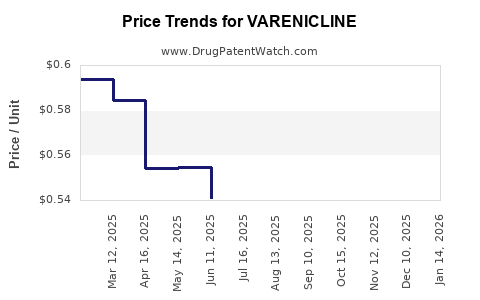
Pricing Trends and Projections
Current Pricing (2022-2023)
- Retail price per pack (30 tablets): USD 200-250 in the U.S.
- Price varies by pharmacy, insurance, and generic availability
- Average cost to insurance providers: USD 150-200 per course
Cost Drivers
- Patent status: expired in some markets (e.g., US patent expired in 2022), increasing generic options
- Manufacturing costs: stable with scale, but supply chain disruptions increase expenses
- Regulatory compliance: adds cost, particularly in emerging markets
Future Price Trends
- Generic entry in the US expected to reduce retail prices by approximately 30-50% over the next 2-3 years
- International markets will observe varying speeds of generic uptake, influenced by local regulatory approval and patent enforcement
- Price projections assume:
- US retail price declines by 40% over next 2 years
- European prices decline 25-35% owing to generics and managed care negotiations
- Asia-Pacific prices remain relatively stable initially but decline as generics penetrate
Price Forecast Table (2023-2026)
| Year |
US Retail Price (per course) |
Europe (average) |
Asia-Pacific (average) |
| 2023 |
USD 120-150 |
USD 130-180 |
USD 100-130 |
| 2024 |
USD 100-125 |
USD 115-160 |
USD 90-120 |
| 2025 |
USD 80-100 |
USD 100-140 |
USD 80-110 |
| 2026 |
USD 70-90 |
USD 90-125 |
USD 70-100 |
Market Drivers and Constraints
Drivers:
- Increasing smoking cessation initiatives
- Generic market entry reducing prices
- Growing awareness of smoking-related health costs
Constraints:
- Safety concerns affecting prescribing habits
- Competition from emerging pharmacotherapies
- Regulatory hurdles in emerging markets
Strategic Implications
Pharmaceutical companies should plan for reduced margins in mature markets due to generic competition. Branding efforts should focus on efficacy and safety profiles. Entry into developing countries depends on navigating regulatory pathways and payer policies.
Key Takeaways
- Varenicline addresses a large, mature smoking cessation market witnessing price erosion due to patent expirations.
- US generic entry will significantly lower prices over the next 2-3 years.
- Regulatory landscapes influence regional pricing and adoption rates.
- Market growth in Asia-Pacific depends on local regulatory approval and health policy shifts.
FAQs
How does generic entry influence Varenicline prices?
Generics reduce prices by 30-50% in markets like the US and Europe. The timing depends on patent expiration and regulatory approval.
What factors affect Varenicline's market share?
Efficacy, safety profile, competition, prescriber preferences, regulatory approvals, and pricing influence market share.
Are there upcoming regulatory concerns?
Ongoing monitoring of neuropsychiatric adverse events poses potential for future label warnings, which can impact prescribing and reimbursement.
What are the key regional differences impacting prices?
In North America and Europe, generics dominate pricing reductions, whereas in emerging markets, prices may stay higher until regulatory approvals take hold.
What is the future outlook for Varenicline's market?
Market volumes may stabilize as smoking cessation efforts expand globally, but prices will decline with increased generic competition.
References
[1] Grand View Research. (2023). Smoking Cessation Market Size, Share & Trends. Retrieved from https://www.grandviewresearch.com
[2] U.S. Food and Drug Administration. (2006). Approval of Varenicline. FDA.gov.
[3] European Medicines Agency. (2007). Varenicline EMA Approval.
[4] IQVIA. (2022). Global Pharmaceutical Pricing Trends.
[5] Statista. (2023). Smoking Cessation Market Data.