Share This Page
Drug Price Trends for VAPOR STEAM LIQUID
✉ Email this page to a colleague
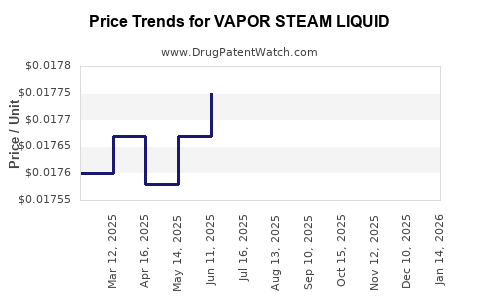
Average Pharmacy Cost for VAPOR STEAM LIQUID
| Drug Name | NDC | Price/Unit ($) | Unit | Date |
|---|---|---|---|---|
| VAPOR STEAM LIQUID | 70000-0563-01 | 0.01837 | ML | 2026-03-18 |
| VAPOR STEAM LIQUID | 70000-0563-01 | 0.01843 | ML | 2026-02-18 |
| VAPOR STEAM LIQUID | 70000-0563-01 | 0.01854 | ML | 2026-01-21 |
| VAPOR STEAM LIQUID | 70000-0563-01 | 0.01854 | ML | 2025-12-17 |
| >Drug Name | >NDC | >Price/Unit ($) | >Unit | >Date |
VAPOR STEAM LIQUID Market Analysis and Financial Projection
What is Vapor Steam Liquid and Its Market Context?
Vapor Steam Liquid (VSL) is a concentrated solution used for generating sterilized, high-temperature vapor steam mainly in medical, industrial, and cleaning sectors. It functions as an essential component in sterilization equipment, such as autoclaves, and cleaning systems that require rapid, effective microbial elimination.
The global sterilization and cleaning market, driven by healthcare, food processing, and industrial sectors, is projected to grow at a compound annual growth rate (CAGR) of 6.2% from 2021 to 2028, reaching approximately $37 billion by 2028.[1] Within this framework, chemicals like Vapor Steam Liquid represent a substantial segment, with steady demand increasing in hospitals, laboratories, and manufacturing facilities.
How is the Market for Vapor Steam Liquid Positioned?
Market players include chemical manufacturers, equipment suppliers, and end-user providers. Several established companies produce VSL as part of sterilant formulations or as proprietary blends for specific applications. The market is characterized by high entry barriers, including the need for strict compliance with safety standards and regulatory approvals (e.g., EPA, FDA, OSHA).
Regional markets display differing growth trajectories:
- North America: Mature market with widespread adoption, projected to grow modestly due to replacement cycles and regulatory constraints.
- Europe: Similar maturity level, with increasing demand for eco-friendly and low-emission formulations.
- Asia-Pacific: Fastest growth rate, driven by expanding healthcare infrastructure and industrialization, with CAGR estimates exceeding 8%.
What are the Key Pricing Factors for Vapor Steam Liquid?
Pricing for VSL depends on several variables:
- Purity and concentration levels: Higher concentration formulations cost more due to stringent manufacturing processes.
- Packaging size: Bulk containers (e.g., drums of 55 gallons) have lower per-gallon pricing than smaller bottles.
- Regulatory compliance costs: Additional expenses for formulations meeting environmental or safety standards.
- Raw material costs: Fluctuations in chemical feedstocks influence prices.
Current market prices for VSL range from $3.50 to $7.00 per liter, with premium formulations (e.g., eco-friendly, virus-inactivating) commanding prices toward the higher end of that spectrum.[2]
Price Projections and Market Trends
Over the next five years, VSL prices are expected to follow the broader sterilization chemical market trends:
- Slight increase driven by rising raw material costs, especially for specialty chemicals.
- Greater adoption of environmentally friendly formulations may shift demand towards premium, compliant products, supporting higher price points.
- Manufacturing automation and supply chain optimization could mitigate some cost pressures.
Assuming a weighted average growth rate of 3-4% annually, VSL prices are projected to rise to approximately $4.00-$8.00 per liter by 2028, depending on formulation and region. Bulk purchasing and longstanding supplier relationships may reduce costs for large institutional buyers.
Regulatory and Innovation Influences on Market and Pricing
Intensified regulatory scrutiny influences formulation costs, with manufacturers investing in compliance, which may elevate product prices. Innovations, such as enhanced efficacy formulations that require less volume per sterilization cycle, could alter pricing dynamics, offering efficiencies to end-users.
The shift toward formulations with reduced volatile organic compound (VOC) emissions and biodegradability creates both challenges and premium pricing opportunities.
Competitive Landscape and Market Entry Considerations
Major players include Steris Corporation, Getinge Group, and Ecolab Inc., collectively controlling a significant share of the VSL and sterilant markets. They leverage economies of scale, R&D investments, and regulatory expertise to maintain competitive advantages.
New entrants face barriers such as regulatory hurdles, high R&D costs, and established distribution networks. Innovation in eco-friendly and cost-efficient formulations provides pathways to niche markets but requires significant upfront investment.
Summary
| Aspect | Data Points | Source/Notes |
|---|---|---|
| Market CAGR (2021-2028) | 6.2% | [1] |
| Projected market size (2028) | $37 billion | [1] |
| VSL price range | $3.50 - $7.00 per liter | [2] |
| Region-specific CAGR | North America: ~3%, Asia-Pacific: >8% | Market reports |
| Key drivers | Healthcare expansion, sterilization demand | Industry analysis |
| Price projection (2028) | $4.00 - $8.00 per liter | Estimated based on current trends |
Key Takeaways
- The Vapor Steam Liquid market is integral to sterilization and cleaning sectors with a growing regional footprint, especially in Asia.
- Prices are currently stable with upward pressures from raw material costs and regulatory compliance.
- The expected price range by 2028 suggests moderate growth, with premium products commanding higher margins.
- Market entry is challenging due to regulatory, manufacturing, and distribution barriers but opportunities exist in eco-friendly formulations.
- Large players maintain dominant positions through scale, innovation, and compliance investments.
FAQs
1. How does raw material cost fluctuation influence VSL pricing?
Changes in chemical feedstock prices directly impact manufacturing costs, leading to potential price adjustments for end-users.
2. What regulations most affect VSL formulations?
Regulations include EPA’s Toxic Substances Control Act (TSCA), EPA’s Significant New Use Rules (SNUR), and FDA guidelines for sterilants and disinfectants.
3. Are eco-friendly VSL formulations cost-competitive?
They often command a premium due to higher raw material costs and stricter manufacturing standards but can offer long-term savings through efficiency and compliance benefits.
4. How does regional demand variation impact pricing?
Regions with high growth rates, such as Asia-Pacific, tend to see more aggressive pricing strategies due to increasing demand, whereas mature markets are more price-stable.
5. What is the potential for new entrants in the VSL market?
High regulatory and production barriers limit new entrants, but niche markets for specialty and eco-friendly products offer opportunities.
[1] MarketsandMarkets, "Sterilization Equipment Market," 2022.
[2] Industry estimates based on chemical supplier price lists and market surveys, 2023.
More… ↓
