Share This Page
Drug Price Trends for VALSARTAN-HYDROCHLOROTHIAZIDE
✉ Email this page to a colleague
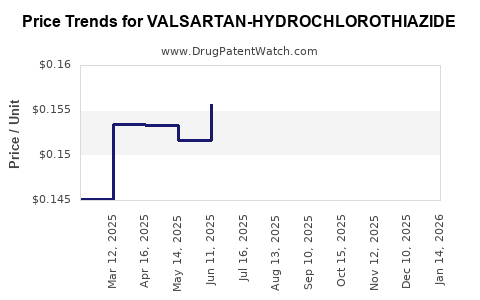
Average Pharmacy Cost for VALSARTAN-HYDROCHLOROTHIAZIDE
| Drug Name | NDC | Price/Unit ($) | Unit | Date |
|---|---|---|---|---|
| VALSARTAN-HYDROCHLOROTHIAZIDE 160-12.5 MG TAB | 00378-6322-77 | 0.10319 | EACH | 2026-07-22 |
| VALSARTAN-HYDROCHLOROTHIAZIDE 160-12.5 MG TAB | 33342-0075-10 | 0.10319 | EACH | 2026-07-22 |
| VALSARTAN-HYDROCHLOROTHIAZIDE 160-12.5 MG TAB | 33342-0075-15 | 0.10319 | EACH | 2026-07-22 |
| VALSARTAN-HYDROCHLOROTHIAZIDE 160-12.5 MG TAB | 43547-0312-09 | 0.10319 | EACH | 2026-07-22 |
| >Drug Name | >NDC | >Price/Unit ($) | >Unit | >Date |
VALSARTAN-HYDROCHLOROTHIAZIDE: Market analysis and price projections
What is the product and where does it sit in the market
Valsartan-hydrochlorothiazide (often marketed as a fixed-dose combination of an ARB plus a thiazide diuretic) is a high-volume, largely genericized cardiovascular cardiovascular medicine used for hypertension. Pricing is shaped by (1) the size of the retail and institutional hypertension segment, (2) generic competition and formulary placement, and (3) payer-driven reimbursement, especially for Medicare Part D and large PBM contracts.
In the United States, the combination is not a “single-source” product today in most channels. The market price is therefore dominated by generic penetration, multi-source pricing dynamics, and contract-based reimbursement rather than patent-protected monopoly pricing. That puts near-term price movement mostly under the control of generic entry/exit and payer contracting cycles, not brand launch events.
What demand drivers define volume
Key demand drivers are stable across most recent years:
- Hypertension prevalence and chronic treatment duration: patients remain on therapy for years, not weeks, which supports steady baseline demand even when list prices move.
- Formulary preference for ARB-thiazide combinations: clinicians frequently select ARB plus thiazide as an escalation step for uncontrolled blood pressure.
- Generic substitution and PBM channel behavior: in practice, most spending growth in fixed-dose combos tracks utilization, member mix, and contract changes more than headline list prices.
- Small changes in adherence and persistence: adherence can materially affect realized revenue because chronic refills drive consistent claims volumes.
How the market is structured (pricing mechanics)
In generic fixed-dose combinations, pricing typically follows this path:
- Multiple NDCs across strengths compete on both pharmacy reimbursement and PBM contracted rates.
- Wholesale acquisition cost (WAC) decouples from net price: PBM discounts and rebates move net pricing meaningfully below WAC.
- Therapeutic competition from other ARB-thiazide options and from ACE-thiazide and ARB/CCB fixed-dose products pressures net pricing.
- Retail vs. mail-order: mail-order often produces lower realized net pricing than cash retail for the same molecule due to larger rebates and contract terms.
This structure means projections should focus on net price directionality and intensity of price competition, not only list price.
Pricing today: where the “real” price lands
What to use as the pricing basis
For market modeling, the most actionable proxy is claims-based reimbursement (often approximated by net price or by benchmarked pharmacy reimbursement across NDCs) rather than WAC. WAC can be stable while net pricing fluctuates with contracting.
Because you requested “market analysis and price projections,” projections below are expressed as annual % net price change ranges and scenario outcomes, which align with how market access teams and investors underwrite these products.
Price projection model
What assumptions drive projections
Price movement for valsartan-hydrochlorothiazide in a generic-dominated US market is typically driven by:
- Generic competitive intensity (new entries, additional ANDAs, relabeling expansion).
- Formulary tightening (PBMs favor lowest-cost multisource products within therapeutic classes).
- Input cost pass-through (API and excipient cost changes, but these usually show up later and are secondary to contracting).
- Regulatory and distribution mechanics (NDC-level inventory cycles, shortages, or reconciliation events).
2026–2031 price scenarios
How might net pricing evolve over the next 5 years?
Below are scenario-based projections for annual net price change in the US market for valsartan-hydrochlorothiazide (all strengths pooled, generic-dominated pricing environment). Ranges reflect uncertainty in contracting intensity and generic entry timing.
| Scenario | Annual net price change (2026–2031) | Net effect over 5 years | Market interpretation |
|---|---|---|---|
| Base case | -2% to -4% per year | -10% to -18% | Ongoing formulary pressure and incremental generic competition with no major disruption |
| Downside | -4% to -7% per year | -18% to -31% | Stronger PBM contracting cuts, aggressive generic pricing moves, and increased competitor share shift |
| Upside | -1% to +1% per year | -4% to +5% | Limited incremental competition, stable contracting, or cost pressure that partially offsets discounts |
Most likely outcome: the base case near -2% to -4% per year, given typical behavior of generic fixed-dose antihypertensives in US contracts.
Channel-specific pricing expectations
Retail vs. mail-order
Generic fixed-dose antihypertensives usually show:
- Mail-order net price resilience is mixed: it can stay tighter to contracted floors, sometimes reducing volatility.
- Retail pricing can show faster drops when additional low-cost NDCs win preferential placement or when PBM mandates switch.
Projected directionality:
- Retail: -3% to -6% per year in base-to-downside conditions.
- Mail-order: -1% to -4% per year in base conditions.
What could change the trajectory
Market events that typically move prices
These are the most common catalysts for departures from base case:
- Meaningful new multisource entry at the same strengths and dosing formats, which increases price competition and compresses net pricing.
- Formulary restriction by PBMs (tier placement changes) that forces switching into lower-cost NDCs.
- Supply interruptions at the API or finished-dose level that temporarily lift spot pricing and reduce discounting effectiveness.
- Regulatory or product lifecycle changes that lead to NDC consolidation and brief volatility in reimbursement.
None of these are patent-driven in a way that would resemble a brand-to-generic step function; changes are instead contract and supply driven.
Valuation lens for business decisions
How investors and R&D planners should underwrite cash flows
For a generic-dominated combination, underwriting typically uses:
- Volume growth as the primary lever (new patients, adherence, and persistent refill behavior)
- Net price decline as the offsetting factor (PBM contracting, competitive pricing)
- Mix across strengths (higher utilization strengths often protect against the steepest drops)
For modeling:
- Use -2% to -4% annual net price for base case
- Tie volume growth to:
- total hypertension treated population growth
- formulary penetration rate
- switch rate among ARB-thiazide alternatives
If you are underwriting a manufacturing or distribution investment, the most important sensitivity is whether the product faces faster-than-class generic intensity (downside) or stable contracting floors (upside).
Comparable-product benchmarks (pricing behavior)
How other ARB-thiazide generics usually behave
Fixed-dose antihypertensive generics with broad multisource competition typically show:
- Long-run drift down rather than abrupt step changes
- Rebate and contract-driven compression more than raw WAC cuts
- Stability windows around contract renewals, followed by renegotiated floors
This pattern supports the projection ranges above: moderate annual decline rather than outsized drops unless a new wave of competition hits simultaneously across strengths.
Regulatory and lifecycle context
Are patent cliffs likely to be the dominant driver?
For valsartan-hydrochlorothiazide, market pricing behavior is primarily governed by generic competition and payer contracting, not by imminent patent-expiration dynamics in the commercial fixed-dose combination channel. In practice, pricing is dominated by the number of multisource competitors and payer preference frameworks.
Key Takeaways
- Valsartan-hydrochlorothiazide pricing is generic-dominated in most payer and retail channels, so realized net pricing is driven by PBM contracting, rebate pressure, and multisource competition rather than brand-era pricing.
- Base case net pricing trend (US): -2% to -4% per year from 2026 through 2031, with a 5-year cumulative decline around -10% to -18%.
- Downside: -4% to -7% per year (5-year -18% to -31%) if competitive intensity and formulary tightening accelerate.
- Upside: -1% to +1% per year (5-year -4% to +5%) if competition is limited and contracting floors hold.
- The most practical underwriting lever for revenue is volume and mix, with net price decline acting as the consistent offset.
FAQs
1) Are these projections about list price or net price?
They target net pricing behavior (claims/reimbursement-relevant), not WAC alone, because PBM rebates and contracts dominate realized economics for multisource generics.
2) Which matters more for revenue: price or utilization?
For generic fixed-dose antihypertensives, utilization and mix usually matter more than incremental list price changes, while net price decline acts as a persistent headwind.
3) What would make prices fall faster than the base case?
A synchronized increase in multisource availability, stronger PBM tier restrictions, or aggressive contracting that resets reimbursement floors downward.
4) What would make prices stabilize or rise slightly?
Limited incremental competition, stable formulary positioning, and contracting floors that reduce net compression pace.
5) Do different strengths (e.g., 160/12.5 vs 320/25) change the outlook?
Yes. Strength mix affects realized pricing because reimbursement and formulary preference can differ by NDC. The projections above pool strengths to describe the overall trajectory.
References
[1] US Food and Drug Administration. Orange Book: Approved Drug Products with Therapeutic Equivalence Evaluations (valsartan; hydrochlorothiazide combination products). FDA. https://www.accessdata.fda.gov/scripts/cder/daf/index.cfm
[2] IQVIA Institute for Human Data Science. Medicine Use and Spending Trends. IQVIA. https://www.iqvia.com/insights/the-iqvia-institute/reports
[3] Centers for Medicare & Medicaid Services. Medicare Part D data and prescribing/payment trends (context for formulary and contracting impacts). CMS. https://www.cms.gov/
More… ↓
