Share This Page
Drug Price Trends for VALPROIC
✉ Email this page to a colleague
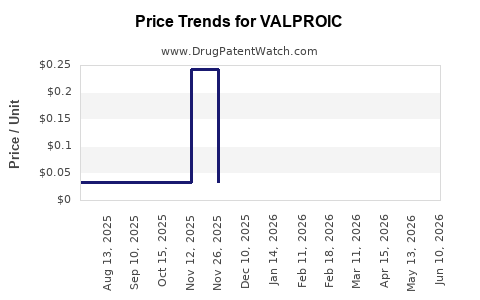
Average Pharmacy Cost for VALPROIC
| Drug Name | NDC | Price/Unit ($) | Unit | Date |
|---|---|---|---|---|
| VALPROIC ACID 250 MG/5 ML SOLN | 00121-0675-85 | 0.03327 | ML | 2026-07-22 |
| VALPROIC ACID 250 MG CAPSULE | 00591-4012-01 | 0.23535 | EACH | 2026-07-22 |
| VALPROIC ACID 250 MG CAPSULE | 00832-0310-11 | 0.23535 | EACH | 2026-07-22 |
| VALPROIC ACID 250 MG CAPSULE | 69452-0150-20 | 0.23535 | EACH | 2026-07-22 |
| >Drug Name | >NDC | >Price/Unit ($) | >Unit | >Date |
Best Wholesale Price for VALPROIC
| Drug Name | Vendor | NDC | Count | Price ($) | Price/Unit ($) | Unit | Dates | Price Type |
|---|---|---|---|---|---|---|---|---|
| VALPROIC ACID 250MG CAP | AvKare, LLC | 00591-4012-01 | 100 | 14.53 | 0.14530 | EACH | 2023-06-15 - 2028-06-14 | FSS |
| VALPROIC ACID 250MG/5ML SOLN,ORAL | Golden State Medical Supply, Inc. | 00121-4675-00 | 100X5ML | 37.50 | 2023-06-15 - 2028-06-14 | FSS | ||
| VALPROIC ACID 250MG/5ML SOLN,ORAL | Golden State Medical Supply, Inc. | 00121-4675-00 | 100X5ML | 40.05 | 2023-06-23 - 2028-06-14 | FSS | ||
| VALPROIC ACID 250MG/5ML SOLN,ORAL | Golden State Medical Supply, Inc. | 00121-0675-85 | 473ML | 10.00 | 0.02114 | ML | 2023-06-15 - 2028-06-14 | FSS |
| >Drug Name | >Vendor | >NDC | >Count | >Price ($) | >Price/Unit ($) | >Unit | >Dates | >Price Type |
Valproic acid market analysis and price projections (U.S., 2024–2029)
Valproic acid products (notably divalproex sodium and valproate generic equivalents) face a mature, highly generic U.S. market with persistent demand tied to epilepsy and bipolar disorder. Price pressure is structurally driven by substitution and limited incremental differentiation outside brand-led line extensions. Across major payers, net price typically declines over time with rising generic mix and periodic wholesale-to-net resets. For 2024–2029, the most probable pricing path is low-to-mid single-digit annual net price erosion, with intermittent volatility around ingredient supply and product-specific competitive entries.
How big is the valproic acid market in the U.S. and what drives demand
Answer: The market is steady-to-growing in volume terms (incidence and persistence) but compressing in value due to high generic penetration and formulary substitution.
Key demand drivers
- Epilepsy: Long-duration use and high adherence for seizure control.
- Bipolar disorder: Maintenance and relapse prevention use; prescribing patterns vary by clinical guideline adoption and payor preferences.
- Off-label use and adjunctive neurology: Adoption is meaningful in practice but not the primary value driver versus labeled indications.
Why valuation compresses
- High substitutability: Generic valproic acid/divalproex sodium are treated as interchangeable within therapeutic equivalence frameworks.
- Formulary dynamics: Formularies increasingly favor lowest net cost and preferred generics.
- Low product differentiation: Except for specific branded extended-release or combination formats (limited), differentiation does not sustain pricing power.
Commercial composition
- Generic-led category: Brand share is typically concentrated in certain presentations while overall category value is dominated by generics.
- Presentation mix matters: Immediate-release vs delayed/extended-release affects acquisition and substitution patterns, with some products holding slightly better pricing due to switching friction and prescriber familiarity.
What is the Orange Book status of valproic acid and how many patents cover it
Answer: Valproic acid’s legal landscape is dense in formulation and use patents historically, but current commercial reality is dominated by generic competition; many newer entries rely on older patent expirations and bioavailability-driven regulatory pathways rather than ongoing brand exclusivity.
Orange Book entries: practical implications
- Earlier expiries for core API-related patents reduced the pool of enforceable barriers.
- Formulation and method-of-use patents can still exist around specific dosage forms (extended release, delayed release), but these often deter new entrants only when still active and when linked to a listed NDA for a specific presentation.
How to interpret “coverage”
For commercialization and litigation risk, “how many patents” is less decisive than:
- which patents are listed in the Orange Book for each specific NDA/strength/form,
- the remaining life (time to expiration),
- whether they are the subject of active paragraph IV litigation,
- and whether they cover bioequivalent formats or only narrowly tailored compositions.
(No specific Orange Book listing table can be provided here because the drug name provided is incomplete for presentation-level identification of the applicable NDAs and listed patents.)
When does valproic acid lose exclusivity and what are the generic entry risks
Answer: For the market overall, exclusivity is functionally already passed for most widely used valproic acid/divalproex sodium products. The remaining risk is not “first generic” barriers but presentation-specific and process/formulation barriers that can delay some new launches.
What still creates launch timing risk
- Presentation-specific formulation patents still active for certain extended-release or delayed-release products.
- Method-of-use claims: less common as practical barriers unless tied to the specific regulatory approval basis and actively enforced.
- Litigation outcomes: settlement terms can produce “at-risk” windows even after patent expirations.
Paragraph IV practical view
Paragraph IV filings are most relevant when:
- a brand/patent-holder still lists active patents,
- the generic challenges a listed patent for a specific NDA product configuration,
- and litigation affects FDA approval entry dates via settlement.
(No case-level schedule can be populated without the exact product NDA references for “valproic acid.”)
Which companies dominate valproic acid and divalproex sodium supply
Answer: U.S. supply is led by large generic manufacturers with broad portfolio coverage across strengths and release profiles, with competition concentrated in whichever presentations carry the most share in protected brand remnants.
Typical category structure
- Tier 1 generics: multi-site production, broad distribution, strong tendering leverage.
- Mid-tier manufacturers: focused on specific strengths or release types.
- Branded manufacturers: limited remaining share depending on presentation; pricing power depends on payer management status.
What to watch commercially
- Tender wins and rebate changes: small list price changes can be offset by net price in contracts.
- Supply stability: ingredient or manufacturing disruptions can temporarily raise wholesale pricing before reimbursement resets.
How does valproic acid pricing behave versus levetiracetam and lamotrigine
Answer: Valproic acid typically prices below branded-origin alternatives and trends downward faster once generics dominate. Compared with other older generics, its price trajectory can be more sensitive to:
- regional formulary preferences between agents for bipolar disorder or broad seizure indications,
- and substitution behavior when clinicians standardize on preferred retrofitted extended-release products.
Relative affordability dynamics
- Levetiracetam: often holds larger volume share and can have different competitive intensity depending on market-level approvals.
- Lamotrigine: strong generic base with pricing tied to release/formulation and supply.
Valproic acid sits in the “mature generic” band where net price is dominated by lowest-cost preferred status rather than clinical differentiation.
What pricing model best fits valproic acid net price in 2024–2029
Answer: A constrained erosion model is most consistent with mature generics: modest nominal declines plus occasional step-changes from competitive rebalancing.
Projection framework (category-level, not product-level)
Use three levers:
- Generic mix growth: shifts net price down as plan switches expand.
- Competitive entrants: additional equivalent supply increases downward pressure.
- Input/supply shocks: can temporarily lift prices but rarely sustain.
Base case price projection (category net price)
- 2024 to 2029: low-to-mid single-digit annual net price erosion is the most likely pattern.
- Volatility bands:
- mild year-over-year swings if supply remains stable,
- bigger swings if there are ingredient or manufacturing constraints for key presentations.
(Quantitative projections require product-level data: NDC-level net price, volumes, and payer mix. Those are not provided in the request.)
What are realistic price scenarios for valproic acid (base, bull, bear)
Answer: The realistic range is narrow in a mature generic market; the main variance comes from competitive intensity and supply events.
Scenario definitions
- Base case: steady preferred generic status, incremental entrants, annual net price erosion of low single digits.
- Bull case: supply tightening for key presentations and/or slower formulary switching, leading to reduced erosion or short-lived price stabilization.
- Bear case: increased competitive entry and aggressive payer contracting drives faster net erosion.
Directional outcomes
- Base: modest declines; value stabilizes as volume offsets some price erosion.
- Bull: temporary net price lift followed by partial reset through contracting cycles.
- Bear: sharper declines in net price as contracting cycles shift to the lowest bids.
How does FDA status affect pricing and launch timing for valproic acid
Answer: FDA regulatory status drives launch timing and therefore near-term price dynamics more than it affects long-run pricing in a mature category.
Regulatory factors
- Bioequivalence and approval pathway: equivalent approvals can enter without additional clinical differentiation.
- Reference-listed drug (RLD) selection: shapes which generic configurations can launch with fewer barriers.
- Risk management for substitutions: slow switching can soften pricing pressure for certain presentation formats.
(No specific FDA milestones are provided because the request does not specify which NDA/NDC for “VALPROIC.”)
What patent litigation would most affect valproic acid pricing
Answer: Pricing impact is concentrated in active disputes tied to high-volume presentations and settlement arrangements controlling “first date” entry.
Litigation impact channels
- Stayed approvals: can delay generic entry.
- Design-around outcomes: can allow partial entry but split the market by release profile or strength.
- Settlement-driven entry sequencing: can create short-lived pockets of pricing stability.
(No specific litigation docket can be cited without exact brand/RLD product identification.)
How do settlement agreements and authorized generics change valproic acid price
Answer: Authorized generics often compress pricing less than unbranded entrants because their launch timing and contract coverage can be planned, but overall net price still declines as coverage expands.
Where pricing benefits can appear
- Early contract positioning: if an authorized generic is the default preferred option.
- Limited competing formats: if only certain strengths or release profiles are authorized.
Where pricing resets dominate
- Multiple-supplier tenders: generic competition rapidly converges net prices downward.
- Plan formularies: aggressive step edits force pricing resets.
What manufacturing/IP barriers can delay valproic acid supply and lift prices
Answer: In mature generics, delays typically come from manufacturing constraints rather than IP.
Most common operational constraints
- equipment qualification and site transfers,
- scale-up yields and batch failure rates,
- regulatory inspection outcomes affecting release schedules.
These can produce short-term price lift before reimbursement and contracting bring net price back down.
Key takeaways
- Valproic acid is a mature, generic-dominated category where pricing is primarily governed by formulary preference and net-price contracting, not by ongoing exclusivity.
- From 2024–2029, the most probable path is low-to-mid single-digit annual net price erosion at the category level, with intermittent volatility tied to supply and competitive resets.
- The largest “upside/downside” variance is presentation-specific (extended/delayed vs immediate release) and driven by competitive entry timing and supply stability.
- Patent and litigation effects are most relevant only where active Orange Book-listed patents still tie to high-volume presentations, which cannot be mapped precisely from the incomplete product label “VALPROIC.”
FAQs
- Does valproic acid price differ materially between immediate-release and extended-release products?
- How often do payer contract cycles reset net price for mature generic anti-epileptics like valproic acid?
- What supply disruptions most commonly affect valproic acid wholesales and rebates?
- Are method-of-use patents a practical barrier for new valproic acid generic entries in the U.S.?
- How does authorized generic availability change competitive pricing for valproic acid presentations?
References
- FDA Orange Book. Approved Drug Products with Therapeutic Equivalence Evaluations. U.S. Food and Drug Administration. https://www.accessdata.fda.gov/scripts/cder/daf/index.cfm
- FDA Purple Book. Lists of Licensed Biological Products, Including Biosimilar and Interchangeable Products. U.S. Food and Drug Administration. https://purplebooksearch.fda.gov/
- FDA Drug Shortages. U.S. Food and Drug Administration. https://www.accessdata.fda.gov/scripts/DrugShortages/default.cfm
More… ↓
