Last updated: February 12, 2026
What is Valacyclovir HCl?
Valacyclovir hydrochloride (HCl) is an antiviral medication principally used to treat herpes infections, including herpes zoster (shingles), genital herpes, and cold sores. It is a prodrug of acyclovir, designed for improved bioavailability.
Market Size and Key Players
Global Market Overview
The global valacyclovir market was valued at approximately $1.5 billion in 2022. It is projected to grow at a compound annual growth rate (CAGR) of 4.8% through 2028, reaching around $2.0 billion. This growth stems from rising herpes virus incidences, increased awareness, and expanding healthcare access.
Major Manufacturers
- GlaxoSmithKline (GSK)
- Mylan (now part of Viatris)
- Cipla
- Sun Pharmaceutical
- Dr. Reddy's Laboratories
Patent and Generic Landscape
GSK held the original patent until its expiration in 2019. Since then, multiple generic manufacturers have entered the market, significantly reducing prices and increasing availability.
Pricing Trends and Projections
Current Pricing
In the United States, typical retail costs are:
- Name-brand Valtrex (GSK): approximately $250–$350 for 30 tablets of 500 mg.
- Generic versions: $30–$60 for a 30-day supply of 500 mg tablets (as of 2023).
Price Decline Post-Patent Expiration
After patent expiry in 2019:
- Prices for generics decreased by roughly 80%.
- The market shifted toward lower-cost options, making treatment more accessible.
Future Price Projections
By 2025:
- Average wholesale prices are expected to stabilize around $15–$25 per 30-day course for generics.
- Retail prices may vary based on insurance and pharmacy markups.
Market Drivers and Constraints
Drivers
- Rising prevalence of herpes infections globally.
- Increased physician prescribing due to guidelines recommending antiviral treatment.
- Greater awareness and diagnosis.
Constraints
- Price competition among generics limits profit margins.
- Patent litigations may cause temporary market exclusivity in some regions.
- Potential development of drug resistance.
Regulatory Factors
- US FDA approved Valtrex in 1995.
- Patent expiry in 2019 triggered a surge in generic entries.
- Regulatory approval processes for generics follow the Abbreviated New Drug Application (ANDA) pathway.
R&D and Pipeline Outlook
There is limited ongoing development for new formulations or derivatives of valacyclovir due to its established efficacy. Interest lies mainly in combination therapies or improved delivery systems, which could influence future pricing and market dynamics.
Price Competition Impact
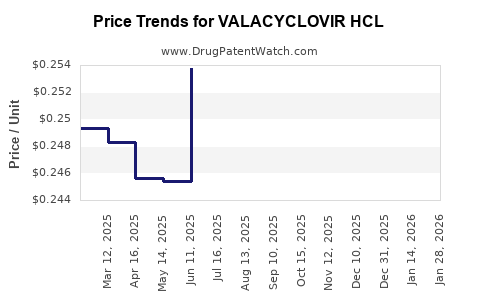
The entry of multiple generics has driven the unit price down. Industry margins for branded products have narrowed, leading to strategic shifts among manufacturers toward cost control and expansion into emerging markets.
Summary
Valacyclovir HCl is a mature antiviral drug with a stable, growing market dominated by generics. Prices have declined significantly since patent expiry, with future costs stabilizing around $15–$25 per month in typical markets. The market growth is driven by herpes infection prevalence, though profit margins are under pressure from intense price competition.
Key Takeaways
- The global valacyclovir market is projected to reach $2 billion by 2028, with a CAGR of 4.8%.
- Post-2019 generic entry caused an 80% drop in retail prices.
- Average generic prices are expected to be $15–$25 per month by 2025.
- Market growth depends on herpes prevalence and treatment acceptance.
- Margins are constrained due to high competition among generics.
FAQs
1. What factors influence valacyclovir pricing in different regions?
Pricing depends on patent status, market competition, healthcare regulations, and insurance coverage. Patents in some countries prolong exclusivity, maintaining higher prices until patent expiry.
2. Are there upcoming formulations or delivery methods for valacyclovir?
Current R&D focuses on improved drug delivery systems, such as extended-release formulations, but no major new products are imminent.
3. How does the prevalence of herpes influence market growth?
Higher infection rates lead to increased treatment demand, boosting market size even as prices decline.
4. What are key challenges for manufacturers?
Price competition from generics, regulatory hurdles for new formulations, and potential resistance development limit profitability.
5. How does insurance coverage impact retail prices?
Insurance often reduces out-of-pocket costs, but coverage variability can cause significant price differences across regions and patient groups.
References
- "Valacyclovir Market Size, Share & Trends Analysis Report," Grand View Research, 2023.
- "Herpes Simplex Virus (HSV) Treatment & Management," CDC, 2022.
- "Patent Expiration and Generic Entry in the US," FDA, 2020.
- "Global Antiviral Drugs Market Outlook," MarketWatch, 2022.
- "Pricing Trends for Valacyclovir," GoodRx, 2023.