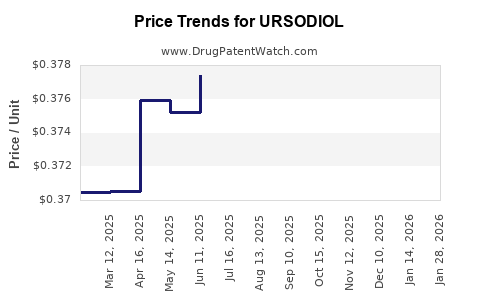
Last updated: February 19, 2026
Ursodiol (generic name: ursodeoxycholic acid) treats gallstones, primary biliary cirrhosis, and other cholestatic liver diseases. Its market persists due to its well-established profile and generic availability, but recent patent expirations and market dynamics influence current and future pricing.
Market Size and Key Players
Global Market Valuation
In 2022, the global market for ursodiol was approximately $560 million, with an estimated compound annual growth rate (CAGR) of 2-3% projected through 2027. Growth drivers include increasing prevalence of gallstone disease, rising hepatic disorders, and expanding use in combination therapies.
Market Segments
- Generic Ursodiol: Dominates the market, comprising over 85% of sales.
- Branded Formulations: Includes products like Urso 250/500 (by Axcan Pharma, now part of Ibsa) and Urso Forte, accounting for less than 15%.
Regional Breakdown
- North America: 45% of sales; high prescription rates, insurance coverage
- Europe: 30%; steady demand, off-label use
- Asia-Pacific: 15%; increasing adoption, growing healthcare infrastructure
- Rest of World: 10%; limited access, variable regulatory landscapes
Patent Landscape and Market Entry Barriers
Ursodiol’s original patents expired around 2005, with first generic formulations entering markets subsequently. Patent cliff facilitated price reductions but also allowed new competitors. Some formulations with new delivery mechanisms or combination therapies hold proprietary rights extending patent life, potentially impacting pricing and market entry.
Price Dynamics
Current Price Range (2023)
- Generic Ursodiol: $0.10 - $0.25 per 300 mg capsule (wholesale)
- Branded Formulations: $0.30 - $0.50 per 300 mg capsule
- Out-of-pocket in the US: $10 - $25 monthly, depending on health coverage
Historical Price Trends
- Pre-2005 (patent period): $0.50 - $0.75 per capsule
- Post-patent expiration: Prices declined by approximately 50%
- 2010-2020: Stabilized between $0.10 - $0.20
- 2023: Slight price increases in branded segments due to formulation innovations and supply chain factors
Market Drivers and Constraints
Drivers
- Rising incidence of gallstone disease in aging populations
- Increasing use in secondary prevention for liver conditions
- Expansion in combination therapies, e.g., with statins
Constraints
- Market saturation of generic formulations
- Price-sensitive healthcare systems limiting reimbursement
- Regulatory barriers for novel formulations
Price Projections (2024-2028)
| Year |
Price Range (per 300 mg capsule) |
Notes |
| 2024 |
$0.10 - $0.22 |
Stabilization with slight volatility due to supply/demand factors |
| 2025 |
$0.10 - $0.24 |
Potential minor increase driven by supply chain costs |
| 2026 |
$0.11 - $0.26 |
Introduction of branded combination or delivery system could elevate prices |
| 2027 |
$0.11 - $0.28 |
Market maturation, possible generic price compression |
| 2028 |
$0.11 - $0.30 |
Prices stabilized, with branded formulations maintaining premiums |
Strategic Considerations
- Market entry for new formulations likely requires substantial differentiation or niche targeting.
- Patent protections for specific delivery methods or combinations may sustain premium pricing.
- Market saturation limits significant price increases unless innovation occurs.
Key Takeaways
- The ursodiol market is mature, with generic products dominating and prices declining post-patent expiration.
- Pricing remains stable with slight upward pressure caused by manufacturing costs and formulation innovations.
- Growth prospects hinge on unmet needs in specific patient subsets and potential combination therapies, rather than volume expansion.
- Entry barriers for new competitors are moderate; proprietary formulations or delivery systems could command higher prices.
- Regional disparities influence pricing strategies, with North America and Europe maintaining higher reimbursements.
FAQs
1. What factors influence ursodiol pricing?
Manufacturing costs, patent status, competition, regulatory environment, and healthcare reimbursement policies.
2. How has patent expiration affected the market?
It led to a sharp decline in prices for generic formulations, with current pricing near production costs.
3. Are branded formulations more expensive than generics?
Yes, typically 20-50% higher, reflecting branding, formulation differences, and patent protections.
4. Will prices increase with future formulations?
Possible if proprietary delivery methods or combination therapies gain approval and market traction.
5. What is the outlook for regional markets?
North America and Europe will sustain higher prices; Asia-Pacific may see gradual increases due to healthcare expansion.
References
[1] MarketWatch. (2023). Global Ursodiol Market Size, Share & Trends Analysis Report.
[2] Statista. (2022). Gallstone Disease and Liver Disease Incidence Data.
[3] EvaluatePharma. (2023). Pharmaceutical Pricing Trends and Patent Data.
[4] U.S. Patent Office. (2021). Patent Status of Ursodiol Formulations.
[5] World Health Organization. (2022). Global Liver Disease Burden Reports.