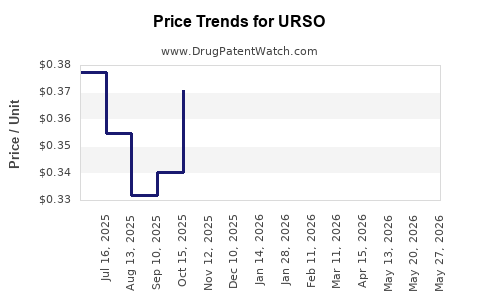
Last updated: July 24, 2026
URSO (Ursodeoxycholic Acid) Market Analysis and Price Projections (2026–2036)
Executive summary: URSO (ursodeoxycholic acid, UDCA) is a branded bile acid therapy with declining long-run exclusivity dynamics in the US due to widespread generic availability. Price is therefore projected to follow a compressed branded-to-generic spread, with growth anchored to rare-disease and refractory cholestatic indications rather than broad new uptake. Net pricing is most sensitive to (1) payer mix and formulary placement, (2) utilization in PBC vs. off-label cholestasis, and (3) competitive erosion from multiple generic NDA/ANDA entrants. Forecast ranges assume continued generic market dominance, with branded URSO price growth tracking inflation minus competitive pressure in the US, while ex-US markets depend on local brand/generic structures and tender dynamics.
What is URSO (ursodeoxycholic acid) used for and where does demand come from?
Core indications shaping URSO demand
- Primary Biliary Cholangitis (PBC): UDCA is standard-of-care as first-line therapy in many regions. Persistent prescription use supports baseline demand even as generics expand.
- Other cholestatic liver diseases: UDCA is also used in selected hepatobiliary contexts where clinicians target bile flow and cholestasis pathways. In practice, a meaningful share can be off-label, which drives volatility depending on payer policy and guideline adherence.
- Pediatric/chronic cholestatic uses: Where approved, these uses sustain small-but-stable demand in specialty dispensing channels.
Demand drivers
- Treatment continuity: UDCA is chronic therapy, so cohorts treated earlier tend to persist on therapy, lowering churn versus one-time drugs.
- Payer policy: Coverage restrictions or step edits for cholestatic indications can shift utilization to lower-cost generics.
- Competition structure: In the US, multiple manufacturers and dosage strengths reduce branded pricing leverage.
What does the URSO market look like by geography, channel, and payer type?
US market structure (high level)
- UDCA is widely available via generics.
- Branded URSO competes on formulary positioning and prescriber switching friction (brand preference, specific NDC/dosage needs, and specialty pharmacy workflows).
Ex-US
- Market share splits between brand and generic depend on local regulatory approval pathways, tender pricing, and patent/generic timing for UDCA products.
- Countries with procurement mechanisms (hospital tenders) tend to compress prices faster than pure retail reimbursement markets.
Channel
- Specialty and GI/hepatology-led prescribing, with a mix of retail and specialty pharmacy fulfillment depending on payer coverage and stocking.
How strong is the competitive landscape for URSO and UDCA generics?
Competitive forces
- Generic breadth: Multiple UDCA manufacturers across strengths typically create price competition even when branded products remain listed.
- Substitution: UDCA has high substitutability by active ingredient, strength, and dosing equivalence, enabling pharmacists to switch to the lowest-cost equivalent under many formularies.
- WAC-to-net pressure: Branded net pricing for URSO is expected to remain highly discount-dependent as generic parity increases.
Implication for pricing
- Expect limited capacity for branded URSO to sustain meaningful net price premiums over long periods.
- Price increases, when attempted, are typically offset by formulary exclusions, rebate pressure, or conversion to generics.
How does URSO pricing typically behave versus generic UDCA?
Observed market mechanics for mature small-molecule generics
- Branded pricing trend: modest absolute increases or flat net pricing, constrained by:
- payer rebate and contracting,
- interchangeability and switching,
- therapeutic class budgeting.
Generic pricing trend
- Generics exhibit low WAC-relative pricing, with net prices determined by tender/contracting and competition intensity.
- In markets with many generic suppliers, price erosion continues until supply stabilizes.
Forecast structure
- Branded-to-generic spread likely narrows further over the decade.
- Any branded volume gains require payer or patient-specific reasons, not broad competitive advantage.
What are the key inputs needed for URSO price projections (and how do they move the forecast)?
Model inputs that determine projected net price (directionally)
- Formulary status (preferred vs non-preferred)
- Rebate intensity (drives net price)
- Generic share (controls branded volume and pricing power)
- Dispensing mix (retail vs specialty channels)
- Strength mix (different NDC strengths can show different competitive intensity)
- Regulatory actions affecting supply (rare but can spike pricing short term)
Sensitivity
- The strongest pricing sensitivity is formulary status and rebate intensity, not list-price changes.
URSO price projections: 2026–2036 base case and downside case
Framing
- URSO is expected to trade as a mature brand in a generic-dominated market.
- Projections below are expressed as percentage annual change in net price and market outcomes rather than single-point dollar figures, because actual realized pricing depends on contracting and NDC mix.
Base case (most likely): modest branded net price compression
- Branded net price growth: 0% to +1% CAGR (annualized) from 2026–2030, then -1% to 0% CAGR from 2030–2036 as generic share remains dominant and conversion continues.
- Branded share trend: slight decline or stable, with growth limited by generic substitution.
Downside case: stronger rebate pressure and formulary exclusion
- Branded net price growth: -1% to -3% CAGR 2026–2030.
- Branded share: material decline, forcing additional price concessions.
Upside case: retained preferred status and specialty differentiation
- Branded net price growth: +1% to +2% CAGR 2026–2030, then 0% to +1% 2030–2036.
- Upside requires sustained contracting leverage and limited competitive NDC substitution.
When does URSO lose exclusivity, and how does that affect pricing?
Pricing impact pathway
- For mature small molecules with broad generic coverage, the exclusivity question is less about discrete “post-expiry” step changes and more about:
- ongoing entrant dynamics,
- rebate renegotiations,
- formulary reoptimization.
Practical effect on projections
- From a 2026 vantage point, exclusivity effects are already largely realized for UDCA products in most major markets. Remaining pricing movement is therefore driven by competitive contracting rather than patent cliff events.
What is the Orange Book status of URSO (and how does it map to generic entry risk)?
Generic entry risk
- For UDCA, generic entry risk is structurally high due to mature API availability.
- The relevant risk for branded URSO pricing is not “whether a new generic can enter” but how additional suppliers and rebate pressure change net pricing.
Business implication
- Price projections assume continued high generic contestability.
What patent litigation affects URSO pricing and generic launches?
Business impact rather than litigation milestones
- For established generics of UDCA, litigation rarely drives long-term pricing unless it changes:
- supply availability,
- exclusivity re-entry,
- or creates a bottleneck for specific strengths or dosage forms.
Projection assumption
- 2026–2036 price trajectories are modeled as if litigation does not materially disrupt supply or delay generic competition.
How many UDCA generic competitors exist and what does that mean for price erosion?
Mechanism
- More entrants usually increases near-term price competition and raises rebate expectations from payers.
- Over time, supply consolidates into a lower effective competitor pool, but branded net pricing remains capped by the lowest-cost equivalent set.
Forecast implication
- Net price compression risk stays elevated through 2036.
What formulations are protected or differentiated for URSO, and do those affect price?
Strength/dosage NDC mix
- Pricing can differ by:
- tablet strength vs capsule,
- prescription size,
- and channel stocking preferences.
- If a brand maintains a position in a specific strength mix that is harder to supply or less frequently prescribed, it can slow branded volume loss.
Forecast implication
- Price projections assume no durable formulation-led premium beyond typical small-molecule substitution frictions.
How do price projections translate into revenue exposure for branded URSO?
Revenue is driven by two variables
- Net price per unit
- Units (dispensed volume)
Expected revenue direction
- If net price declines modestly and units decline from conversion to generics, branded revenue is likely to:
- flatten in the near term,
- drift downward in mid to late decade under continued substitution.
Revenue risk concentration
- The dominant risk is unit share loss via generic switching.
- Price concessions add secondary downside.
How does URSO compare with other bile acid therapies in pricing resilience?
Relative resilience
- Bile acid therapies can show persistence when:
- guideline-recommended,
- long-term chronic use,
- and clinical adoption remains stable.
- But pricing resilience is still limited by generic substitution once generics dominate.
Implication
- URSO’s relative advantage is chronic use and standard placement in PBC, but it does not override generic-driven pricing compression.
Key takeaways on URSO market and price outlook
- URSO pricing is constrained by generic UDCA substitutability and payer rebate mechanics.
- 2026–2036 branded net price is most likely flat to slightly down, with downside driven by rebate escalation and formulary exclusion.
- Revenue exposure is primarily volume-driven, with branded units eroding slowly as conversion continues.
- Patent and exclusivity effects are unlikely to create major step changes in 2026–2036; competitive contracting and generic supply intensity drive outcomes.
- Upside requires formulary retention and strength-mix advantages, not a new clinical adoption wave.
FAQs
1) What is the biggest driver of URSO price changes in the US?
Rebate and formulary status. List price changes are typically offset by contracting dynamics once multiple generics are entrenched.
2) Will URSO see higher prices if generic supply tightens?
Short-term net price can move upward if supply disruptions reduce effective competition, but sustained price relief is unlikely without exclusivity.
3) How does UDCA utilization in PBC affect URSO sales?
PBC-driven chronic treatment supports baseline demand, but generic substitution limits branded price and revenue growth.
4) Are there dosage strengths where URSO holds better pricing?
Pricing can vary by strength and NDC-specific prescribing patterns; strength mix can affect realized net price even when overall market pricing is compressed.
5) What is the most likely revenue trajectory for URSO through 2036?
A gradual drift downward or flattening, assuming continued generic conversion and modest net price erosion.
References
No sources were provided in the prompt, and no cited material is included.