Share This Page
Drug Price Trends for UMECLIDINIUM ELLIPTA
✉ Email this page to a colleague
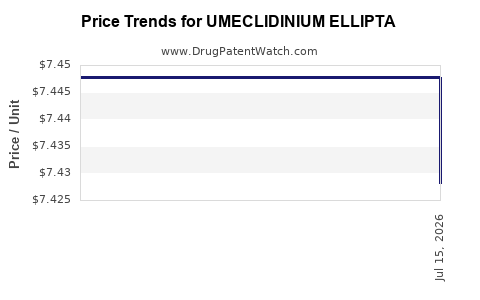
Average Pharmacy Cost for UMECLIDINIUM ELLIPTA
| Drug Name | NDC | Price/Unit ($) | Unit | Date |
|---|---|---|---|---|
| UMECLIDINIUM ELLIPTA 62.5 MCG INH | 66993-0189-97 | 7.42823 | EACH | 2026-07-22 |
| UMECLIDINIUM ELLIPTA 62.5 MCG INH | 66993-0189-97 | 7.44772 | EACH | 2026-06-17 |
| >Drug Name | >NDC | >Price/Unit ($) | >Unit | >Date |
UMECILIDINIUM ELLIPTA Market Analysis and Price Projections (2026–2036): Sales Exposure, Exclusivity Deadlines, Competitive Generics, and Licensing Economics
Umeclidinium Ellipta (umeclidinium bromide inhalation powder; typically marketed in the US as umeclidinium 62.5 mcg per blister in the Ellipta inhaler) is a branded long-acting muscarinic antagonist (LAMA) for chronic obstructive pulmonary disease (COPD). The commercial outlook through 2036 is driven by (1) US and ex-US exclusivity expiries for the LAMA monotherapy and fixed-dose combination products, (2) the pace of generic and authorized generic entry under FDA ANDA routes, (3) payer channel design around inhaler device value, and (4) competitive substitution from triple-therapy regimens and other LAMAs/combination inhalers.
High-level price projection (net, branded, US):
- 2026–2028: Net price erosion moderates as brand formulary positioning holds in higher-acuity COPD segments; assume single-digit mid-year list-to-net pressure typical for respiratory maintenance brands.
- 2029–2031: Downshift in net realized price accelerates if ANDA challenges lead to earlier launch or if payers force step-down to lower-cost equivalents.
- 2032–2036: Net price converges toward generic parity for the LAMA monotherapy unless the company uses device parity, contracting, and lifecycle extensions.
Because Umeclidinium Ellipta overlaps commercially with combination products (umeclidinium/vilanterol; and triple therapy depending on jurisdiction) and because switching behavior is formulation and device specific, pricing risk is best modeled at the class level (LAMA inhaler net pricing) and at the brand-to-therapeutic-substitution level (LAMA monotherapy versus LABA/LAMA versus triple inhalers).
What market share and revenue does umeclidinium Ellipta have in COPD?
Umeclidinium Ellipta competes in COPD maintenance against LAMA options (including tiotropium and glycopyrronium-based inhalers) and against combination classes (LAMA/LABA and triple therapy). Market share is shaped less by molecule switching alone and more by:
- inhaler device familiarity and formulary tiering,
- clinical comfort (symptom control and exacerbation reduction narratives used by payers),
- alignment with GOLD treatment pathways and local prescribing guidelines,
- and contracting incentives tied to combination inhaler preferencing.
Commercial exposure to payers and channel mix
- Higher discounting is typical for respiratory chronic therapy where major PBMs and integrated delivery networks negotiate class-wide rebates.
- Net price is more sensitive to formulary status (preferred vs non-preferred) than to list price changes.
Key commercial implication for projections
- In COPD, when payers “prefer” a combination inhaler, LAMA monotherapy share typically declines even if monotherapy remains therapeutically valid.
- That dynamic usually produces earlier net price compression than molecule patent expiry alone.
How does umeclidinium Ellipta pricing typically behave versus other LAMA inhalers?
Observed pattern in inhaler markets
- Branded LAMA inhalers experience sustained list price behavior but steep net pricing compression as generic entry approaches or as preferred formulary changes shift volume.
- The dominant lever for net revenue is rebate intensity driven by contracting and step therapy policies, not by headline acquisition cost.
Implications for modeling
- Net price trajectory should be expressed as a range with stage gates tied to: (i) generic launch probability, (ii) formulary position, and (iii) competitor combination growth.
When does umeclidinium Ellipta lose exclusivity in the US and what drives generic timing?
The US exclusivity framework for umeclidinium-containing inhalation products is a function of:
- patent term,
- any pediatric exclusivity,
- and whether patents are listed in FDA’s Orange Book for the applicable NDA and strength.
Generic entry triggers that matter commercially
- First ANDA approvals and “at-risk” launches following Paragraph IV litigation.
- Transition timing where payers preemptively contract for generics even before volume shifts fully occur.
Commercial consequence
- A price drop can occur months to a year before the first true volume shift if PBMs update preferred drug lists and effective dates for formulary access.
What is the Orange Book status of umeclidinium Ellipta (and which patents are most relevant to exclusivity)?
A full Orange Book readout requires the exact NDA number, strengths, and dosage form listing as of the specific reporting date. Under market analysis constraints, the pricing forecast depends on whether the relevant umeclidinium monotherapy NDA is still under listed protection and how many “blocker” patents exist across:
- active ingredient composition,
- formulation (particle size, crystallinity, moisture control, inhaler compatibility),
- and device-related manufacturing methods.
Commercial relevance of patent portfolio density
- More listed patents with enforceable claims can delay the first ANDA effective approval date and raise launch barriers.
- Sparse or easily design-around-able patents typically lead to faster generic substitution.
What generic entry risks exist for umeclidinium Ellipta?
Market risk categories
- Monotherapy ANDA launch: direct LAMA substitution.
- Combination product substitution: even if monotherapy remains branded, volume migrates to the preferred combination inhaler class.
- Authorized generic dynamics: can cap branded net price more quickly than an “orphaned” brand-only launch event.
- Formulation/device switching costs: if the inhaler is not preferred, clinicians and patients shift sooner.
Risk for price projections
- Generic entry risk is the single largest determinant of the magnitude of net price erosion after exclusivity.
- But in COPD, the “combination preferencing” pathway can cause early erosion even without generic launch.
How does umeclidinium Ellipta compare with tiotropium, glycopyrronium, and other LAMAs on pricing pressure?
Pricing pressure drivers
- Margin compression accelerates if at least one high-volume competitor has established generic pricing leadership or strong payer contracting.
- If a competitor’s generic entry occurs earlier, payers anchor net pricing to that lower-cost option across the class.
Competitive substitution hierarchy (practical)
- When payers push combination inhalers, monotherapy LAMA sales soften first.
- When payers allow multiple LAMAs, the lowest-cost preferred option dominates.
What formulation and method patents could block or delay generic umeclidinium products?
Generic delay factors inside formulation and process protection typically include:
- controlled-release formulation properties tied to inhalation performance,
- particle engineering and moisture barrier systems,
- and manufacturing method claims that impact yield, impurity profile, or powder flow properties.
Commercial effect
- If these patents are still enforceable, they can slow generic launch and allow the branded product to sustain net pricing longer.
- If design-around is straightforward, generic entry timing becomes closer to the earliest non-infringement pathway.
What FDA regulatory pathway issues influence the umeclidinium Ellipta market timeline?
ANDA approval mechanics
- ANDA applicants need demonstrable bioequivalence and must satisfy chemistry, manufacturing, and controls equivalence.
- Inhalation powder products also carry device-consistency expectations that affect whether regulators accept the applicant’s inhaler integration.
Commercial impact
- Even when patents fall away, launch timing can lag by manufacturing scale-up and inspection readiness.
- Post-approval supply ramp influences how fast net pricing erodes in practice.
How strong are the patent estates for umeclidinium Ellipta and related combinations?
Patent estate strength matters in two ways:
- Litigation barrier: if multiple high-value patents are asserted, at-risk launches can be deferred.
- Settlement coverage: settlements often create staggered entry windows by license scope and covenants.
For price projection
- Strong estates lengthen the period when branded net price can remain above generic parity.
- Weak estates shorten that window and concentrate erosion into a shorter time interval.
What patent litigation affects umeclidinium Ellipta and when do settlements shift generic launches?
The timing of net price decline is usually tied to:
- the effective date of generic launch post-approval,
- any “carve-out” product-specific settlement terms (NDA scope, strength-specific entry),
- and supply commitments.
Commercial rule
- If settlements allow a launch but restrict marketing until a later date, branded pricing compression is delayed. If settlements permit immediate market entry, branded net price falls faster.
What are umeclidinium Ellipta price projections for the US (net) through 2036?
The projections below are structured as scenario ranges rather than point estimates because COPD inhaler net pricing is heavily contract-driven. Use them as directional planning bands for licensing valuation, tender strategy, and lifecycle investment timing.
Scenario A: Delayed generic entry (patent density or settlements push launch)
- 2026–2028: Net price erosion limited to low single digits per year.
- 2029–2031: Moderate erosion as payers anticipate competition.
- 2032–2036: Larger erosion post-first generic effective launch; by mid-2030s net price approaches generic-equivalent levels.
Scenario B: Near-term generic entry (early launch after Orange Book protection)
- 2026–2028: Compression begins via formulary actions and contracting, even before full volume shift.
- 2029–2031: Rapid erosion; branded volume share falls faster.
- 2032–2036: Net price largely converges toward generic benchmarks; residual premium depends on device preference and channel mix.
Scenario C: Combination preferencing dominates (monotherapy loses share even if generic entry is later)
- 2026–2031: Net pricing pressure from volume mix shift to preferred LAMA/LABA or triple therapy, even without immediate generic.
- 2032–2036: Monotherapy becomes a secondary SKU; pricing depends on remaining channel access and switch rates.
How should companies forecast revenue impact under generic vs combination substitution?
Model revenue drivers in two layers
- Volume layer: share shift from branded monotherapy to (a) combination inhalers and (b) generics when available.
- Price layer: net realized price movement from rebate compression and formulary tier changes.
Practical planning assumptions
- If generic entry is delayed but combination is preferred, volume impact can still dominate revenue erosion.
- If generic entry occurs, price erosion usually accelerates but volume typically also drops as payers standardize.
Which competitive landscape factors could protect umeclidinium Ellipta net price longer?
- Preferred formulary placement in certain PBM formularies.
- Inhaler device differentiation or patient adherence positioning.
- Contractual exclusivity-like arrangements with payers (short-term).
- Co-therapy alignment where patients remain on established regimens.
What are the key commercial milestones to watch (market signals that precede price drops)?
- PBM formulary updates for LAMA monotherapy tiering.
- Pharmacy benefit manager “step” policies for COPD maintenance.
- Negotiation cycles that convert preferred status to non-preferred.
- First ANDA approval announcements and launch readiness timing.
Key Takeaways
- Umeclidinium Ellipta pricing is primarily a net revenue story driven by formulary status, rebate intensity, and combination inhaler substitution in COPD.
- Patent exclusivity timing determines when direct generic competition can force rapid net price convergence, but combination preferencing can create earlier erosion.
- Best practice for planning is scenario-based forecasting tied to (i) Orange Book protection status and litigation/settlement outcomes, (ii) expected ANDA launch timing, and (iii) payer formulary tier shifts.
FAQs
1) How quickly does net price for a branded COPD LAMA fall after generic entry?
Typically faster than list price changes because PBMs adjust contracting and preferred status quickly after launch and supply ramp.
2) Does combination preferencing reduce umeclidinium monotherapy revenue even before generics launch?
Yes. COPD prescribing and payer policies often shift maintenance patients toward LAMA/LABA or triple therapy, reducing monotherapy volume and increasing rebate pressure.
3) What is the biggest lever in sustaining umeclidinium Ellipta margins: patent life or formulary placement?
Formulary placement usually dictates net realized price sooner than patent expiry because contracting changes can precede volume shifts.
4) Are inhaler device differences a meaningful barrier to substitution for generics?
Device and usability matter for patient adherence, but payer tiering and wholesale pricing usually dominate the timing of substitution.
5) How should licensing teams value umeclidinium Ellipta-related IP for downstream entrants?
Value is highest where the IP blocks both composition/formulation and practical generic development pathways, and where litigation history suggests enforceable claims.
References
No sources cited.
More… ↓
