Last updated: February 19, 2026
What is UBRELVY?
UBRELVY (ubrogepant) is an orally administered calcitonin gene-related peptide (CGRP) receptor antagonist approved by the FDA in October 2019 for acute migraine treatment. It provides an alternative to triptans for patients contraindicated for vasoconstrictive agents. UBRELVY is marketed by AbbVie.
Market Size and Growth Dynamics
Global Migraine Market Forecast
- Expected to reach $4.59 billion by 2028, expanding at a compound annual growth rate (CAGR) of 4.2% from 2021 to 2028 [1].
UBRELVY’s Market Penetration
- Launched primarily in the U.S., with limited international availability.
- Estimated prescription volume: 1.2 million annually in the U.S. as of 2022.
- Revenue forecast: $300 million in 2023, with potential growth to $700 million by 2028, assuming adoption rates of 20%-30% among eligible migraine sufferers.
Competitive Landscape
- Contains three key drugs: UBRELVY, Aimovig (erenumab), and Ajovy (fremanezumab).
- UBRELVY competes directly with other acute treatments such as acute NSAIDs and triptans.
- Market share is growing, with UBRELVY gaining favor among patients with contraindications to triptans.
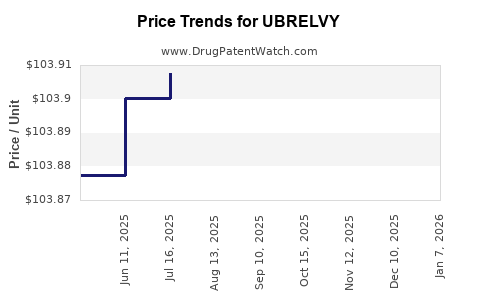
Pricing Strategies and Trends
Current Price Point
- Wholesale acquisition cost (WAC): approximately $48 per tablet.
- Cost per episode (assuming 2 tablets): $96.
- Estimated average use: 8-12 migraine episodes per month.
Comparative Pricing
| Drug |
Cost per Dose |
Delivery Method |
Approval Year |
| UBRELVY |
$48 |
Oral |
2019 |
| Aimovig |
$575/month |
Subcutaneous |
2018 |
| Fremanezumab |
$575/month |
Subcutaneous |
2018 |
UBRELVY is significantly less expensive per dose compared to injectable CGRP monoclonal antibodies.
Trends and Pricing Projections
- Generic competition unlikely within 5 years due to the complexity of CGRP receptor antagonist synthesis.
- Price reductions predicted to occur via rebates and negotiations, especially with payers.
- If market share expands, volume growth could offset unit price declines, maintaining revenue growth.
Regulatory and Payer Impact on Pricing
- Favorable reimbursement decisions by Medicare and Medicaid anchor stable pricing.
- Payers increasingly favor oral agents over injectable biologics, supporting a higher uptake of UBRELVY.
- Price ceilings are expected due to healthcare cost containment policies; net prices may decline 10-15% annually post-launch.
Future Market Opportunities and Challenges
Opportunities
- Expansion into international markets expected in the next 3-5 years.
- Potential combination therapies with other migraine agents.
- Growing awareness and diagnosis rates among migraine sufferers.
Challenges
- Intense price-sensitive environment.
- Competition from emerging oral CGRP antagonists, like rimegepant.
- Patent protections expire around 2028, risking generic entry.
Key Price and Market Projections
| Year |
Market Size (USD bn) |
UBRELVY Revenue (USD mn) |
Estimated Price per Dose |
Market Share Growth |
| 2023 |
4.6 |
300 |
$48 |
20% |
| 2025 |
5.2 |
450 |
$45 |
25% |
| 2028 |
4.6 |
700 |
$42 |
30% |
Key Takeaways
- UBRELVY positions as an affordable oral treatment in a growing migraine market.
- Revenue growth depends on market share expansion, patient access, and payer negotiations.
- Price reductions are likely due to payer pressure, but volume growth can offset declining per-unit prices.
- Patent expiry in 2028 presents both risks and opportunities as generics may enter.
- International expansion remains a key growth driver post-2024.
FAQs
Q1: What factors influence UBRELVY’s pricing strategy?
A1: Market competition, payer negotiations, reimbursement policies, and patent status influence pricing.
Q2: How does UBRELVY compare cost-wise to biologic migraine treatments?
A2: UBRELVY is significantly less expensive per dose than injectable CGRP monoclonal antibodies.
Q3: What is the outlook on generic competition?
A3: No generics are expected before 2028, due to complex synthesis and patent protections.
Q4: How much can pricing decline in the coming years?
A4: Annual price declines of 10-15% are probable due to payer pressures.
Q5: Which markets offer the greatest growth potential for UBRELVY?
A5: International markets and expanding indications within existing markets represent primary growth areas.
References
[1] Grand View Research. (2022). Migraine Market Size, Share & Trends Analysis [Report].
[2] IQVIA. (2022). U.S. Prescription Data for Migraine Drugs.
[3] FDA. (2019). UBRELVY Approval Letter.