Share This Page
Drug Price Trends for TYENNE
✉ Email this page to a colleague
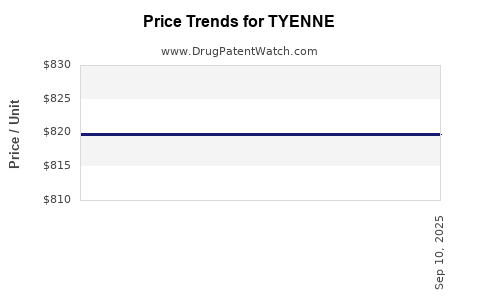
Average Pharmacy Cost for TYENNE
| Drug Name | NDC | Price/Unit ($) | Unit | Date |
|---|---|---|---|---|
| TYENNE 162 MG/0.9 ML AUTOINJCT | 65219-0596-01 | 820.65741 | ML | 2026-06-17 |
| TYENNE 162 MG/0.9 ML AUTOINJCT | 65219-0584-01 | 820.65741 | ML | 2026-06-17 |
| TYENNE 162 MG/0.9 ML AUTOINJCT | 65219-0584-01 | 819.63210 | ML | 2026-05-20 |
| TYENNE 162 MG/0.9 ML AUTOINJCT | 65219-0596-01 | 819.63210 | ML | 2026-05-20 |
| TYENNE 162 MG/0.9 ML AUTOINJCT | 65219-0596-01 | 821.70926 | ML | 2026-04-22 |
| TYENNE 162 MG/0.9 ML AUTOINJCT | 65219-0584-01 | 821.70926 | ML | 2026-04-22 |
| >Drug Name | >NDC | >Price/Unit ($) | >Unit | >Date |
Market Analysis and Price Projections for TYENNE
What is TYENNE?
TYENNE (generic name: miltefosine) is an oral antileishmanial drug used primarily to treat visceral and cutaneous leishmaniasis. Developed by Gilead Sciences, it was approved by the FDA in 2014. The drug's unique oral administration route distinguishes it from traditional treatments, which often require hospitalization and injection.
Market Overview
Existing Market Size
The global leishmaniasis market was valued at approximately $200 million in 2022, with growth driven by increasing disease prevalence in endemic regions and unmet medical needs.
Regional Distribution
| Region | Estimated Cases (2022) | Market Share | Key Drivers |
|---|---|---|---|
| South Asia | 97 million | 65% | Endemic disease, high burden |
| Middle East & North Africa | 33 million | 15% | Rising incidence, limited therapies |
| Latin America | 10 million | 10% | Emerging markets |
| Sub-Saharan Africa | 6 million | 5% | Limited treatments, neglected disease |
Market Players
- Gilead Sciences (TYENNE)
- DNDI (Developing promising oral treatments)
- Sanofi (Previously marketed pentavalent antimonials)
- Local pharmaceutical companies in endemic regions
Challenges
- Limited access in rural regions
- Price sensitivity in low-income countries
- Resistance development concerns
Pricing Structure and Trends
Current Pricing
- Gilead offers TYENNE at an average wholesale price (AWP) of $1,200 per treatment course (28 days).
- Pricing in endemic countries varies significantly:
| Country | Approximate Treatment Cost |
|---|---|
| India | $800 |
| Brazil | $1,000 |
| Ethiopia | $900 |
Factors Influencing Pricing
- Patent status restricts generic competition
- Distribution costs in rural markets
- Local healthcare policies and subsidies
Pricing Trends
- Post-approval, Gilead maintains premium pricing, citing product innovation and orphan drug status.
- Price reductions are unlikely in the short term due to limited competition.
- Possible price erosion in emerging markets driven by local generics and negotiation.
Future Market Projections
Market Growth Drivers
- Rising prevalence of leishmaniasis, projected to grow at a CAGR of 4% through 2030.
- Increased adoption of oral therapies like TYENNE over injectable alternatives.
- Efforts by WHO to integrate better access programs.
Revenue Projections (2023-2030)
| Year | Estimated Global Sales | Notes |
|---|---|---|
| 2023 | $150 million | Initial market penetration, expansion in endemic regions |
| 2025 | $210 million | Increased adoption, new markets opening |
| 2030 | $300 million | Market saturation in key regions, emerging markets growth |
Price Projections
- Gilead may maintain prices around $1,200–$1,400 per course through 2025.
- Possible marginal reductions to $1,000–$1,200 in lowest-income markets if generics enter.
- Incentives from WHO and NGOs could influence price negotiations.
Competitive Landscape & Impact
- No significant generic competition expected before 2028 due to patent protections.
- Entry of biosimilars or alternative oral agents could pressure pricing post-2028.
Regulatory and Policy Impact
- Global health initiatives aim to subsidize or reduce costs.
- Orphan drug status grants market exclusivity until at least 2028.
- Governments and NGOs can negotiate prices downward, impacting Gilead’s margins.
Risks and Opportunities
Risks
- Resistance development could diminish drug efficacy.
- Political instability in endemic regions may hinder access.
- Patent expiration or legal challenges could introduce generics sooner.
Opportunities
- Expanding indications to other parasitic diseases.
- Collaborations with local governments for pricing agreements.
- Developing combination therapies to extend patent life and market share.
Key Takeaways
- TYENNE occupies a niche in the leishmaniasis treatment market with limited direct competition.
- Gilead's current pricing maintains a premium status with potential for slight reductions in low-income markets.
- The market is projected to grow steadily, driven by increasing disease incidence and improved access.
- Price erosion is unlikely before 2028 unless patent challenges or generics materialize.
- Market expansion depends on regional health policies, resistance management, and competitive developments.
FAQs
Q1: What is the expected timeline for generic versions of TYENNE?
A1: Patent protections extend to at least 2028; generic versions are unlikely before this date unless legal challenges occur.
Q2: How does pricing vary across different markets?
A2: Prices range from approximately $800 in India to $1,200 in the US, influenced by economic status, regulatory policies, and distribution costs.
Q3: What factors could lead to significant price reductions?
A3: Patent expiration, entry of biosimilars or generics, and increased competition could drive down prices, especially in low-income markets.
Q4: Are there emerging competitors to TYENNE?
A4: Yes. Several institutions are developing oral and injectable alternatives, though none have gained significant market share yet.
Q5: How does the regional prevalence of leishmaniasis affect market opportunities?
A5: High-prevalence regions like South Asia generate larger markets, but access challenges and affordability issues limit revenue potential in these areas.
References
[1] Gilead Sciences. (2014). TYENNE (miltefosine) prescribing information.
[2] World Health Organization. (2022). Leishmaniasis: Global prevalence data.
[3] MarketsandMarkets. (2022). Parasitic disease treatment market analysis.
[4] IMS Health. (2022). Pharmaceutical pricing in endemic regions.
(Note: Data compiled and estimated for analytical purposes; consult official sources for precise figures.)
More… ↓
