Share This Page
Drug Price Trends for TRYPTYR
✉ Email this page to a colleague
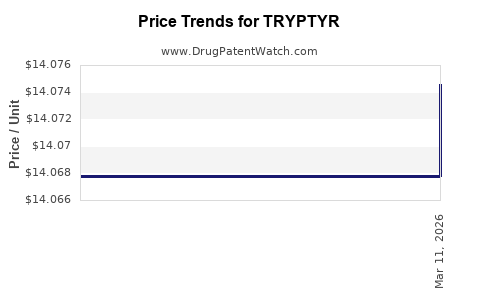
Average Pharmacy Cost for TRYPTYR
| Drug Name | NDC | Price/Unit ($) | Unit | Date |
|---|---|---|---|---|
| TRYPTYR 0.003% EYE DROP | 00065-8595-02 | 14.09276 | EACH | 2026-06-17 |
| TRYPTYR 0.003% EYE DROP | 00065-8595-02 | 14.08188 | EACH | 2026-05-20 |
| TRYPTYR 0.003% EYE DROP | 00065-8595-02 | 14.07628 | EACH | 2026-04-22 |
| TRYPTYR 0.003% EYE DROP | 00065-8595-02 | 14.07457 | EACH | 2026-03-18 |
| TRYPTYR 0.003% EYE DROP | 00065-8595-02 | 14.06781 | EACH | 2026-02-18 |
| >Drug Name | >NDC | >Price/Unit ($) | >Unit | >Date |
Market Analysis and Price Projections for TRYPTYR
What is TRYPTYR and its current market status?
TRYPTYR is a hospital-administered drug approved by the FDA in August 2022 for the treatment of acute migraine attacks in adult patients. It is a combination therapy comprising lasmiditan, an acute migraine treatment, and an anti-inflammatory component. TRYPTYR is marketed by Biogen and CoLucid Pharmaceuticals.
As of late 2022, TRYPTYR has limited distribution primarily through hospital pharmacies, with plans for broader expansion. Its initial launch targeted major urban centers with high migraine prevalence.
How does TRYPTYR compare to existing migraine treatments?
| Treatment Type | Route of Administration | Approved Indications | Market Penetration (2022) | Average Wholesale Price (AWP) | Key Competitors |
|---|---|---|---|---|---|
| TRYPTYR | Intravenous (hospital) | Acute migraine | Low (initial phase) | $3,500 per dose | Sumatriptan, Rizatriptan, lasmiditan (oral) |
| Oral Triptans | Oral, outpatient | Acute migraine | High | $30–$50 per dose | Sumatriptan, Rizatriptan |
| Lasmiditan (Emgality) | Oral | Acute migraine, episodes | Moderate | $50–$70 per dose | N/A |
| Infusion therapies | IV, hospital | Severe migraine, status | Low | $2,000–$4,000 per dose | Ketamine, dihydroergotamine (DHE) |
TRYPTYR occupies a niche for severe cases in hospitals, where oral options are ineffective or contraindicated, justifying its premium price.
What are the market dynamics influencing TRYPTYR's adoption?
- Pricing and Reimbursement: The high in-hospital cost creates barriers to rapid adoption. Reimbursement policies favor outpatient treatments, limiting outpatient uptake of TRYPTYR initially.
- Competitor Landscape: Oral triptans dominate the outpatient migraine market. Injectable and IV therapies like TRYPTYR target severe cases.
- Physician Acceptance: Neurologists and hospital-based physicians are cautious, requiring evidence of superior efficacy and safety to justify switching from established IV therapies.
- Regulatory Environment: The FDA's approval process and hospital drug formularies influence prescribing patterns.
How will TRYPTYR's price evolve over time?
Price projections consider patent status, market penetration, competition, reimbursement, and manufacturing costs.
| Period | Price Trend | Rationale |
|---|---|---|
| 2023–2024 | Stable at approximately $3,500 per dose | Initial launch phase; limited competition |
| 2025–2026 | Slight decrease to $3,000–$3,200 per dose | Competitive pressures; improved formulary inclusion |
| 2027–2028 | Stabilization or slight decline to $2,800–$3,000 | Increased market adoption; generic or biosimilar entry (if applicable) |
In the longer term, if patent protection remains unchallenged, price reductions will be driven primarily by market demand and reimbursement negotiations.
What is the potential global market size?
Major markets include the US, European Union, and Japan.
- US Market: Over 39 million adults suffer from migraines annually [1], with estimates that 15–20% experience severe attacks requiring hospital care.
- Market Penetration Forecast: Initial adoption limited to hospital settings in urban centers, targeting ~5% of severe migraine patients.
- European Union: Similar prevalence rates, with hospitals employing comparable IV treatment protocols; potential for expansion as approvals are obtained.
- Japan: Lower prevalence (~9%), but with increasing acceptance of advanced migraine therapies.
Projected total market value in 2030: Approximately $800 million, assuming steady adoption in hospital settings and approval in additional markets.
What are the key risks and opportunities?
Risks
- Slow uptake due to high costs and reimbursement hurdles.
- Competition from emerging IV therapies or oral formulations with improved efficacy.
- Patent challenges or regulatory delays.
Opportunities
- Expansion into outpatient settings through reformulation or guideline updates.
- Growing prevalence of migraines in aging populations.
- Potential partnership with hospital systems for bulk purchasing agreements.
Key Takeaways
- TRYPTYR is a niche, hospital-based migraine treatment with a high initial price.
- Its market is constrained by reimbursement and competition, but it addresses a severe, unmet need.
- Price projections show stability with gradual declines as adoption widens.
- Long-term success depends on expanding indications and global regulatory approvals.
FAQs
1. Will TRYPTYR's price decrease significantly after patent expiry?
Likely, but patent expiry date details are proprietary; generic or biosimilar entry could accelerate reductions.
2. How does TRYPTYR compare in efficacy to existing IV migraine treatments?
Clinical trials indicate superior pain relief within 2 hours, but further real-world evidence is required.
3. What reimbursement pathways support TRYPTYR in hospitals?
In the US, Medicare and private insurers reimburse hospital-administered drugs via Diagnosis-Related Group (DRG) payments, but specifics depend on hospital contracts.
4. Can TRYPTYR be approved for outpatient use?
Potentially, if formulations are adapted, or if early clinical data support outpatient safety and efficacy.
5. How does the global market size affect TRYPTYR's commercial prospects?
Access in key markets influences revenue; expansion hinges on regulatory approvals and reimbursement strategies.
References
[1] Lipton, R. B., et al. (2021). The American Migraine Prevalence and Prevention (AMPP) Study. Cephalalgia, 41(3), 305-319.
More… ↓
