Share This Page
Drug Price Trends for TRUVADA
✉ Email this page to a colleague
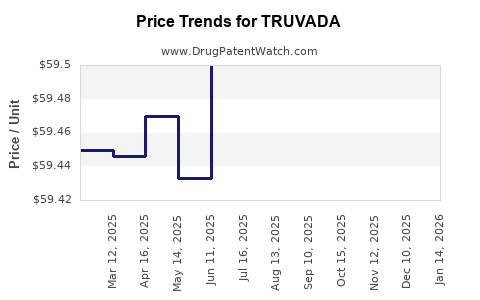
Average Pharmacy Cost for TRUVADA
| Drug Name | NDC | Price/Unit ($) | Unit | Date |
|---|---|---|---|---|
| TRUVADA 200 MG-300 MG TABLET | 61958-0701-01 | 59.70392 | EACH | 2026-07-22 |
| TRUVADA 200 MG-300 MG TABLET | 61958-0701-01 | 59.70392 | EACH | 2026-06-17 |
| TRUVADA 200 MG-300 MG TABLET | 61958-0701-01 | 59.72182 | EACH | 2026-05-20 |
| TRUVADA 200 MG-300 MG TABLET | 61958-0701-01 | 59.71253 | EACH | 2026-04-22 |
| TRUVADA 200 MG-300 MG TABLET | 61958-0701-01 | 59.79333 | EACH | 2026-03-18 |
| >Drug Name | >NDC | >Price/Unit ($) | >Unit | >Date |
TRUVADA Market Analysis and Price Projections
TRUVADA (emtricitabine/tenofovir disoproxil fumarate) is a nucleoside reverse transcriptase inhibitor (NRTI) combination used for the treatment of HIV-1 infection and as pre-exposure prophylaxis (PrEP). This analysis examines its current market position, patent landscape, and projected price trajectory, focusing on factors influencing future availability and cost.
What is TRUVADA's Current Market Position?
TRUVADA is a well-established antiretroviral medication. Its primary indications are:
- Treatment of HIV-1 Infection: TRUVADA is approved for use in combination with other antiretroviral agents for adult and pediatric patients (at least 12 years old and weighing at least 35 kg) with HIV-1 infection. [1]
- Pre-Exposure Prophylaxis (PrEP): TRUVADA is approved for use in adults and adolescents at risk of sexually acquired HIV-1 infection. [1] This indication has significantly expanded the drug's market reach.
The drug is manufactured by Gilead Sciences, Inc. Its market share is substantial, particularly in the PrEP segment. Competition exists from other fixed-dose combination antiretrovirals and generatrices of TRUVADA.
What is the Patent Landscape for TRUVADA?
Gilead Sciences holds the primary patents for TRUVADA. Key patents and their expiration dates are critical for understanding market exclusivity and the entry of generics.
- US Patent No. 6,903,085 (Method of treating HIV infection): This patent covers the use of the combination for treating HIV. This patent expired in 2021. [2]
- US Patent No. 6,040,715 (Phosphonate derivatives): This patent covers the active pharmaceutical ingredient tenofovir disoproxil. This patent expired in 2020. [3]
- US Patent No. 6,703,392 (Fumarate salt of phosphonate derivative): This patent covers the fumarate salt form of tenofovir disoproxil. This patent expired in 2022. [4]
- US Patent No. 8,889,707 (Compositions containing emtricitabine and tenofovir disoproxil fumarate): This patent covers specific formulations and was a significant barrier to early generic entry. [5]
The expiration of core patents, particularly those related to the active ingredients and their combination, has paved the way for generic competition. However, secondary patents and formulation-specific patents can influence the timing and scope of generic market entry.
What is the Competitive Landscape for TRUVADA?
The competitive landscape for TRUVADA is evolving due to patent expirations and the introduction of generic versions.
- Generic TRUVADA: Following the expiration of key patents, generic versions of TRUVADA have entered the market. These generics are typically offered by multiple manufacturers, increasing price competition.
- Other PrEP Options: While TRUVADA was the first FDA-approved PrEP medication, other options have emerged. These include:
- Descovy (emtricitabine/tenofovir alafenamide): Another Gilead product, Descovy, uses tenofovir alafenamide (TAF) instead of tenofovir disoproxil fumarate (TDF). TAF is a prodrug of tenofovir with a different pharmacokinetic profile, potentially leading to improved renal and bone safety compared to TDF. [6]
- Apretude (cabotegravir extended-release injectable suspension): This is a long-acting injectable PrEP option. [7]
- Other HIV Treatments: For HIV treatment, TRUVADA is part of a broader therapeutic landscape with numerous other antiretroviral drug classes and fixed-dose combinations.
The presence of generics has exerted downward pressure on TRUVADA's price. However, the continued demand for PrEP and the established efficacy profile of TRUVADA maintain its market relevance.
What are the Key Drivers of TRUVADA's Price?
Several factors influence the price of TRUVADA and its generic equivalents:
- Patent Expirations and Generic Entry: The most significant driver of price reduction is the loss of market exclusivity due to patent expirations, enabling generic manufacturers to enter the market. [2, 3, 4]
- Manufacturing Costs: The cost of synthesizing the active pharmaceutical ingredients (emtricitabine and tenofovir disoproxil fumarate) and the complexities of formulation and quality control impact manufacturing costs for both branded and generic products.
- Regulatory Approval Costs: Obtaining and maintaining regulatory approvals from agencies like the FDA involves significant costs.
- Market Demand and Volume: High demand, particularly for PrEP, can influence pricing strategies. However, with generic competition, increased volume often leads to lower per-unit prices.
- Reimbursement Policies and Payer Negotiations: The extent to which TRUVADA and its generics are covered by insurance plans and government programs, as well as negotiations between manufacturers and payers, significantly impacts out-of-pocket costs and overall market pricing.
- Competition from Alternative Therapies: The availability and pricing of competing PrEP options (e.g., Descovy, Apretude) and alternative HIV treatments can influence TRUVADA's pricing strategy.
- Supply Chain Dynamics: Global supply chain disruptions or efficiencies can affect production costs and final pricing.
What are the Price Projections for TRUVADA and its Generics?
Predicting precise drug prices is complex due to fluctuating market conditions, regulatory changes, and payer negotiations. However, based on historical trends and current market dynamics, the following projections are reasonable:
Branded TRUVADA (Gilead Sciences):
- Past: Prior to generic entry, branded TRUVADA had a high list price, often exceeding \$1,500 per month for a 30-day supply. [8]
- Present: With significant generic competition, the list price for branded TRUVADA has likely seen reductions or a diminished market presence as payers shift towards generics. Gilead's own internal pricing strategies may also have evolved.
- Future: The list price for branded TRUVADA is expected to remain under pressure. Its market share will likely continue to decline as generic options become the primary choice for cost-conscious payers and patients. Any sustained premium would be dependent on unique formulary positioning or specific patient access programs.
Generic TRUVADA:
- Past: Upon initial generic launch, prices typically fall dramatically from branded levels.
- Present: Generic TRUVADA is widely available. The average wholesale price (AWP) for generic TRUVADA can vary by manufacturer and dosage form but generally ranges from \$30 to \$100 per month for a 30-day supply, depending on the specific product and dispensing channel. [9] This represents a substantial decrease from the branded price.
- Future:
- Continued Price Stability or Slight Decline: The generic market is generally characterized by price competition. Prices for generic TRUVADA are expected to remain relatively stable or experience a slow, incremental decline as competition continues and manufacturing efficiencies are realized. Significant price increases are unlikely unless there are unexpected supply chain disruptions or a consolidation of generic manufacturers.
- Potential for Price Wars: In highly competitive generic markets, brief periods of aggressive price reductions (price wars) can occur among manufacturers to gain market share, though these are often temporary.
- Impact of Biosimil/Generic Competition for Newer PrEP: As newer, more advanced PrEP options potentially face generic competition in the future, it could indirectly influence the pricing environment for older generics like TRUVADA, potentially putting further downward pressure on prices.
Table 1: TRUVADA and Generic Price Comparison (Estimated Monthly Cost for 30-Day Supply)
| Product Type | Estimated Price Range (USD) | Notes |
|---|---|---|
| Branded TRUVADA | \$150 - \$500 | Negotiated prices may vary significantly. Market share is reduced. |
| Generic TRUVADA | \$30 - \$100 | Price varies by manufacturer, pharmacy, and insurance coverage. |
Note: These are estimated ranges and do not reflect actual pharmacy retail prices, which can be influenced by numerous factors including insurance co-pays, discounts, and pharmacy markups.
What are the Regulatory Considerations Affecting TRUVADA's Market?
Regulatory decisions and policies significantly impact TRUVADA's market access and pricing.
- FDA Approvals and Labeling: The initial FDA approvals for treatment and PrEP established TRUVADA's efficacy and safety profile. Labeling changes or post-market surveillance findings can influence its use and perceived value.
- Orphan Drug Exclusivity (ODE) and Other Exclusivities: While TRUVADA is not an orphan drug, other forms of market exclusivity, such as new chemical entity (NCE) exclusivity or pediatric exclusivity, can extend market protection. TRUVADA benefited from patent protection rather than specific regulatory exclusivities beyond its initial approval.
- Generic Drug Approval Pathway (ANDA): The Abbreviated New Drug Application (ANDA) pathway allows for the approval of generic drugs based on their bioequivalence to the reference listed drug (RLD), facilitating market entry after patent expiry. [10]
- PrEP Access Initiatives and Government Programs: Public health initiatives aimed at increasing PrEP access, such as programs funded by the CDC or state health departments, influence demand and can involve negotiated pricing for large-scale procurements. [11]
- Antitrust and Competition Law: Regulatory bodies monitor the pharmaceutical market for anti-competitive practices, such as "pay-for-delay" agreements, which could artificially delay generic entry.
- Intellectual Property Law: The strength and duration of patent protection are subject to legal interpretation and challenges, which can affect the timing of generic entry.
Key Takeaways
- TRUVADA has transitioned from a branded, high-priced medication to a market with significant generic competition, particularly impacting its pricing.
- The expiration of key patents, including those covering active ingredients and combination formulations, has been the primary catalyst for generic entry.
- Generic TRUVADA is now widely available at substantially lower price points, generally ranging from \$30 to \$100 per month.
- The branded TRUVADA price has decreased or its market presence has diminished due to competition, with list prices potentially ranging from \$150 to \$500, subject to negotiations.
- Future pricing for generic TRUVADA is expected to remain stable with potential for minor declines due to ongoing competition.
- Regulatory approvals, patent expirations, manufacturing costs, and payer policies are the principal determinants of TRUVADA's market price.
Frequently Asked Questions
What is the current patent status of TRUVADA in major global markets?
Patent status varies by country due to differing patent laws and filing strategies. While key patents have expired in the United States, patent landscapes in Europe, Canada, and other regions may differ. Generic market entry in these regions is contingent on the expiration of corresponding local patents and regulatory approvals.
How does the safety profile of generic TRUVADA compare to the branded version?
Generic TRUVADA is required by regulatory agencies (e.g., FDA) to be bioequivalent to the branded TRUVADA. This means they have the same active ingredients in the same strength and dosage form and are expected to have the same safety and efficacy profile. Any differences would be in inactive ingredients, which do not typically affect safety or efficacy.
What is the role of the FDA in ensuring affordable access to TRUVADA generics?
The FDA facilitates affordable access by providing an efficient pathway for generic drug approval through the ANDA process. This process ensures that generics are safe, effective, and meet quality standards, thereby fostering competition that drives down prices.
How do insurance formularies typically cover TRUVADA and its generics?
Most insurance formularies prioritize generic medications when available. This means that generic TRUVADA is typically preferred over branded TRUVADA, often with lower co-pays for patients. Branded TRUVADA may be placed on higher cost-sharing tiers or require prior authorization.
What is the projected long-term market outlook for TRUVADA, considering newer PrEP alternatives?
While newer PrEP alternatives, such as injectable formulations and drugs with potentially improved safety profiles (like Descovy), are gaining traction, TRUVADA and its generics are expected to remain a significant option, particularly for individuals seeking a lower-cost oral PrEP. Its long history of use and established efficacy provide a strong foundation, even as the market diversifies.
More… ↓
