Share This Page
Drug Price Trends for TROSPIUM
✉ Email this page to a colleague
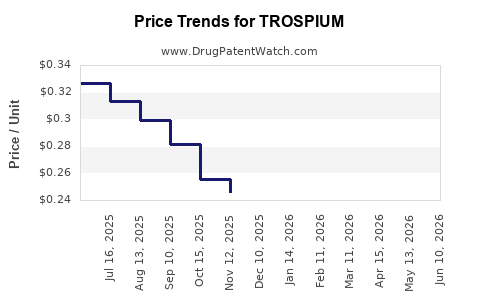
Average Pharmacy Cost for TROSPIUM
| Drug Name | NDC | Price/Unit ($) | Unit | Date |
|---|---|---|---|---|
| TROSPIUM CHLORIDE 20 MG TABLET | 00574-0145-60 | 0.21415 | EACH | 2026-07-22 |
| TROSPIUM CHLORIDE 20 MG TABLET | 00904-7059-52 | 0.21415 | EACH | 2026-07-22 |
| TROSPIUM CHLORIDE 20 MG TABLET | 23155-0530-05 | 0.21415 | EACH | 2026-07-22 |
| >Drug Name | >NDC | >Price/Unit ($) | >Unit | >Date |
Best Wholesale Price for TROSPIUM
| Drug Name | Vendor | NDC | Count | Price ($) | Price/Unit ($) | Unit | Dates | Price Type |
|---|---|---|---|---|---|---|---|---|
| TROSPIUM CL 20MG TAB | AvKare, LLC | 23155-0530-05 | 500 | 121.01 | 0.24202 | EACH | 2023-06-16 - 2028-06-14 | FSS |
| TROSPIUM CL 20MG TAB | AvKare, LLC | 23155-0530-06 | 60 | 14.52 | 0.24200 | EACH | 2023-06-16 - 2028-06-14 | FSS |
| TROSPIUM CL 20MG TAB | AvKare, LLC | 23155-0530-06 | 60 | 14.29 | 0.23817 | EACH | 2023-06-25 - 2028-06-14 | FSS |
| >Drug Name | >Vendor | >NDC | >Count | >Price ($) | >Price/Unit ($) | >Unit | >Dates | >Price Type |
TROSPIUM Market Analysis, Competitive Landscape, and Price Projections (US and Key International Markets)
Trospium (usually as trospium chloride) is an established antimuscarinic for overactive bladder (OAB). The market remains mature, with pricing driven by (1) generic share, (2) payer preference for formulary antimuscarinics and beta-3 agonists, and (3) product-level settlement and switching behavior rather than new clinical entrants. Near-term price projections in the US skew flat to modestly down as generic competition sustains low net pricing.
Where does trospium sit in the OAB market and what is its size?
Featured snippet answer: Trospium is a mature, mostly generic OAB antimuscarinic. Revenue is largely concentrated in branded or authorized generic periods historically, but current US commercial economics are dominated by generic net price levels and payer-driven substitution among antimuscarinics and beta-3 agonists.
OAB therapeutic context: antimuscarinics vs beta-3 agonists
OAB prescribing has shifted from antimuscarinics toward beta-3 agonists (mirabegron, vibegron) and combination strategies. Trospium competes on anticholinergic efficacy with tolerability limitations that tend to push prescribers toward newer agents and toward formulary step edits.
US channel drivers that pressure trospium pricing
- High generic penetration and multiple AB-rated products
- Formularies favoring preferred agents (often mirabegron or vibegron, or specific antimuscarinics with better formulary status)
- Switching within class based on dry mouth and constipation burden
- Procurement via group purchasing and rebates that compress net pricing
Commercial implication for revenue forecasts
In mature OAB categories, unit demand can hold but revenue declines with net price pressure unless a higher-priced formulation or brand revival offsets substitution. For trospium, the economics typically track net price more than volume.
What is the current trospium pricing and what price drivers matter?
Featured snippet answer: Trospium’s public list price is less predictive than net price, which is compressed by generic competition, rebate structures, and payer substitution among antimuscarinics.
Key pricing levers in mature US generics
- Wholesale acquisition cost (WAC) instability versus net price stability
- PBM rebate dynamics and formulary tiering
- Bid-based contracting (especially for state and large institutional formularies)
- Patient mix: Medicare Part D tends to produce more aggressive substitution behavior
Major formulation considerations that change price per dose
Trospium is sold in OAB as:
- Trospium immediate-release (IR) and
- Trospium extended-release (ER)
ER products can sustain higher net pricing than IR in some periods due to adherence and dosing convenience, but payer status and generic availability typically erode the advantage over time.
How should trospium price projections be modeled in 2026-2030?
Featured snippet answer: A reasonable projection structure is a base case of modest further net price erosion in the US (low-single-digit percentage), with volume broadly flat to slightly down as beta-3 agonists take incremental share.
Scenario model (US net price, annual)
Given a generic-mature profile, use three scenarios anchored to category substitution rather than patent-driven entry risk:
| Scenario | Net price trend (US) | Unit trend (US) | Revenue trend (US) | Primary driver |
|---|---|---|---|---|
| Base case | -2% to -4% per year | 0% to -1% | -2% to -5% | Generic price erosion + OAB shift to beta-3 |
| Bear case | -4% to -6% per year | -1% to -3% | -5% to -9% | Stronger formulary displacement + aggressive PBM contracting |
| Bull case | -0% to -2% per year | 0% to +1% | -0% to -2% | Improved channel access or relative formulary preference for trospium ER |
International pricing dynamics that affect global projections
- Tender systems in EU and other jurisdictions compress pricing to the lowest-contract outcome for generics
- EU5 price controls and reference pricing tend to cap upside
- Emerging markets may maintain higher relative prices longer, but volumes are often smaller and reimbursement variable
What this means for forecasting
For an investment or licensing valuation, treat trospium as a cash-flow product with limited upside and emphasize:
- contract and channel leverage
- payer formularies in Medicare and managed care
- ER vs IR mix
- substitution intensity by region
What competitive products set the trospium price floor?
Featured snippet answer: Trospium’s practical price floor is shaped by generic antimuscarinics and by the newer standard-of-care alternatives (mirabegron, vibegron). Competitive pressure acts via formulary position and patient switching, not only via price.
Closest substitutes inside OAB
- Other antimuscarinics: oxybutynin (various forms), tolterodine, solifenacin, fesoterodine, darifenacin, etc.
- Beta-3 agonists: mirabegron, vibegron
- Combination pathways that reduce antimuscarinic monotherapy share
Class-level substitution patterns relevant to pricing
- If preferred status shifts to beta-3 agonists, trospium net price declines faster than volume.
- If a payer prefers an antimuscarinic at a specific tier, trospium’s net price clusters to the tier’s contracted rate.
Which companies market trospium and how does that impact pricing?
Featured snippet answer: Trospium is marketed by generic and authorized-generic suppliers; pricing is dominated by the tender and PBM contracting behavior of those suppliers rather than by a single branded manufacturer.
Practical competitive landscape structure
- Multiple distributors and manufacturers for AB-rated trospium products
- ER and IR products competing in different segments depending on dosing preference and payer policies
- Authorized generics can tighten pricing if they gain market access through settlements or exclusivity pathways
Business implication for price projections
If a new supplier enters and gains volume, it can accelerate net price compression. Conversely, if supply concentrates among fewer contract holders, net pricing can stabilize. Trospium’s market is more sensitive to contracting than to differentiated clinical value.
What patent and exclusivity events affect trospium pricing and generic entry?
Featured snippet answer: For mature trospium, price trajectory is generally more influenced by generic competition than active exclusivity. Patent estate-driven shocks matter primarily when a new product form or method-of-use extension creates a temporary barrier.
How to think about exclusivity risk in a generic-mature product
- Primary pricing risk events are new entrants gaining favorable formulary position
- Secondary events are shortages, product discontinuations, or enforcement of method or formulation patents that temporarily restrict certain generics
Relevance to price projections
In most cases for trospium, you should not assume major upward pricing from patent cliffs. Instead, model continued low pricing with episodic volatility when channel access changes.
What is the litigation and Paragraph IV landscape for trospium?
Featured snippet answer: Paragraph IV litigation is typically a short-term driver of launch timing, but in a mature trospium market, its lasting impact on price depends on how quickly generic coverage expands and how PBMs manage substitution after resolution.
How litigation affects net pricing
- A delayed launch can preserve higher net prices for incumbents during the delay window
- A rapid expansion after settlement can trigger step-down net price erosion
- If exclusivity or settlement restricts specific ANDA configurations (for ER vs IR), the mix shift can influence pricing per day
Business use
For projections, litigation matters only if it changes near-term supply expansion and PBM substitution patterns.
What is the regulatory status of trospium in the US (FDA pathways) and why does it matter for price?
Featured snippet answer: Trospium is an established drug category with generic availability. US FDA regulatory status mainly affects who can sell and when, which then drives competitive pricing.
US approval structure: generics vs new formulations
- Generics typically enter via ANDAs using bioequivalence to the reference listed drug
- New formulations can drive incremental differentiation but still face rapid genericization once AB-rated equivalents exist
Price relevance
Regulatory approvals and new dosage-form entries usually affect price only if they change:
- the reference listed drug (RLD) position
- the ER-to-IR mix accessible through formularies
- supply continuity and contracting
How does trospium compare with mirabegron and vibegron on competitive pricing?
Featured snippet answer: Mirabegron and vibegron often have higher list prices but win formulary position through perceived tolerability and, in some plans, payer contracting that narrows the net price gap versus antimuscarinics. Trospium faces structural price pressure from generic compression even when it is therapeutically effective.
Competitive positioning that affects net pricing
- Beta-3 agonists: payer-preferred on tolerability and persistence, reducing the payer’s need to cover multiple antimuscarinics
- Trospium: often relegated to tiering among antimuscarinics unless it is a preferred agent in a given PBM contract
Projection impact
Trospium pricing likely declines faster in plans where beta-3 agonists consolidate formularies and where antimuscarinic coverage is limited to selected products.
Key market risks for trospium pricing (and what they do to projections)
Featured snippet answer: The biggest downside risks are increased beta-3 displacement and intensified generic price competition; the main upside is any stabilization in ER contract positioning or procurement consolidation among suppliers.
Downside risk checklist
- Formulary tightening (step edits and prior auth favoring beta-3)
- Increased PBM rebate aggression
- Expanded generic coverage that drives net price step-down
- Supply constraints that paradoxically raise short-term pricing but reduce overall paid claims (leading to net revenue loss)
Upside risk checklist
- Improved ER formulary preference
- Contract wins that stabilize net price and protect share
- Limited supplier competition in certain tiers or regions
Revenue exposure and price sensitivity: what to prioritize in commercial planning
Featured snippet answer: Trospium revenue is more sensitive to net price and formulary retention than to modest volume swings.
What to prioritize
- Contract coverage by PBM and integrated delivery networks
- ER mix vs IR mix
- Medicare Part D tiering status
- Wholesale and distribution availability that affects bid performance
Practical planning horizon
For 12 to 24-month planning, prioritize:
- payer formulary updates
- tender outcomes in key regions
- supplier consolidation and inventory behavior
- ER vs IR substitution rates observed in claims data
Key Takeaways
- Trospium is a mature OAB antimuscarinic with price behavior dominated by generic competition and PBM/formulary contracting, not by clinical differentiation.
- US net pricing is projected to trend flat to modestly down in 2026-2030, with base case erosion of roughly 2% to 4% annually as beta-3 agonists continue taking incremental share.
- International pricing faces stronger reference and tender pressures, capping upside even when volume holds.
- Forecasting should focus on ER vs IR mix, formulary position, and contract outcomes; litigation-driven launches can cause short-term volatility but are unlikely to create sustained price recovery in a generic-mature market.
FAQs
- How will beta-3 agonist market share gains affect trospium ER vs IR net pricing?
- What contract levers most influence trospium net price in Medicare Part D?
- How do EU reference pricing and tenders typically change trospium generic margins?
- What commercial impact occurs if a supplier exits the trospium market or supply tightens?
- What pricing assumptions should be used for trospium when modeling PBM rebate changes?
References
- FDA. Orange Book: Approved Drug Products with Therapeutic Equivalence Evaluations. US Food and Drug Administration.
- FDA. Drugs@FDA. US Food and Drug Administration.
- IQVIA (industry reporting), general category dynamics for overactive bladder (OAB) therapies.
More… ↓
