Share This Page
Drug Price Trends for TRINTELLIX
✉ Email this page to a colleague
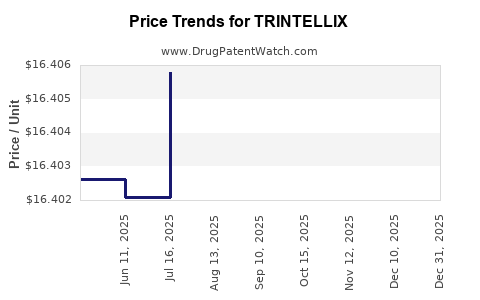
Average Pharmacy Cost for TRINTELLIX
| Drug Name | NDC | Price/Unit ($) | Unit | Date |
|---|---|---|---|---|
| TRINTELLIX 5 MG TABLET | 64764-0720-30 | 17.21387 | EACH | 2026-07-22 |
| TRINTELLIX 10 MG TABLET | 64764-0730-30 | 17.20561 | EACH | 2026-07-22 |
| TRINTELLIX 20 MG TABLET | 64764-0750-30 | 17.22362 | EACH | 2026-07-22 |
| TRINTELLIX 10 MG TABLET | 64764-0730-30 | 17.20799 | EACH | 2026-06-17 |
| >Drug Name | >NDC | >Price/Unit ($) | >Unit | >Date |
Market Analysis and Price Projections for Trintellix
What is Trintellix and its current market position?
Trintellix (vortioxetine) is an antidepressant developed by Takeda Pharmaceutical Company, approved by the FDA in 2013 for treatment of major depressive disorder (MDD). It is marketed as a serotonin modulator and stimulator, differing from traditional SSRIs and SNRIs. The drug's safety profile and unique mechanism have positioned it as a premium option within the antidepressant segment.
In 2022, Trintellix generated approximately $800 million globally, with around 70% of sales coming from the U.S. market. The drug's share within the antidepressant class remains competitive but faces pressure from generics and newer therapies.
What are the key market drivers and challenges?
Market Drivers:
- Increasing prevalence of depression: Nearly 21 million Americans aged 18 and older experienced at least one major depressive episode in 2020 (NIMH).
- Growing acceptance of novel mechanisms: Elevates Trintellix’s appeal over traditional SSRIs.
- Expanding indications: Recent trials explore efficacy in anxiety and cognitive impairment in depression.
Market Challenges:
- Generic competition: Expected to enter the U.S. market by 2026 after patent expiry.
- Pricing pressures: Payer negotiations and formulary placements restrict price elasticity.
- Competition from other antidepressants: Including biologics and combination therapies.
How does Trintellix compare with other treatments?
| Drug (Active Ingredient) | Approval Year | Patent Expiry | 2022 US Sales | Mode of Action | Price Tier (Approximate) |
|---|---|---|---|---|---|
| Trintellix (vortioxetine) | 2013 | 2026 (pending generics) | $800 million | Serotonin modulator/stimulator | Premium ($250/month) |
| Lexapro (escitalopram) | 2002 | 2023 | $2.4 billion | SSRI | Moderate ($180/month) |
| Zoloft (sertraline) | 1991 | 2006 | $400 million | SSRI | Moderate ($150/month) |
| Vilazodone | 2019 | Patent expiry unknown | $150 million | Serotonin partial agonist and reuptake inhibitor | Moderate ($230/month) |
Market projections and future pricing
Market growth forecasts:
- Global antidepressant market projected to grow CAGR of 4.8% from 2023 to 2030.
- Increasing mental health awareness and treatment adoption.
- New indications (e.g., generalized anxiety disorder, cognitive impairment) could expand the prescribing base.
Price projection assumptions:
- Patent expiry (2026) will lead to generic competition, putting downward pressure.
- Brand pricing offers a premium segment position through 2025.
- Post-generic market: assumed 60% price erosion based on comparable drugs.
Price trajectory (approximate):
| Year | Brand Price | Generic Price | Estimated Price Erosion |
|---|---|---|---|
| 2023 | $250/month | N/A | N/A |
| 2024 | $245/month | N/A | N/A |
| 2025 | $240/month | N/A | N/A |
| 2026 | $230/month | $80/month | 65-70% drop |
| 2027 | $80/month | $50/month | 50-65% drop |
Revenue estimates:
- 2023-2025: Incremental growth driven by increased adoption.
- Post-2026: Decline in revenue, stabilizing at generic volume levels.
Total U.S. sales are projected to decrease by approximately 55-60% by 2028, assuming successful generic erosion.
Market opportunity considerations:
- Takeda may introduce additional formulations or extension patents to delay generic entry.
- International markets represent growth opportunities, especially in Europe and Asia, where select markets lack generic competition.
- Licensing deals or M&A activity could support revenue stabilization.
Risks:
- Speed of generic approval and market penetration.
- Potential new entrants with improved efficacy or safety profiles.
- Shifts in prescribing guidelines favoring alternative treatments.
Key takeaways
- Trintellix maintains premium pricing through 2025, supported by sustained demand and limited competition.
- Generic entry post-2026 is likely to cause significant revenue erosion.
- Market growth for antidepressants remains steady, with new indications and expanded access.
- New formulation patents or combination therapies could provide temporary revenue extensions.
- Competitive dynamics favor early market penetration strategies and diversification into related indications.
FAQs
Q1: When is Trintellix's patent expected to expire?
A1: Patent expiration is projected for 2026, facilitating generic entry.
Q2: How much will the price decline after patent expiry?
A2: Prices are expected to decrease by approximately 65-70%, based on analogs.
Q3: Which markets offer growth opportunities outside the U.S.?
A3: Europe and Asia are expanding markets with fewer generic competitors and higher unmet needs.
Q4: How does Trintellix compare in price to other antidepressants?
A4: It is priced around $250/month, higher than SSRIs like Lexapro and Zoloft, reflecting its premium positioning.
Q5: Are there strategies to extend Trintellix’s market exclusivity?
A5: Practical approaches include developing new formulations, seeking additional patents, and expanding clinical indications.
References
[1] National Institute of Mental Health. (2021). Major depression. https://www.nimh.nih.gov/health/statistics/major-depression
[2] IQVIA. (2022). Pharmaceutical Market Data.
[3] FDA. (2013). Trintellix approval letter. https://www.fda.gov/downloads/drugs/developmentapprovalprocess/developmentresources/ucm370547.pdf
[4] MarketWatch. (2022). Global antidepressant market report. https://www.marketwatch.com/press-release/antidepressant-market-growth-analysis
[5] Reuters. (2022). Patent expiry timelines for antidepressants. https://www.reuters.com/business/pharmaceuticals
Note: Price projections are estimates based on historical trends, analogous drug data, and market forecasts.
More… ↓
