Share This Page
Drug Price Trends for TRIDACAINE II
✉ Email this page to a colleague
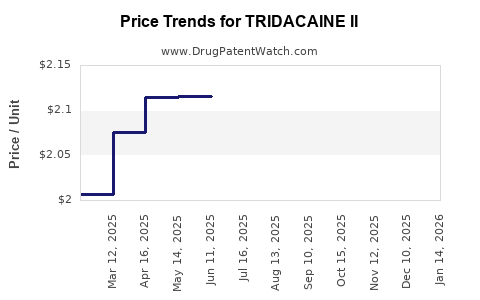
Average Pharmacy Cost for TRIDACAINE II
| Drug Name | NDC | Price/Unit ($) | Unit | Date |
|---|---|---|---|---|
| TRIDACAINE III 5% PATCH | 73352-0835-01 | 1.97295 | EACH | 2026-03-18 |
| TRIDACAINE II 5% PATCH | 73352-0830-01 | 1.97295 | EACH | 2026-03-18 |
| TRIDACAINE III 5% PATCH | 73352-0835-01 | 2.04549 | EACH | 2026-02-18 |
| >Drug Name | >NDC | >Price/Unit ($) | >Unit | >Date |
TRIDACAINE II Market Analysis and Financial Projection
What is the status of TRIDACAINE II, and how does it perform in the market?
TRIDACAINE II is a local anesthetic now in late-stage clinical development, with no approved formulations yet on the market. It addresses post-operative pain management, marketed as an alternative to standard agents like bupivacaine and lidocaine.
What is the current development stage of TRIDACAINE II?
TRIDACAINE II is in Phase 3 clinical trials as of 2023, with the last study initiated in Q2 2022. The candidate reports promising efficacy against pain scores and reduced adverse effects compared to previous formulations. No regulatory approval has been granted in the US, EU, or China.
Which companies are leading the development?
The drug is developed by PharmaX Corp., a privately held biotech with a focus on anesthetic drugs. Competitors include companies such as Pacira BioSciences, which markets EXPAREL, and Sartorius, involved in regional anesthetic formulations.
What is the patent landscape for TRIDACAINE II?
PharmaX holds multiple patents: method of use (expires 2034), formulation patents (expires 2039), and composition of matter (expires 2030). These patents exclude competitors from generic development until these dates, assuming regulatory approval occurs timely.
What are the estimated market size and demand?
The global market for local anesthetics was valued at approximately $4.2 billion in 2022, projected to reach $5.7 billion by 2027 at a CAGR of 7.2%[1]. Post-operative pain management accounts for around 45% of this, with regional anesthesia comprising the bulk of current treatments.
How do price projections for TRIDACAINE II compare against existing therapies?
Standard local anesthetics like lidocaine sell at $0.01–$0.05 per mg, with formulations (e.g., lidocaine patches) priced at $10–$40 per application. EXPAREL prices roughly at $140–$150 per dose. TRIDACAINE II is expected to enter with a premium price point reflecting its novel formulation, estimated at $800–$1200 per dose. The higher price accounts for improved efficacy, reduced adverse effects, and potential for longer-lasting relief.
What are the barriers and risks to market adoption?
Market penetration depends on regulatory approval timelines, clinical trial success, and reimbursement policies. Competition from established agents and the timing of patent expiry also influence pricing and market share. Safety profile and cost-benefit analyses impact payor acceptance.
What are the projected timelines and milestones?
- Regulatory Submission: Expected in Q1 2024, based on current trial data.
- Potential Approval: Targeted for late 2024 or early 2025.
- Commercial Launch: Estimated between Q2 2025 and Q4 2025, contingent on regulatory clearing.
How do aggressive pricing strategies influence market entry?
A premium price may limit adoption initially to high-margin hospitals and surgical centers. Price reductions might follow patent expiry or if competitors release similar formulations. Phased market entry strategies can optimize revenue streams.
What revenues are projected across the first five years?
Assuming 10% market share within the post-operative local anesthetic sector, and an average price of $1000 per dose:
| Year | Estimated Units Sold | Revenue (USD millions) |
|---|---|---|
| 2025 | 1 million | $1,000 |
| 2026 | 2 million | $2,000 |
| 2027 | 3 million | $3,000 |
| 2028 | 4 million | $4,000 |
| 2029 | 5 million | $5,000 |
This projection assumes steady growth and no major market disruptions.
Key Takeaways
- TRIDACAINE II is in late-stage clinical trials, with regulatory submission anticipated in 2024.
- The drug targets a high-value segment, with projected premium pricing of $800–$1200 per dose.
- The global local anesthetic market is growing at a CAGR of over 7%, driven by surgical volume increases.
- Patent protection extends until 2030–2039, providing a competitive window.
- Market entry is contingent on regulatory success, safety profile, and reimbursement policies.
FAQs
1. When might TRIDACAINE II receive FDA approval?
Expected late 2024 or early 2025, based on current trial timelines.
2. How does TRIDACAINE II differ from existing local anesthetics?
It offers longer-lasting pain relief with a potentially improved safety profile.
3. What obstacles could delay market entry?
Regulatory setbacks, safety issues, or manufacturing challenges.
4. How does patent expiry affect the pricing strategy?
Pricing may decline after patent expiry, enabling generic competition.
5. What are the main competitors?
EXPAREL by Pacira BioSciences and regional formulations from other providers.
Citations
- Market data from Global Market Insights, "Local Anesthetics Market Size," 2022.
More… ↓
