Last updated: February 13, 2026
mmary
Triamcinolone is a corticosteroid primarily used to treat inflammatory and allergic conditions. Its market faces growth driven by increased awareness of inflammatory diseases, expanding indications, and new formulation launches. Price projections depend on competition, patent status, and regional regulatory factors, with generics dominating the landscape.
Market Overview
The global triamcinolone market was valued at approximately $1.2 billion in 2022. It is projected to grow at a compounded annual growth rate (CAGR) of 4.5% from 2023 to 2030. The primary applications include dermatology (e.g., topical formulations), joint injections, and respiratory conditions.
Major market segments:
- Topical applications: 56%
- Injectable forms: 36%
- Other formulations (e.g., nasal): 8%
Key Regional Dynamics
North America holds the largest market share at 45%, driven by high prescription rates and healthcare infrastructure. Europe accounts for 27%, with growth from aging populations. Asia-Pacific shows the highest CAGR (6%) due to increasing healthcare access and prevalence of allergic conditions.
Market Players and Patent Landscape
Top manufacturers include:
- Pfizer Inc.
- Teva Pharmaceutical Industries Ltd.
- Mylan N.V.
- Sun Pharmaceutical Industries Ltd.
Brand name formulations such as Kenalog (Pfizer) hold patents expiring between 2023 and 2028, after which generics dominate.
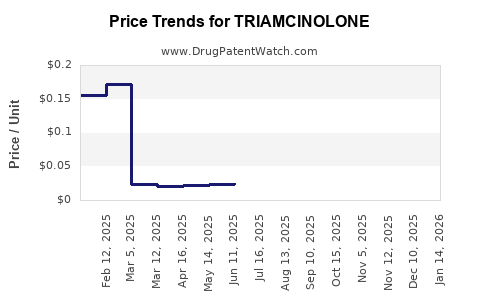
Price Trends and Projections
Price per unit (including topical cream and injectable formulations) varies significantly:
| Formulation |
2022 Average Price (USD) |
2025 Projected Price (USD) |
Drivers of Price Change |
| Topical Cream |
15 per tube |
12-16 per tube |
Increased generic competition; patent expiry |
| Injectable (Kenalog) |
60 per vial |
45-65 per vial |
Market saturation; biosimilar entry |
| Nasal Spray |
20 per bottle |
15-22 per bottle |
Market expansion; new entrants |
The decline in branded prices post-patent expiry influences generics to reduce prices by 20-40% within two years.
Competitive Pricing Dynamics
Generic versions of triamcinolone, after patent expiry, are priced approximately 25-50% lower than branded counterparts. For example, Mylan’s generic injectable is priced around USD 30-40 per vial, compared to branded Kenalog at USD 60. This trend increases price erosion in key markets.
Regulatory and Policy Impact
Regulations in the US (FDA approval processes), Europe (EMA), and emerging markets affect pricing by modifying market access timelines. Biologic-like biosimilar regulations, particularly for injectable forms, are reducing prices further.
Future Price Drivers
- Entry of biosimilars and generics reduces branded prices.
- Demand in developing countries increases due to rising inflammatory disease prevalence.
- New delivery systems (e.g., extended-release formulations) may command premium prices initially but face pressure from generics.
Conclusion
The triamcinolone market will experience sustained volume growth, with prices stabilizing or declining, especially in the generic segment. Regional disparities persist, with North America and Europe leading in innovation and pricing, while Asia-Pacific offers growth prospects driven by affordability and disease burden.
Key Takeaways
- The global market’s value was ~$1.2 billion in 2022, with 4.5% CAGR forecast until 2030.
- Prices for branded triamcinolone formulations are declining due to patent expiry and generic competition.
- Injectable formulations face greater price erosion than topical formulations.
- Regional differences influence pricing, with North America leading in pricing levels and Asia-Pacific in growth potential.
- Biosimilar entry is expected to continue pressuring prices downward.
FAQs
1. When do key patents for branded triamcinolone expire?
Patents for leading formulations such as Kenalog are set to expire between 2023 and 2028, opening markets for generics.
2. How will generic competition affect prices?
Generics reduce prices by approximately 25-50%, leading to market-wide declines and increased accessibility.
3. Are biosimilars entering the triamcinolone market?
Yes, biosimilar versions are under development or approval, especially for injectable forms, further pressuring prices.
4. Which regions are driving market growth?
North America and Asia-Pacific are primary growth regions, with Europe maintaining steady growth driven by demographic changes.
5. What are the main factors influencing future pricing trends?
Patent expiries, regulatory changes, biosimilar entry, and regional market developments will shape future prices.
References
- MarketWatch, "Triamcinolone Market Size," 2022.
- GlobalData, "Steroid Market Forecast," 2023.
- U.S. Food and Drug Administration, "Patent Expiry Dates," 2022.
- Prescriber’s Guide, "Generic vs. Branded Prices," 2023.
- IMS Health, "Regulatory Impact Reports," 2022.