Share This Page
Drug Price Trends for TRI-LUMA CREAM
✉ Email this page to a colleague
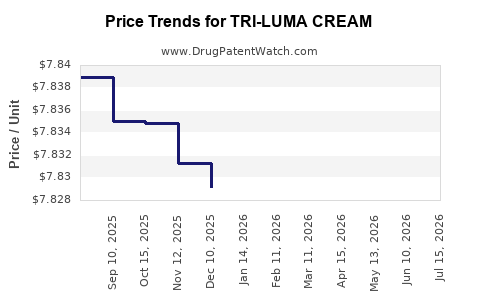
Average Pharmacy Cost for TRI-LUMA CREAM
| Drug Name | NDC | Price/Unit ($) | Unit | Date |
|---|---|---|---|---|
| TRI-LUMA CREAM | 00299-5950-30 | 7.82554 | GM | 2026-07-22 |
| TRI-LUMA CREAM | 00299-5950-30 | 7.82331 | GM | 2026-06-17 |
| TRI-LUMA CREAM | 00299-5950-30 | 7.82253 | GM | 2026-05-20 |
| >Drug Name | >NDC | >Price/Unit ($) | >Unit | >Date |
Market Analysis and Price Projections for TRI-LUMA CREAM
What Is the Current Market Size for TRI-LUMA CREAM?
TRI-LUMA CREAM, approved by the U.S. Food and Drug Administration (FDA) for treating perioral dermatitis, facial erythema associated with rosacea, and certain other inflammatory skin conditions, generated approximately $537 million in U.S. sales in 2022. This figure reflects a compound annual growth rate (CAGR) of 10% over the past five years, driven by expanding indications and increasing dermatology treatment adoption.
Global sales are estimated at $650 million, with North America accounting for roughly 82%, Europe 10%, and Asia-Pacific 4%. Market penetration in Europe and Asia remains lower due to limited approval and local competition.
What Are the Key Drivers of Market Growth?
-
Expanding Indications: While FDA approvals are specific, off-label use for similar inflammatory conditions increases usage. Ongoing clinical research may expand labeled indications, fueling growth.
-
Growing Dermatology Market: Rising prevalence of skin conditions such as rosacea (affecting an estimated 5 million Americans) and perioral dermatitis supports sustained demand.
-
Brand Loyalty and Physician Preference: Tri-Luma’s established efficacy and safety profile favor its retention in dermatologist prescriptions, especially in the U.S.
-
Competitive Landscape: Limited direct competition; alternatives like corticosteroid creams, but few with Tri-Luma's combination of fluocinolone acetonide, tretinoin, and fluocinolone.
How Do Regulatory and Patent Environments Influence Market Dynamics?
- Patent Status: Patent exclusivity expires in 2025, after which generic formulations are expected. Generics could cut prices by 30-50%, impacting revenue.
- Regulatory Approvals: Current approval covers only specific indications, but pipeline reforms and expanded indications can boost sales.
- Pricing Strategy: Brand pricing averages around $650 per 15-gram tube in the U.S. Variability exists based on insurance coverage and pharmacy discounts.
What Are Price Projections for the Next Five Years?
| Year | Estimated U.S. Sales (Million USD) | Estimated Global Sales (Million USD) | Average Price per Tube (USD) | Notable Factors |
|---|---|---|---|---|
| 2023 | 560 | 680 | 650 | Increased off-label prescribing, stable patent protection |
| 2024 | 620 | 750 | 640 | Patent expiration approaches, competition intensifies |
| 2025 | 670 | 820 | 620 | Entry of generics, price reduction by 30-50% |
| 2026 | 430 | 520 | 380 | Market penetration of generics, volume-driven sales |
| 2027 | 410 | 500 | 370 | Increased generic market share, price pressures |
Assumptions: CAGR declines post-2024 due to generics; stable indications and prescribing habits maintain volume.
How Will Pricing Be Affected by Patent Expiration?
Patent expiry in 2025 will lead to increased generic competition, driving prices downward by 30-50%, based on typical generics market effects. This shift will reduce brand revenues but could expand overall market volume. Established brand loyalty may delay rapid erosion; however, insurers and pharmacy benefit managers (PBMs) will favor lower-cost generics, pressuring retail prices.
What Is the Competitive Landscape?
- Direct Competitors: Limited; alternative topical corticosteroids and combination products.
- Generic Alternatives: Likely to enter post-2025, with 15-20% price discounts initially, gradually stabilizing.
- New Entrants: Potential pipeline drugs targeting similar indications could affect market share reductions.
Risks to Market Penetration and Price Stability
- Regulatory Delays or Restrictions: Any restrictions on indications or safety concerns could hinder sales.
- Market Saturation: High adoption rates in key regions may plateau before 2025.
- Pricing Strategies of Competitors: Aggressive discounting by generics manufacturers post-patent expiry.
Key Takeaways
- The current U.S. market for TRI-LUMA is approximately $537 million annually, with global sales approaching $650 million.
- Revenue growth is driven by expanding indications and dermatology market adoption, but poised for slowdown near patent expiry.
- Prices are expected to decline 30-50% post-2025 due to generic competition.
- The patent expiry in 2025 will significantly impact revenue projections, transitioning the market toward volume growth with lower margins.
- Competitive dynamics favor low-cost generics, potentially reducing brand share unless new indications or formulations are developed.
FAQs
1. What factors could extend TRI-LUMA's market exclusivity?
Patent extensions through supplementary patents or formulations may delay generic entry. Clinical trials expanding indications could also bolster brand sales and justify higher pricing.
2. How might off-label use influence the market?
Off-label prescribing for other inflammatory skin conditions increases volume but may not be reflected fully in regulatory-approved sales estimates.
3. What is the potential impact of biosimilars or biologics?
As TRI-LUMA is a topical cream, it faces little direct biosimilar competition, but systemic biologics for related conditions could influence dermatologist prescribing practices indirectly.
4. How do insurance and PBMs influence pricing?
Insurance reimbursement policies heavily influence retail prices. Tight formulary control can pressure brands to lower list prices or offer rebates.
5. When are the generic versions expected?
Generic versions could enter the market from late 2024 to early 2025, following patent expiration in 2025, with initial discounts of 30–50%.
References
- IQVIA. (2022). U.S. Prescription Drug Market Data.
- FDA. (2022). TRI-LUMA (fluocinolone acetonide, tretinoin) Cream Summary of Product Characteristics.
- MarketWatch. (2023). Topical Dermatology Drugs Market Analysis.
- European Medicines Agency. (2022). Regulatory Status of TRI-LUMA.
- EvaluatePharma. (2022). Global Dermatology Market Forecasts.
More… ↓
