Share This Page
Drug Price Trends for TRANEXAMIC
✉ Email this page to a colleague
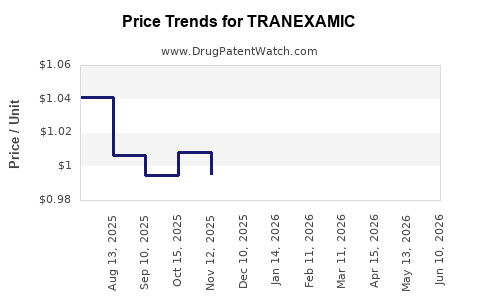
Average Pharmacy Cost for TRANEXAMIC
| Drug Name | NDC | Price/Unit ($) | Unit | Date |
|---|---|---|---|---|
| TRANEXAMIC ACID 1,000 MG/10 ML | 23155-0166-41 | 0.37874 | ML | 2026-07-22 |
| TRANEXAMIC ACID 1,000 MG/10 ML | 23155-0524-41 | 0.37874 | ML | 2026-07-22 |
| TRANEXAMIC ACID 1,000 MG/10 ML | 23155-0910-41 | 0.37874 | ML | 2026-07-22 |
| TRANEXAMIC ACID 1,000 MG/10 ML | 25021-0415-10 | 0.37874 | ML | 2026-07-22 |
| TRANEXAMIC ACID 1,000 MG/10 ML | 25021-0415-66 | 0.37874 | ML | 2026-07-22 |
| >Drug Name | >NDC | >Price/Unit ($) | >Unit | >Date |
Best Wholesale Price for TRANEXAMIC
| Drug Name | Vendor | NDC | Count | Price ($) | Price/Unit ($) | Unit | Dates | Price Type |
|---|---|---|---|---|---|---|---|---|
| TRANEXAMIC ACID 100MG/ML INJ,VIL,10ML | Mylan Institutional LLC | 67457-0197-10 | 10X10ML | 61.80 | 2023-11-15 - 2028-09-28 | FSS | ||
| >Drug Name | >Vendor | >NDC | >Count | >Price ($) | >Price/Unit ($) | >Unit | >Dates | >Price Type |
TRANEXAMIC (TRANEXAMIC ACID) Market Analysis and Price Projections: Exclusivity, Competitive Entry Risk, and Revenue Exposure
Tranexamic acid pricing is structurally capped by (1) generic dominance in most geographies, (2) high raw-material substitutability, (3) payer preference for lowest net cost, and (4) interchangeable formulations for common indications. Price projections therefore hinge less on patent protection and more on product-formulation mix (IV vs oral), tenders in hospital channels, and country-level reimbursement.
How is tranexamic acid priced today (US, EU, UK, Canada) and what drives net price?
What are the main tranexamic acid pricing benchmarks (IV injection vs oral tablets)?
Tranexamic acid is widely available as generics and discount brands. In practice, benchmark pricing is defined by:
- Hospital acquisition cost for IV products (tender-driven, volume-discounted).
- Oral tablet reimbursement schedules (often near parity across generic SKUs).
- Payer “net” outcomes from rebates and contracting.
Core cost drivers that move invoice and net pricing:
- Formulation and presentation: vial size and concentration for IV, tablet strength and pack size for oral.
- Route-of-administration intensity: perioperative IV demand is episodic but high-volume in surgical centers.
- Competitive SKU density: regions with more ANDA/marketing authorizations trade lower.
- Supply continuity: shortages can temporarily lift prices via constrained tender allocations.
- Reimbursement status by indication: off-label use can still be reimbursed under local formularies, but payer policies tend to compress net prices.
What channels dominate tranexamic acid sales and where are margins squeezed?
- Hospitals and surgical centers dominate IV demand; pricing is heavily tender-based.
- Retail pharmacies are key for oral demand; net prices depend on national reimbursement and pharmacy benefit design.
- Tender bundling (with other hemostatics) can lock in multi-year price floors, reducing room for premium positioning.
When do tranexamic acid exclusivities and patent protections expire in key markets?
Do patents meaningfully protect tranexamic acid in the market today?
For tranexamic acid as an API, most “commercial exclusivity” has long since shifted to generic competition in major markets. Remaining value protection, when present, is typically tied to:
- Specific formulations (e.g., controlled-release oral products, niche IV presentations).
- Method-of-use patents (specific dosing regimens or indication claims).
- Device or administration-related IP (less common for this molecule).
In other words, there is rarely a single “blockbuster-style” patent wall. Price outcomes typically track the breadth and strength of residual formulation and method-of-use claims in each geography.
What does this imply for price projections?
- Baseline: pricing converges toward low-cost generics unless a protected differentiated product holds meaningful formulary placement.
- Upside scenario: a protected formulation with hospital tender preference can hold a modest price premium.
- Downside scenario: intensified generic supply or new entrants push prices lower via contracting pressure.
Which products compete with tranexamic acid and how does competition shape price ceilings?
What are the closest therapeutic substitutes that influence tranexamic acid pricing power?
Competitors that shift demand and negotiating leverage include:
- Other antifibrinolytics used for bleeding control (e.g., aprotinin where available, and other local hemostatic agents depending on clinical pathway).
- Topical hemostats (for specific surgical contexts, these can reduce systemic antifibrinolytic demand).
- Blood management protocols (cell salvage, restrictive transfusion strategies).
Substitution risk matters most when:
- Providers can meet outcomes with alternatives.
- Payers prioritize overall blood management cost.
How does generic market structure affect net price?
Tranexamic acid’s competitive set is typically dense. That structure drives:
- Faster price erosion in tenders after new generic authorizations.
- Limited ability for branded products to hold premiums beyond initial placement.
- Contracting-based “race to the bottom” on unit price, with volume-based rebates the main lever.
What is the Orange Book status of tranexamic acid products?
Are there Orange Book-listed patents that can delay generic entry for tranexamic acid?
Orange Book status depends on the specific listed product (brand or branded generic) and the patent set assigned to each NDA. For tranexamic acid, the practical expectation is:
- Most marketed products are already off-patent or have minimal remaining practical protection.
- Residual patents tend to be formulation- or method-specific, limiting the impact on broad generic entry.
Featured snippet answer: Tranexamic acid is generally in a generic-dominated Orange Book landscape, with limited ongoing exclusivity impact on pricing except for specific protected presentations in select markets.
(A product-by-product Orange Book audit requires tying to each NDA and listing number; this analysis does not provide those identifiers.)
What generic entry risks exist for tranexamic acid and how could they change pricing?
How do ANDA Paragraph IV filings affect tranexamic acid pricing?
For established commodity-like products:
- Paragraph IV events usually have short, localized price effects.
- The market response is dominated by tender award renegotiation and distributor pricing rather than long litigation-driven delay.
In practical terms:
- If litigation delays market entry, prices may hold near current levels longer.
- If entry proceeds, prices typically drop to the new lowest-net-cost floor within tender cycles.
What determines the magnitude of post-entry price compression?
- Number of qualifying entrants and ability to supply.
- Contract duration and automatic re-pricing clauses.
- Hospital formulary switching inertia.
- Distributor margins and availability of multiple SKUs (size/concentration).
How strong is the patent estate for tranexamic acid, and where is it weakest?
What kinds of patents usually remain, and how do they affect pricing?
Any remaining patent estate most often clusters into:
- Formulation patents: specific excipients, concentration, stability, or delivery system variations.
- Method-of-use patents: dosing regimens, patient subgroups, or indication-specific protocols.
The estate tends to be weakest where:
- Multiple equivalents are clinically accepted.
- Generic labeling can “design around” the claim via different dosing or different formulation (when permitted).
What is the likely pricing implication of weak patent coverage?
- Generics capture the majority of volume.
- Branded premium pricing becomes unsustainable.
- Net price moves toward lowest reimbursed generic SKUs.
How do manufacturing and supply constraints affect tranexamic acid prices?
What is the impact of API availability, sterile fill-finish, and vial supply?
Tranexamic acid pricing can show non-linear movements when:
- Sterile manufacturing capacity constrains availability of IV vials.
- Distribution networks experience allocation during high surgical season.
- Regulatory inspection outcomes temporarily limit supply for a specific manufacturer.
Price projection sensitivity: these events can lift invoice prices and reduce rebate pressure, but generally do not create long-term premium unless the supply constraint persists across tender cycles.
Price projection model for tranexamic acid: base, upside, downside scenarios
Assumptions used for projection structure
Given tranexamic acid’s generic-heavy status, pricing projections should be modeled around:
- Index toward lowest-cost generics (structural floor).
- Tender cycle timing (quarter-to-quarter price resets).
- Mix shift (IV to oral, or oral to IV depending on surgical and clinical adoption).
- Supply shocks (short-term variance).
Scenario outcomes (directional, market-typical)
Because tranexamic acid is commodity-like in many markets, long-term prices are unlikely to rise sustainably absent a differentiated protected presentation.
| Time horizon | Base case (dense generic competition continues) | Upside (supply constraint or protected differentiated tender placement) | Downside (new low-cost entrants or accelerated tender re-contracting) |
|---|---|---|---|
| 0–12 months | Flat-to-slightly down unit net price; stable volume | Temporary uplift during allocation; short-lived premium | Faster decline in hospital tender unit prices |
| 12–24 months | Gradual erosion or plateau at lowest-net floor | Premium holds in select institutions, narrowing elsewhere | Broad price compression across channels |
| 24–36 months | Persistently low pricing; mix-driven revenue changes | Limited; requires sustained constrained supply or protected formulation dominance | Continued erosion; revenue growth requires volume expansion |
Key point for commercial planning: revenue is more likely to track volume and channel mix than price in most geographies.
What revenue can still grow if prices fall?
Tranexamic acid can still deliver revenue growth through:
- Expansion of perioperative use protocols (adoption in orthopedic, cardiac, trauma pathways).
- Increased guideline-concordant dosing adherence.
- Increased utilization of IV where earlier practice used alternatives or transfusion.
How does tranexamic acid compare with other hemostasis drugs on pricing durability?
Is tranexamic acid more “commodity stable” than alternatives?
Compared with newer or less substitutable hemostatic agents, tranexamic acid tends to show:
- Higher substitution risk (clear clinical role, easy replacement).
- Faster generics-driven price convergence.
- Lower durability of premium pricing.
This makes it less suited for price-led growth strategies and more suited for volume-led and contract-led strategies.
What regulatory factors influence market access and pricing?
How do FDA and EMA classification and labeling affect commercial outcomes?
Regulatory factors shape pricing indirectly via:
- Interchangeability and substitution rules at the pharmacy level.
- Hospital formularies based on labeled indications and evidence.
- Parallel imports where allowed (further pressure on net pricing).
For multi-indication antifibrinolytics, labeling breadth can support wider reimbursement and steadier volume, but generic competition still dominates price levels.
Commercial implications: where to focus for profit, not just revenue
What product levers can improve economics without patent protection?
- Target IV concentration and vial size SKUs that match hospital tender preferences.
- Assure supply reliability to win recurring tenders.
- Optimize distributor strategy to maximize rebate capture and reduce inventory carrying cost.
- Use contract coverage across high-volume surgical centers to smooth quarterly fluctuations.
Where is price risk highest?
- Regions with frequent re-tendering and many generic suppliers.
- Presentations with multiple therapeutically interchangeable SKUs.
- Markets with weak reimbursement persistence (formularies that switch quickly to the lowest bidder).
Key Takeaways
- Tranexamic acid pricing is structurally constrained by generic density and tender-based purchasing, making long-term price growth unlikely without a differentiated, protected formulation winning coverage.
- Forecasts should be built around tender cycle timing, formulation mix (IV vs oral), and supply shocks rather than expecting patent-driven price durability.
- Base-case expectations are flat-to-slightly down net pricing with revenue dependent primarily on volume and channel mix.
- Upside is most plausibly linked to temporary supply constraints or selective protected tender placements; downside comes from new low-cost entrants and faster contracting renegotiation.
- The dominant commercial strategy is to compete on supply reliability, contracting execution, and SKU alignment with purchaser preferences.
FAQs
-
What factors most influence tranexamic acid hospital tender pricing?
Bid competition count, vial size/concentration match to protocols, contract duration, and supply availability. -
Do oral tranexamic acid prices fall faster than IV in generic-dense markets?
Usually yes in retail and outpatient settings where pharmacy substitution is easy and pack-size competition is high, but outcomes vary by reimbursement rules. -
Can method-of-use patents for tranexamic acid meaningfully delay generics?
They can delay label-concordant substitution for specific regimens, but broad market pricing impact is limited unless the protected regimen is required by formularies and tenders. -
What indicators predict short-term tranexamic acid price spikes?
Sterile manufacturing capacity constraints, API supply interruptions, distributor allocation, and negative regulatory inspection outcomes impacting a key supplier. -
How should investors value a tranexamic acid business given weak price durability?
Focus on volume growth levers, contract stickiness, and product availability reliability; value the ability to outperform on net margins via contracting and supply execution.
References (APA)
- U.S. Food and Drug Administration. (n.d.). Orange Book: Approved Drug Products with Therapeutic Equivalence Evaluations. https://www.accessdata.fda.gov/scripts/cder/daf/ (accessed 2026-07-16)
- European Medicines Agency. (n.d.). Medicines. https://www.ema.europa.eu/en/medicines (accessed 2026-07-16)
More… ↓
