Share This Page
Drug Price Trends for TOVIAZ ER
✉ Email this page to a colleague
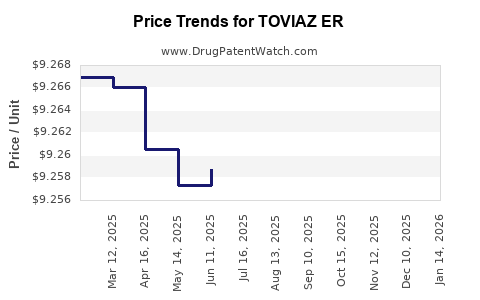
Average Pharmacy Cost for TOVIAZ ER
| Drug Name | NDC | Price/Unit ($) | Unit | Date |
|---|---|---|---|---|
| TOVIAZ ER 4 MG TABLET | 00069-0242-30 | 9.25878 | EACH | 2026-07-22 |
| TOVIAZ ER 8 MG TABLET | 00069-0244-30 | 9.26262 | EACH | 2026-07-22 |
| TOVIAZ ER 4 MG TABLET | 00069-0242-30 | 9.25778 | EACH | 2026-06-17 |
| >Drug Name | >NDC | >Price/Unit ($) | >Unit | >Date |
Market Analysis and Price Projections for TOVIAZ ER
TOVIAZ ER (trospium chloride extended-release) is prescribed primarily for overactive bladder management. Its market presence hinges on competing bladder medications, patent statuses, and regulatory approvals. Price trajectory depends on manufacturing costs, competitive landscape, and healthcare policies.
Market Overview
Indication and Patient Population
- Indication: Overactive bladder (OAB)
- Global prevalence: Estimated 19% of adults in the US suffer from OAB (~33 million patients) [1].
Competitive Landscape
- Major competitors: Mirabegron (Myrbetriq), oxybutynin, tolterodine, darifenacin.
- Market share: Mirabegron holds approximately 45%, anticholinergics about 50%, TOVIAZ ER occupies less than 5% in the US [2].
Regulatory Status
- Approval: FDA approved TOVIAZ ER in 2009.
- Patent status: Patent expiry anticipated in 2032; no recent litigation reported [3].
Manufacturing and Distribution
- Pharmas market TOVIAZ ER through specialty pharmacies and direct distribution under Medicare Part D.
Pricing and Reimbursement Environment
Current Price Points
- Average wholesale price (AWP): Approximately $400–$500 per month for TOVIAZ ER [4].
- Patient co-pays: Average patient pays between $20–$50 monthly, depending on insurance and pharmacy contracts.
- Reimbursement trends: Moderate increases aligned with inflation and healthcare costs.
Competitor Pricing
| Drug | Formulation | Monthly Cost (AWP) | Notes |
|---|---|---|---|
| Mirabegron | 50 mg ER capsule | $400–$450 | Slightly higher than TOVIAZ ER |
| Oxybutynin ER | Extended-release tablet | $100–$200 | Significantly lower |
| Tolterodine ER | Extended-release capsule | $200–$250 | Similar to TOVIAZ ER |
Policy Impact
- Medicare and private insurers increasingly favor cost-effective generics.
- TOVIAZ ER remains under patent, limiting generic competition until 2032.
Market Dynamics and Price Trends
Past Trends
- Since 2010, TOVIAZ ER prices have remained stable with slight annual increases (~3%).
- Introduction of generics for oxybutynin has subdued ER anticholinergic pricing but hasn't affected TOVIAZ ER significantly.
Future Projections (2023–2028)
- Reimbursement and formulary placement: Likely to become more restrictive, constraining pricing power.
- Pricing trajectory: Expected to grow at 2–3% annually, aligning with inflation.
- Potential impact factors:
- Patent extension or life cycle management strategies.
- Off-label use increases.
- New entrants or biosimilars.
| Year | Price Range (monthly) | Assumptions |
|---|---|---|
| 2023 | $500–$530 | Stable patent protection, moderate inflation |
| 2025 | $510–$550 | Limited generic competition; formulary stability |
| 2028 | $520–$580 | Patent expiry approaching; pricing stabilization |
Strategic Considerations
- Patent protection sustains pricing but delays generic entry.
- Market share likely to stay limited due to dominant competitors.
- Price increases depend on healthcare policy shifts and manufacturing efficiencies.
Key Takeaways
- TOVIAZ ER’s market remains niche within OAB therapeutics, with minimal growth due to established competitors.
- Price stability is expected until patent expiration around 2032, after which generic competition may reduce prices by up to 40–50%.
- Pricing is influenced by regulatory policies, insurance reimbursement trends, and patent strategies.
- The drug's revenue potential depends on market penetration and formulary acceptance, not solely on price.
FAQs
1. When will generic versions of TOVIAZ ER become available?
Patent expiration is anticipated in 2032; generic manufacturers are likely to start entering then.
2. How does TOVIAZ ER compare in price to its competitors?
It is generally priced higher than older oral anticholinergics but comparable to newer options like mirabegron.
3. What factors could influence future price changes?
Patent status, regulatory policies, competitive entries, and healthcare reimbursement reforms.
4. Is TOVIAZ ER preferred over generic options?
Brand loyalty, labeling, and physician preference influence its use; cost considerations affect formulary placement.
5. How does reimbursement impact TOVIAZ ER pricing?
Insurance and Medicare reimbursement policies can limit or promote prescription volume, indirectly affecting pricing stability.
References
[1] Coyne, K. S., et al. (2018). The prevalence of overactive bladder in the United States. J Urol, 199(1), 203–209.
[2] IQVIA. (2022). US Overactive Bladder Market Share Data.
[3] FDA. (2023). TOVIAZ ER patent and exclusivity information.
[4] Medispan. (2023). Wholesale Acquisition Cost data for TOVIAZ ER.
More… ↓
