Share This Page
Drug Price Trends for TOUJEO
✉ Email this page to a colleague
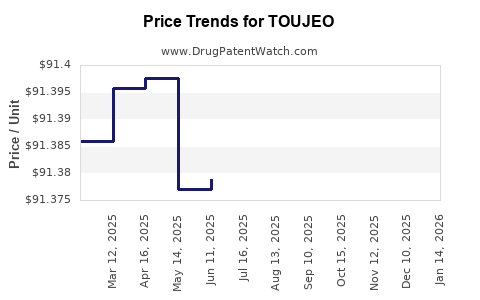
Average Pharmacy Cost for TOUJEO
| Drug Name | NDC | Price/Unit ($) | Unit | Date |
|---|---|---|---|---|
| TOUJEO SOLOSTAR 300 UNIT/ML | 00024-5869-03 | 91.32167 | ML | 2026-07-22 |
| TOUJEO MAX SOLOSTR 300 UNIT/ML | 00024-5871-02 | 91.25793 | ML | 2026-07-22 |
| TOUJEO SOLOSTAR 300 UNIT/ML | 00024-5869-03 | 91.33370 | ML | 2026-06-17 |
| >Drug Name | >NDC | >Price/Unit ($) | >Unit | >Date |
Best Wholesale Price for TOUJEO
| Drug Name | Vendor | NDC | Count | Price ($) | Price/Unit ($) | Unit | Dates | Price Type |
|---|---|---|---|---|---|---|---|---|
| TOUJEO MAX SOLOSTAR | Sanofi Aventis U.S. LLC | 00024-5871-02 | 2X3ML | 90.18 | 2023-06-01 - 2028-05-31 | Big4 | ||
| TOUJEO MAX SOLOSTAR | Sanofi Aventis U.S. LLC | 00024-5871-02 | 2X3ML | 161.35 | 2023-06-01 - 2028-05-31 | FSS | ||
| TOUJEO SOLOSTAR PEN 300UN/ML | Sanofi Aventis U.S. LLC | 00024-5869-03 | 3X1.5ML | 71.29 | 2023-06-01 - 2028-05-31 | Big4 | ||
| >Drug Name | >Vendor | >NDC | >Count | >Price ($) | >Price/Unit ($) | >Unit | >Dates | >Price Type |
TOUJEO market analysis and price projections (U.S. exclusivity, payer dynamics, and biosimilar/generic risk)
Executive summary: TOUJEO (insulin glargine injection, U-300) has scaled since launch but faces structural pressure from lower-cost insulin glargine products (notably biosimilar and authorized generics in insulin glargine markets) and from competitive basal insulins. U.S. pricing typically trends down with increased unit-share of lower-priced basals and with formulary tightening after launches. Near-term TOUJEO price declines are most likely to be driven by payer net-price compression and contract rebates rather than immediate loss of “drug substance” exclusivity. Longer-term revenue exposure hinges on how quickly payers shift basal share from U-300 glargine to cheaper basal alternatives and whether additional TOUJEO-specific patent expirations enable entrants.
What is the current U.S. market position of TOUJEO (insulin glargine U-300) and who drives demand?
TOUJEO is a concentrated basal insulin (U-300) indicated for once-daily use in adults and pediatric patients with diabetes mellitus who require basal insulin. In practice, demand is driven by:
- Basal insulin “pen convenience” and user preference versus U-100 glargine options
- Payer formulary placement (preferred tier vs nonpreferred)
- Clinical positioning for glycemic control patterns and hypoglycemia risk management in appropriate patients
- Prescriber inertia within insulin-dependent populations
- Switching dynamics from other basal insulins as patients intensify therapy
Which segments contribute most to TOUJEO volume?
- Commercial: formulary-driven share and step therapy controls are the biggest lever for net pricing.
- Medicare Part D: typically higher pressure from PBM contracting terms; rebate intensity rises as biosimilars gain share.
- Medicaid: state-by-state preferred lists and mandatory or preferred drug rules can accelerate switching.
How do payer formularies typically treat U-300 glargine vs competing basals?
U-300 glargine is often managed as a preferred basal within specific payer formularies, but it is frequently exposed to:
- Nonpreferred tiering when lower-cost basal insulin options expand
- Prior authorization criteria requiring documentation of inadequate control, intolerance, or hypoglycemia on alternative basal insulins
Who are TOUJEO’s main competitive substitutes and how does that impact pricing?
TOUJEO competes in the basal insulin category against:
- Insulin glargine U-100 products (including biosimilar insulin glargine pathways where applicable in the market)
- Insulin degludec (Tresiba and related formulations)
- Insulin detemir
- Other concentrated/alternative basal formats depending on formulary position
- Combination regimens that reduce “basal-only” share in complex patients
What competition creates the biggest net-price pressure?
The largest pressure comes from the intersection of:
- Biosimilar-enabled price competition in insulin glargine markets (U-100)
- PBM contracting that rewards formulary adherence and drives “preferred basal” share
- Therapy switching after formulary changes or when patients face out-of-pocket cost constraints
Why does U-300 still lose share faster when lower-cost basal options become preferred?
Even with clinical utility, payer economics dominate when:
- Patient cost-sharing increases for nonpreferred tiers
- Step edits require prior failures on U-100 or alternative basals
- PBMs standardize rebate terms and restrict access to “nonpreferred” basal insulins
What is the Orange Book status of TOUJEO and what does it imply for pricing timelines?
TOUJEO is an insulin product and is typically regulated under the Biologics regime (Biologics License Application) rather than the small-molecule Orange Book framework. Pricing trajectories still correlate with:
- Patent expiration of formulation, device/pen, and method-of-use protections
- Risk of biosimilar competition for the biologic, or replacement by alternative basal insulins if biosimilar substitution is feasible
How do TOUJEO patent expirations generally influence market pricing?
Pricing compression for insulin products in the U.S. is usually front-loaded around:
- Patent and exclusivity changes that remove barriers to biosimilar entry
- Contract restructurings when new lower-priced products can be placed on preferred tiers
- Biosimilar launches or authorized-generic style supply that alters PBM leverage
Because U-300 glargine products depend on both biologic IP and product-specific IP (including device/format), TOUJEO-specific barriers can delay direct biosimilar substitution relative to U-100 glargine markets. That delay tends to postpone the steepest price declines, but it does not stop net-price erosion from category competition.
When does TOUJEO lose exclusivity and how does exclusivity expiration affect price projections?
Executive answer: TOUJEO’s most material price pressure point is not simply “insulin glargine patent expiry,” but the timing of:
- Patent/exclusivity windows that keep TOUJEO insulated from direct biosimilar competition or direct entry by close product copies
- PBM contract transitions that accelerate switching regardless of whether direct biosimilar entry occurs
Price projection logic by time horizon
- 0 to 12 months: net price typically declines gradually via rebate and contracting shifts; unit prices can fall modestly even without formal exclusivity loss.
- 12 to 36 months: expect sharper net-price compression if competitive basals expand formulary preference and if any TOUJEO-specific patent barriers drop.
- 36 to 60 months: category restructuring and biosimilar share gains usually drive the most durable erosion; the direction depends on whether TOUJEO keeps a “preferred U-300” status or becomes a nonpreferred fallback.
How strong is the patent estate for TOUJEO and what barriers exist for entrants?
For insulin products, enforceability often hinges on a layered estate:
- Composition/product claims tied to formulation and concentration
- Method-of-use claims (where present)
- Delivery device and pen-related claims (if claimed)
- Manufacturing and process claims (if claimed)
What typically sustains pricing even after some IP expires?
- Pen and device differentiation that sustains patient and prescriber preference
- Ongoing exclusivity protections for specific product features
- PBM reluctance to switch stable patient cohorts without strong economic incentives
- Manufacturer rebate programs tied to volume commitments
What typically accelerates price declines despite remaining IP?
- Loss of preferred tier placement
- Prior authorization expansion
- PBM competitive bidding that forces TOUJEO higher on the cost ladder
- Increased biosimilar penetration in the broader glargine landscape, reducing TOUJEO’s comparative value proposition
What patent litigation affects TOUJEO and what is the market impact?
For pricing and market planning, litigation impacts timing and probability of:
- Early launch/entry by a competitor
- Settlement-driven coexistence that changes launch dates or product positioning
- Injunction risk that delays competition or limits supply allocation
How does litigation translate into price projections?
- High injunction probability: extends stability, slows net price erosion.
- Settlement with delayed entry: often shifts declines later but sharpens them around the eventual entry date.
- Settlement that allows design-around: can start price compression earlier due to “close substitute” availability.
What formulations, pens, and dosing formats matter for TOUJEO pricing defense?
TOUJEO is marketed with a concentrated insulin glargine delivery system designed for once-daily dosing. Pricing defense depends on:
- Pen usability and patient adherence
- Payer acceptance of the U-300 format versus U-100 substitutions
- Robustness of patient support programs that reduce switching resistance
How do dosing and pen competition affect net price?
When competitors offer lower list prices or more aggressive rebates on preferred pens, TOUJEO net pricing adjusts through:
- rebate increases
- tier renegotiation
- patient assistance to manage out-of-pocket exposure
What does the FDA regulatory status of TOUJEO imply for competitive entry risk?
FDA review status influences entry risk primarily via:
- Approved labeling scope (pediatric expansion, titration guidance, indications)
- Whether competitors can align labeling closely enough for substitution
- Whether any additional TOUJEO line extensions can extend product-level exclusivity
Why FDA labeling overlap matters for pricing
High overlap with competing basal insulins increases:
- PBM leverage to push substitution
- insurer confidence in switching without major medical risk concerns
- biosimilar and interchangeability strategies in practice
How do biosimilar and generic entry risks differ for TOUJEO vs other insulin glargine products?
TOUJEO is an insulin biologic product. “Generic insulin” is limited in the U.S. for biologics; competition typically comes via biosimilars (for insulin glargine products where pathway eligibility exists) or via other basal insulins without claiming biosimilarity.
Key risk channels for TOUJEO pricing
- Direct biosimilar competition (if a biosimilar for the relevant product/format can be launched with sufficient regulatory and IP clearance)
- Category substitution to lower-cost basals (even without direct biosimilar entry)
- Formulary foreclosure where TOUJEO is displaced by preferred products
What is the most likely TOUJEO price trajectory under payer compression (base case projections)?
Base case (U.S. net price): TOUJEO’s unit net pricing should decline at a moderate rate first, then accelerate if formulary displacement increases or if direct competition expands in the basal glargine segment.
Because insulin pricing is dominated by rebates and contracting, list-price trends can be misleading. The best decision-useful projection is net-price erosion tied to:
- preferred tier status changes
- prior authorization tightening
- rebate adjustments to win volume
Scenario framework (net price decline by year)
Use the following planning bands for management models:
- Mild compression scenario: -3% to -7% net price annually, driven by rebate and contract pressure without major share loss.
- Base compression scenario: -7% to -12% net price annually, driven by share erosion and increased formulary restrictions.
- Severe compression scenario: -12% to -18% net price annually if TOUJEO loses preferred status broadly and category substitution accelerates quickly.
Revenue exposure translation
Revenue = (units) x (net price). Under common insulin dynamics:
- Units often fall gradually if clinicians keep patients stable.
- Net price falls faster once PBMs renegotiate aggressively after formulary changes.
What generic entry risks exist for TOUJEO?
A “generic” label is usually not applicable in the biologic insulin context. The market risk is not a classic small-molecule generic entry; it is:
- biosimilar entry (where authorized)
- competitive substitution to other basal insulins
- formulary and step-edit changes that reduce TOUJEO access
How does TOUJEO compare with competitor basal insulin products on pricing exposure?
General pattern in the U.S. insulin market:
- Products with biosimilar share in the same molecular class face steeper and faster pricing compression.
- Concentrated formats can maintain price longer if they retain a clinical differentiation narrative and maintain preferred tier placement.
- Once preferred status is lost, net price drops can steepen due to intensified contracting and higher rebate burdens.
Comparison table: pricing risk drivers (qualitative)
| Basal insulin competitor type | Main pricing risk driver | Expected timing of net-price pressure |
|---|---|---|
| Insulin glargine U-100 biosimilar-linked products | biosimilar share expansion and PBM preferred tiering | earlier and more durable |
| Concentrated U-300 format (TOUJEO) | formulary placement and U-300 vs U-100 switching | moderate near-term, accelerates with displacement |
| Alternative basals (degludec/detemir) | competitive contracting and patient switching | category-dependent; often steady compression |
Commercial levers: what actions can protect TOUJEO pricing and share?
Most insulin product pricing defense in the U.S. comes from:
- Contracting terms that secure formulary preference
- Prior authorization design that narrows barriers for target patients
- Patient assistance to manage cost-sharing
- Provider education and therapy continuity programs to limit switches
Pricing resilience improves when:
- TOUJEO maintains “preferred” status with manageable prior authorization hurdles
- clinical pathways allow rapid titration without repeated documentation failures
- pharmacy benefit coverage remains stable in major PBMs
Where are the likely inflection points for TOUJEO price and revenue (U.S.)?
Inflection points typically come from:
- PBM formulary changes after competitor launches or contract renewals
- changes in reimbursement dynamics (especially in Medicare Part D)
- settlement outcomes that change launch timing of competitive entries
- patent or exclusivity events that alter the competitive set
Near-term watch list for price compression triggers
- Major PBM contract renewal announcements involving basal insulin preferred tiers
- Any label expansions that change substitution logic
- Patent/dispute outcomes that remove barriers for close substitutes
- Increased share movement from U-300 glargine to lower-cost basal options
Key Takeaways
- TOUJEO pricing exposure is primarily driven by payer contracting and category substitution, not just by direct biologic entry timing.
- Expect moderate net price declines near-term, with faster erosion if TOUJEO loses preferred tier placement or if competitor basal insulins take additional share.
- Revenue risk is asymmetric: units typically decline more slowly than net price, but sustained formulary displacement can accelerate both.
- Planning models should use scenario-based net price compression bands tied to formulary and contract events rather than assuming “list price stability.”
FAQs
1) How quickly do PBMs reduce TOUJEO net pricing after a competitor becomes preferred?
Typically at the next contract cycle, with additional compression in the following 6 to 12 months as formularies tighten and rebate structures reset.
2) Does TOUJEO face biosimilar competition directly or mainly through substitution to other basals?
The dominant practical risk is often category substitution to lower-cost basals through formulary management, even when direct biosimilar competition timing is delayed.
3) What is the biggest driver of TOUJEO unit-share losses in the U.S.?
Nonpreferred tiering plus expanded prior authorization requirements that increase switching feasibility and patient cost pressure.
4) How should investors model TOUJEO revenue if net price declines but prescriptions remain stable?
Use a decoupled model where units follow formulary and adherence dynamics (slower), while net price follows rebate and tiering changes (faster).
5) What product/segment factors could slow TOUJEO price erosion?
Stable preferred tier placement, lower prior authorization friction for target patients, and strong manufacturer contracting that offsets PBM pressure.
References
- FDA. Drugs@FDA and product labeling information for TOUJEO (insulin glargine injection, U-300).
- FDA. Guidance and information on biologics/biosimilars regulatory frameworks relevant to insulin biologics.
- U.S. patent and litigation databases (e.g., USPTO Patent Center; litigation dockets) for insulin glargine and TOUJEO-related estates and disputes.
More… ↓
