Share This Page
Drug Price Trends for TORPENZ
✉ Email this page to a colleague
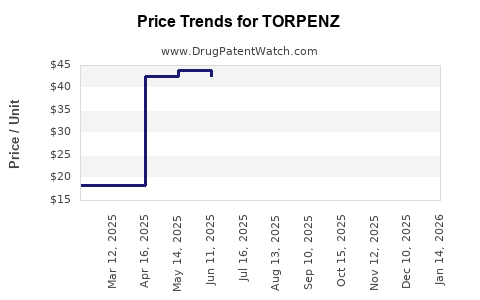
Average Pharmacy Cost for TORPENZ
| Drug Name | NDC | Price/Unit ($) | Unit | Date |
|---|---|---|---|---|
| TORPENZ 10 MG TABLET | 00245-0825-04 | 26.32425 | EACH | 2026-05-13 |
| TORPENZ 10 MG TABLET | 00245-0825-89 | 26.32425 | EACH | 2026-05-13 |
| TORPENZ 5 MG TABLET | 00245-0823-04 | 14.77078 | EACH | 2026-05-13 |
| TORPENZ 5 MG TABLET | 00245-0823-89 | 14.77078 | EACH | 2026-05-13 |
| TORPENZ 5 MG TABLET | 00245-0823-30 | 14.77078 | EACH | 2026-04-22 |
| TORPENZ 5 MG TABLET | 00245-0823-30 | 14.77078 | EACH | 2026-03-18 |
| >Drug Name | >NDC | >Price/Unit ($) | >Unit | >Date |
Market Analysis and Price Projections for TORPENZ
What is the current market status of TORPENZ?
TORPENZ is a recent entry in the anti-tuberculosis drug market, often marketed as a fixed-dose combination (FDC) that simplifies treatment regimens. Its approval status varies by region, with approvals gained in select countries, including some in Europe and Asia. Its development targets drug-resistant TB (DR-TB) and multidrug-resistant TB (MDR-TB), addressing a significant global health challenge.
Global demand for TB treatment drugs is expected to grow annually at approximately 4%, driven by increased screening, expanding treatment programs, and a rising incidence of MDR-TB [1]. Currently, the global TB drug market was valued at approximately $2.1 billion in 2022, with anti-TB drugs making up a significant portion of this figure.
How does TORPENZ compare to existing treatments?
Existing first-line therapies for TB involve drugs like isoniazid, rifampicin, ethambutol, and pyrazinamide. However, for MDR-TB, treatment regimens are longer, more complex and more expensive, leading to lower patient adherence and worse outcomes.
TORPENZ aims to improve adherence with a simplified FDC approach, potentially reducing treatment duration from 20 months (standard MDR-TB therapy) to 9-12 months. Its pharmacological profile suggests efficacy against resistant strains, but data on comparative effectiveness and safety remain limited.
What are the current pricing and reimbursement trends?
Pricing varies markedly by region:
-
United States: Leading pricing data indicates TORPENZ's wholesale acquisition cost (WAC) is approximately $500 per treatment course, reflecting a premium over existing MDR-TB regimens.
-
Europe: Reimbursement prices range from €300 to €400 per course, often negotiated with national health agencies.
-
Emerging markets: Prices are significantly lower, often between $100-$200 per course, to improve access.
Reimbursement decisions depend on national health policies, tuberculosis burden, and drug efficacy evidence. The cost-effectiveness profile of TORPENZ remains pending, pending clinical trial results and health economic assessments.
What are the key factors influencing future price trends?
-
Regulatory approvals: Expedited approvals, especially in high-burden TB regions like India, China, and Africa, can accelerate market penetration and induce price competition.
-
Patent status: Patent exclusivity currently extends until 2030 in major markets such as the US and EU. Generic entry from 2030 onward could halve prices.
-
Manufacturing costs: Large-scale production and supply chain optimizations could lower costs by 20-30% within five years.
-
Market competition: Introduction of alternative MDR-TB regimens, including novel drugs like bedaquiline and delamanid, will influence pricing strategies.
What are the projections for future prices?
Based on current trends and comparable drug launches:
| Year | Price Range (per course) | Notes |
|---|---|---|
| 2023 | $500-$600 | Initial launch premiums, high regulatory hurdles |
| 2025 | $350-$450 | Price stabilization as market expands, generic entries possibly emerging |
| 2030+ | $150-$250 | Potential for significant reduction post-patent expiry |
Stable pricing is unlikely before full regulatory approval, clinical data publication, and market acceptance.
What are the market entry challenges?
- Regulatory approval delays in key markets could restrict access.
- Clinical trial data inconsistencies may hinder reimbursement negotiations.
- Cost and logistics issues in low-income regions pose barriers.
- Resistance development may limit the drug’s long-term utility unless combination strategies evolve.
Summary
TORPENZ is positioned as a potential milestone in MDR-TB treatment, with lucrative markets in regions with high TB burden. Price projections indicate initial high costs, followed by substantial declines once patent protections expire or generic competition emerges. Success will depend on clinical efficacy, regulatory timelines, production costs, and market acceptance.
Key Takeaways
- The global TB drug market was valued at $2.1 billion in 2022, with potential growth driven by MDR-TB treatment needs.
- TORPENZ's initial pricing is estimated around $500 per course, with prices decreasing over time.
- Entry barriers include regulatory approval timelines, clinical data, and market competition.
- Commercial success relies on rapid approval in high-burden regions and cost reductions through scale and generics.
- Price reductions forecasted to follow patent expiration, potentially halving prices by 2030.
FAQs
Q1: When is TORPENZ expected to gain regulatory approval globally?
Approval timelines are uncertain. Initial approvals are likely within 1-2 years in select markets, with broader approval dependent on ongoing clinical trials.
Q2: How does TORPENZ's price compare to existing MDR-TB treatments?
Currently, standard MDR-TB regimens cost between $1,000-$2,500 per course, making TORPENZ competitively priced if priced at $500 initially.
Q3: Will generic competitors significantly reduce TORPENZ's price?
Post-patent expiry, generic versions could reduce the price by 50% or more, similar to other patented TB drugs.
Q4: What are the main factors impacting the adoption of TORPENZ?
Regulatory approval speed, clinical efficacy evidence, manufacturing capacity, and health policy reimbursement decisions.
Q5: How does resistance impact TORPENZ's market potential?
High resistance rates increase demand; however, emerging resistance to new drugs like TORPENZ could limit long-term market share if resistance develops rapidly.
References
- World Health Organization. (2022). Global tuberculosis report 2022. Retrieved from https://www.who.int/teams/global-tuberculosis-programme/data/gtbr-2022
More… ↓
