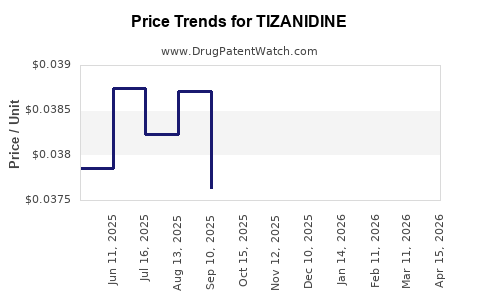
Last updated: July 23, 2026
Tizanidine is an established, off-patent oral muscle relaxant in the US with largely generic-led supply. Pricing is primarily set by generic competition and payer formularies rather than patent scarcity. Near-term price pressure is driven by (1) continued generic substitution across multiple manufacturers and (2) payers tightening step edits for spasticity and musculoskeletal indications. Over the next 2 to 5 years, the most likely pattern is flat-to-down pricing in wholesale acquisition cost (WAC) terms, with stability possible for branded “authorized” supplies only where formularies restrict substitution.
How big is the tizanidine market in the US and what demand trends matter most?
What is the therapeutic use and how does that affect payer coverage?
Tizanidine is used for spasticity (neurologic conditions such as multiple sclerosis and spinal cord injury) and for acute musculoskeletal spasm. Demand is sensitive to:
- Neurology patient volume and treatment switching among antispasticity agents (eg, baclofen, diazepam alternatives, dantrolene use patterns).
- MS/spasticity guideline alignment and payer preference for cost-effective generics.
- Safety-driven utilization: tizanidine’s hypotension, sedation, and liver enzyme monitoring lead to dose titration and sometimes agent switching.
What do formularies typically do with tizanidine generics?
US managed care plans generally treat tizanidine as a low-cost generic option with:
- Step edits or quantity limits in some plans for sedating agents.
- Prior authorization less often than for on-patent drugs, because the ingredient is off-patent and multiple ANDA competitors exist.
- Brand-to-generic substitution driven by pharmacy benefit manager (PBM) contracting.
What demand signals to track
- Neurology pharmacy spend under antispasticity categories.
- Claims volume by dose strength (2 mg, 4 mg, and commonly 6 mg extended-release formulations in some markets, though the US landscape varies by product).
- Generic market share by NDC and PBM formulary tier.
What patents protect tizanidine and what matters for pricing going forward?
Tizanidine is widely available as generics, indicating the active ingredient is well past core composition-of-matter exclusivity. Pricing impact comes less from new patent barriers and more from:
- Whether any remaining patents cover specific dosage forms (eg, sustained-release) or dosing regimens.
- Whether exclusivity attachers exist for particular ANDA products (rare for a mature API unless a specific formulation is protected or an NDA/505(b)(2) pathway was used).
- Whether any company maintains “brand” position via authorized generics or limited supply agreements.
How does remaining patent thicket risk affect generic pricing?
For mature molecules:
- Patent litigation can temporarily support higher pricing only if it prevents at least one high-volume strength from launching at scale.
- If multiple ANDA entrants exist, even an injunction risk typically leads to short-lived price spikes with fast reversion to competitive levels.
What is the Orange Book status of tizanidine products?
How Orange Book listings influence market behavior
For pricing, Orange Book status matters when:
- A product has still-active listed patents (composition, formulation, or method-of-use).
- An ANDA applicant includes paragraph IV certifications that trigger litigation.
- FDA exclusivity (5-year/3-year) applies to specific listed drugs or manufacturing changes.
Given tizanidine’s generic prevalence, practical outcomes in pricing usually follow whether competitors can launch specific strengths or dosage forms without carve-outs.
Which generic competitors sell tizanidine and how does their entry shape price?
What pricing model dominates for tizanidine
For off-patent oral generics:
- Unit cost falls after multiple ANDA entrants increase market supply.
- WAC and net pricing diverge due to PBM rebates, dispensing fees, and contract tiering.
- Strength-level pricing can vary even when the API is the same, because liquidity and contracting differ by NDC.
What to expect in competitive landscape
- Ongoing “normal course” manufacturing expansions by major generics and authorized-generic arrangements.
- Conversion between immediate-release and extended-release offerings (where marketed) can shift payer preference and affect average realized pricing.
- Wholesale price volatility is usually modest unless a supply disruption occurs.
How strong is the patent estate for tizanidine and what is the generic entry risk?
Generic entry risk assessment (pricing lens)
For pricing projections, generic entry risk is low if:
- The molecule is already available from many ANDA sources across the key strengths and dosage forms.
- Any remaining patents are narrow and do not block broad formulation or label-filling.
Risk increases pricing only when:
- An uncovered dosage form is blocked and a large payer network targets that form.
- A single supplier dominates distribution for a key strength.
What formulations are protected by patents and how does that affect pricing?
Dose strength and release form are the main pricing levers
Even without major brand constraints, market segmentation occurs by:
- Strength (mg per unit).
- Immediate-release vs extended-release availability.
- Tablet vs capsule form factor (where applicable).
- Labeling differences (spasticity vs musculoskeletal spasm emphasis).
In practice, pricing holds better for:
- Strengths with fewer suppliers.
- Dosage forms with fewer ANDA equivalents.
When does tizanidine lose exclusivity and how does that timeline affect price?
Tizanidine’s clinical and commercial establishment implies:
- Patent-driven exclusivity for the API itself has ended for many years.
- Pricing today is primarily a function of generic competition, not exclusivity cliffs.
Any future “timeline” effect would be tied to:
- Launch barriers for specific formulations.
- Changes in manufacturing supply or PBM contracting rather than formal exclusivity expiration.
What price projections are realistic for tizanidine over the next 12 to 60 months?
Base-case price path (most likely)
- 12 months: Flat-to-down pricing as contracting continues and low-cost entrants maintain share.
- 24 to 36 months: Additional small declines if a new entrant increases NDC count or if PBM switches preferred products.
- 48 to 60 months: Gradual stabilization as competition saturates, with periodic dips driven by supply shifts or rebate changes.
Range-based projection (directionally)
Because tizanidine is generic and mature, the realistic band is:
- Downside (faster declines): if additional high-volume NDCs gain preferred status or if a competitor expands distribution aggressively.
- Upside (price holds): if supply constraints reduce the number of active suppliers for certain strengths, or if payer contracts favor specific authorized generics.
What drives deviations from the base case
- Supply disruptions: API or tablet/capsule manufacturing interruptions can temporarily lift wholesale prices.
- Regulatory actions: warning letters or recalls can remove a portion of supply.
- PBM strategy: formulary tier changes and rebate renegotiations can quickly move net pricing even when WAC stays flat.
How do tizanidine prices compare with baclofen and other spasticity agents?
What matters in cross-drug pricing competition
Tizanidine competes on:
- Clinical effectiveness for spasticity management.
- Side-effect profile and titration requirements.
- Relative cost versus baclofen and other adjuncts.
- Formulary placement within the antispasticity class.
Generics for most comparators compress class pricing, which supports:
- Lower negotiated net prices for tizanidine if payers can substitute across agents.
- Stable-to-down average unit cost rather than brand-like premium.
What reimbursement and net-price factors will matter most for projections?
The projection should be built on net realizations
For generic oral drugs:
- WAC may remain stable while net pricing moves due to rebates and PBM formulary positioning.
- Dispensing mix (mail order vs retail), patient co-pay structures, and switch-back dynamics alter net revenue for manufacturers.
Contracting effects
- PBMs often drive list-to-net reductions via competitive bidding within a multisource NDC group.
- “Preferred” NDCs can capture a larger share, reducing average selling price (ASP) volatility for the class while individual manufacturers compete on margins.
What generic launch scenarios could trigger near-term price moves?
Scenario 1: New ANDA or strength coverage expands
If a new supplier enters a high-volume strength:
- Average class pricing drops quickly as the preferred slot rotates.
Scenario 2: Concentration due to withdrawal or quality events
If a supplier exits:
- Remaining suppliers can raise net prices for a period, but payer substitution limits the magnitude unless other suppliers are also constrained.
Scenario 3: Dosage-form substitution
If payers shift preference between release forms (where multiple exist in a given market):
- Unit economics can change because dispensing and contract group definitions may differ.
Key Takeaways
- Tizanidine pricing is dominated by generic competition and PBM contracting, not patent exclusivity cliffs.
- The most likely 12 to 60 month path is flat-to-down with stabilization as the supplier pool saturates.
- Price deviations will be driven by supply disruptions, regulatory removals of supply, and formulary/PBM preferred-NDC switches.
- Patent-related pricing impact is expected to be secondary unless a specific dosage form or strength remains constrained by litigation or narrow formulation protections.
FAQs
- What factors most affect tizanidine net price in US managed care? PBM rebate strategy, preferred NDC contracting, and dispensing channel mix (retail vs mail).
- Do tizanidine extended-release and immediate-release units price differently? Yes, release form and NDC-level competition typically produce different negotiated net pricing and market share.
- How do supply disruptions change tizanidine pricing? Temporary wholesale price lifts can occur, but payer substitution and multi-source coverage usually cap sustained increases.
- What reimbursement rules influence switching to lower-cost tizanidine generics? Step edits, quantity limits, and PBM formulary tiering can drive substitution even when clinical regimens remain unchanged.
- Is patent litigation likely to move tizanidine prices now? Not materially for the API overall, but it can affect specific strengths or dosage forms if supply is constrained by legal outcomes.
References (APA)
- FDA. (n.d.). Orange Book: Approved Drug Products with Therapeutic Equivalence Evaluations. US Food and Drug Administration. https://www.accessdata.fda.gov/scripts/cder/daf/