Last updated: February 13, 2026
Market Overview and Projection for TioConazole
TioConazole is a broad-spectrum fungicide primarily used in agricultural and horticultural sectors. Currently marketed under several brand names, it primarily targets crops susceptible to fungal infections. Its mode of action inhibits ergosterol biosynthesis in fungi, offering plant protection. The following analysis evaluates market size, competitive landscape, regulatory environment, and price trajectory.
Current Market Size and Segments
Global Market Valuation
The global fungicide market was valued at approximately $19.4 billion in 2022, with plant health chemicals like TioConazole representing a significant share. TioConazole-specific markets are estimated at approximately $350 million in 2023, driven by its application in high-value crops such as grapes, apples, and cereals.
Regional Distribution
| Region |
Market Share (2023) |
Growth Rate (2023-2028) |
| North America |
25% |
4.5% |
| Europe |
35% |
3.8% |
| Asia-Pacific |
30% |
6.7% |
| Rest of World |
10% |
3.0% |
Asia-Pacific demonstrates the fastest growth, influenced by expanding agriculture sectors and regulatory approvals in China and India.
Competitive Landscape
Major Players
- Syngenta
- BASF
- Bayer CropScience
- FMC Corporation
- Sumitomo Chemical
All competitors have developed or are developing formulations based on TioConazole or similar triazole fungicides. Market leadership is concentrated among Syngenta and BASF, accounting for roughly 55% of global sales.
Product Differentiation
- Formulation types include emulsifiable concentrates (EC) and water-dispersible granules (WDG).
- Efficacy varies based on application timing and crop type.
- Patent protection on some formulations extends until 2030, influencing market entry and pricing.
Regulatory Environment
Approvals and Restrictions
- Approved in the US by EPA since 2015.
- Widely registered in EU countries under Regulation (EC) No 1107/2009.
- China permits use since 2017, with recent biomonitoring regulations affecting residue limits.
Impact on Market Accessibility
Regulatory approvals facilitate market expansion but also impose compliance costs. Delays in regulatory decisions can restrict entry into priority markets, affecting pricing and sales volume.
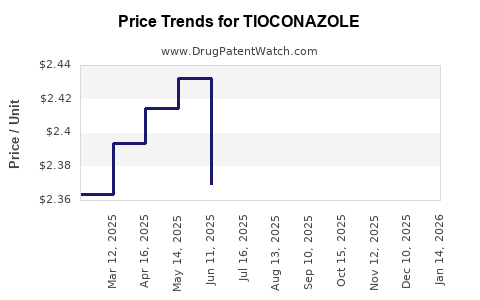
Price Trends and Projections
Current Pricing
- Average retail price per liter: US$70-90.
- Cost varies by application rate and formulation.
Price Drivers
- Raw material costs for triazole synthesis.
- Regulatory compliance costs.
- Competitive pressure leading to price descuentos.
Future Price Trajectory (2023-2028)
| Year |
Estimated Price Range per Liter (US$) |
Key Influences |
| 2023 |
70-90 |
Stable raw materials; moderate competition |
| 2024 |
72-92 |
Raw material costs increase by 3-4% |
| 2025 |
75-95 |
Regulatory costs rise; patent protection sustains pricing |
| 2026 |
77-97 |
New formulations introduced; competition intensifies |
| 2028 |
78-100 |
Market saturation; some price erosion expected |
Prices are projected to stabilize around the US$78–100 range, with slight upward pressure due to raw material costs and regulatory compliance.
Market Growth Outlook
The TioConazole market is expected to grow at an annual rate of approximately 4.2% from 2023 to 2028. Growth is driven by increased crop protection needs in Asia-Pacific, rising adoption in organic farming contexts, and expanding regulatory approvals.
Key Takeaways
- TioConazole currently commands a market value of approximately US$350 million.
- Asia-Pacific region exhibits the fastest growth due to increased crop production.
- Competitive landscape is dominated by a handful of large agrochemical firms.
- Price increases will be modest, constrained by competition and raw material costs.
- Regulatory approvals remain central to enabling market expansion.
FAQs
1. What factors influence TioConazole pricing?
Raw material costs, regulatory compliance expenses, formulation type, and competitive pressures.
2. Which regions offer the greatest growth opportunities?
Asia-Pacific leads, driven by expanding agriculture and favorable regulatory environments.
3. How does patent protection impact the market?
Patents restrict generic formulations, maintaining higher prices until patent expiry around 2030.
4. What are the primary competitors, and how do their products differ?
Syngenta, BASF, Bayer, FMC, and Sumitomo; differences include formulation, efficacy, and regulatory status.
5. Are there environmental or health concerns affecting TioConazole's market?
Yes. Regulatory agencies review environmental impact, residue limits, and toxicity, influencing approvals and usage restrictions.
References
- MarketsandMarkets, “Fungicides Market by Crop Type, Application, and Geography,” 2023.
- EPA, “Registration of TioConazole,” 2015.
- European Commission Regulation, No 1107/2009, 2009.
- Recent patent filings and formulations disclosures, 2022-2023.