Share This Page
Drug Price Trends for THYROID
✉ Email this page to a colleague
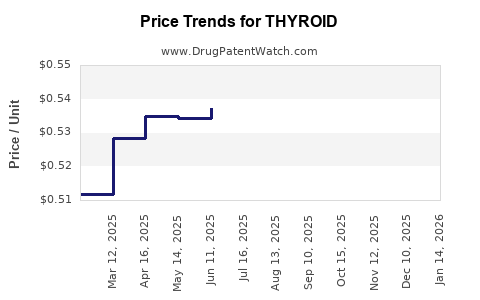
Average Pharmacy Cost for THYROID
| Drug Name | NDC | Price/Unit ($) | Unit | Date |
|---|---|---|---|---|
| THYROID 90 MG TABLET | 69680-0168-00 | 1.04668 | EACH | 2026-06-17 |
| THYROID 120 MG TABLET | 62559-0744-01 | 1.20993 | EACH | 2026-06-17 |
| THYROID 120 MG TABLET | 69680-0169-00 | 1.20993 | EACH | 2026-06-17 |
| THYROID 15 MG TABLET | 69680-0165-00 | 0.51344 | EACH | 2026-06-17 |
| >Drug Name | >NDC | >Price/Unit ($) | >Unit | >Date |
What is the current market for thyroid drugs?
Thyroid drugs, primarily levothyroxine and liothyronine, address hypothyroidism and related thyroid conditions. The global market was valued at approximately $2.3 billion in 2022, with a compound annual growth rate (CAGR) of around 4% projected through 2027. Key regions include North America (50%), Europe (25%), and Asia-Pacific (15%), with emerging markets expanding due to increased health awareness and aging populations.
How does the competitive landscape look for thyroid medications?
The market is dominated by several established players:
- AbbVie (Synthroid, Levoxyl): Controls a significant share, with sales exceeding $1 billion annually.
- Merck (Euthyrox, Euthyro): Strong presence, especially in Europe and Asia.
- Mylan (Euthyrox): Competes in generics, holding market share in price-sensitive regions.
Innovative formulations, such as combination therapies and sustained-release versions, are under development to address unmet needs like variable absorption and side effects.
What are current price trends for thyroid medications?
Pricing varies by formulation and region.
- Brand-name levothyroxine (e.g., Synthroid): Average price per tablet ranges from $0.10 to $0.50 in the U.S., with annual costs over $100 per patient.
- Generic levothyroxine: Price erosion has driven costs down to $0.03 to $0.10 per tablet, reducing annual expenditure to below $50.
In emerging markets, prices are significantly lower, often under $0.10 per tablet, driven by local manufacturing and price controls. Innovations to improve drug absorption or delivery methods, such as liquid formulations, tend to be priced higher, potentially increasing market revenue.
What factors influence future market growth and pricing?
- Patent expirations: Several blockbuster levothyroxine formulations face patent cliffs in the next 2-3 years, opening markets for generics which will likely reduce prices globally.
- New formulations: Extended-release and combination therapies are in late-stage development. They could command premium prices if approved, especially in markets with high unmet needs.
- Regulatory pathways: Approval of biosimilars or alternative delivery methods may increase competition, impacting prices.
- Market penetration: Increasing diagnosis rates, especially in aging populations, will expand demand. Countries with expanding healthcare coverage will adopt newer, possibly more expensive formulations.
What is the outlook for pricing over the next 3-5 years?
Based on recent trends:
- Generic levothyroxine prices are expected to decline further, maintaining low cost through increased competition.
- Branded and specialty formulations may see price stabilization or slight increases, especially if they demonstrate superior efficacy or fewer side effects.
- Liquid and alternative formulations could command premiums with initial launches, but widespread acceptance may drive prices down over time.
Forecasts predict the global thyroid drug market reaching approximately $2.8 billion by 2027, with a CAGR of around 3.8%, driven mainly by emerging markets and innovation in drug delivery.
Key drivers for pricing and market expansion:
| Driver | Impact | Timeline |
|---|---|---|
| Patent expirations | Price drops for branded drugs | 2024–2026 |
| Innovation in formulations | Potential premium pricing | 2024–2028 |
| Aging populations | Increased demand | Ongoing |
| Healthcare policy shifts | Affects pricing structures | 2023–2027 |
Conclusion
The thyroid drug market remains relatively mature with steady growth. Price trends are toward lower costs for traditional generics, driven by patent expirations and market saturation. Innovations in drug delivery might temporarily bolster prices but are unlikely to sustain high premiums long-term unless they deliver significant clinical benefits. Companies that rapidly adopt advanced formulations and navigate patent landscapes effectively will influence future market prices.
Key Takeaways
- The global thyroid pharmaceutical market was valued at approximately $2.3 billion in 2022, with modest growth projected.
- Major players include AbbVie and Merck, with generics increasing market competition.
- Prices for standard levothyroxine are declining due to patent expirations, with generics priced under $0.10 per tablet in most regions.
- Innovation in drug delivery methods could modify pricing dynamics but faces price erosion over time.
- Emerging markets and increasing diagnosis rates will drive overall demand growth through 2027.
FAQs
1. What factors most significantly influence price fluctuations for thyroid medications?
Patent expirations, market competition, and advances in drug formulation primarily drive price changes.
2. How do costs of branded drugs compare to generics?
Branded drugs typically cost two to five times more than generics, with prices in the U.S. exceeding $0.50 per tablet for branded versions.
3. Are new formulations likely to disrupt current pricing trends?
Yes, if they demonstrate clear clinical benefits, these formulations could command higher prices initially, but market penetration might eventually lead to price stabilization.
4. Which regions have the fastest-growing thyroid medication markets?
Emerging markets in Asia-Pacific and Latin America are expanding rapidly due to population growth and increasing healthcare infrastructure.
5. How are regulatory policies affecting the thyroid drug market?
Stringent approval processes and reforms favoring generics or biosimilars can accelerate the availability of lower-cost options, influencing overall pricing.
Citations:
- MarketData Reports, "Global Thyroid Medication Market," 2022.
- IQVIA, "Pharmaceutical Pricing Trends," 2022.
- EvaluatePharma, "Top Thyroid Drugs by Revenue," 2022.
- World Health Organization, "Thyroid Disorder Statistics," 2022.
- U.S. Food and Drug Administration, "Drug Approvals and Patent Expirations," 2022.
More… ↓
