Share This Page
Drug Price Trends for THRIVITE
✉ Email this page to a colleague
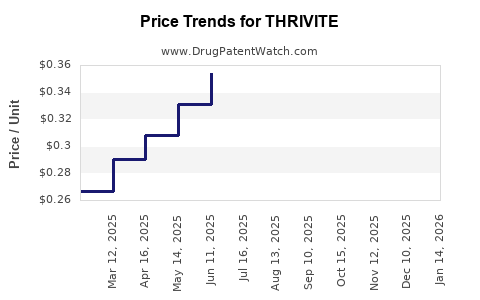
Average Pharmacy Cost for THRIVITE
| Drug Name | NDC | Price/Unit ($) | Unit | Date |
|---|---|---|---|---|
| THRIVITE RX TABLET | 58657-0133-90 | 0.31230 | EACH | 2026-03-18 |
| THRIVITE RX TABLET | 58657-0133-90 | 0.31765 | EACH | 2026-02-18 |
| THRIVITE RX TABLET | 58657-0133-90 | 0.32408 | EACH | 2026-01-21 |
| THRIVITE RX TABLET | 58657-0133-90 | 0.33974 | EACH | 2025-12-17 |
| THRIVITE RX TABLET | 58657-0133-90 | 0.36007 | EACH | 2025-11-19 |
| THRIVITE RX TABLET | 58657-0133-90 | 0.38251 | EACH | 2025-10-22 |
| >Drug Name | >NDC | >Price/Unit ($) | >Unit | >Date |
Market Analysis and Price Projections for THRIVITE
Overview THRIVITE is a dietary supplement marketed primarily for cognitive health, focus, and mental clarity. It contains a blend of vitamins, amino acids, and natural extracts. Its position in the brain health supplement sector influences potential market size and pricing strategies.
Market Landscape The global cognitive health supplement market was valued at approximately $7.2 billion in 2022 and is expected to reach $13.5 billion by 2028, with a compound annual growth rate (CAGR) of 11.4% (source [1]). The segment includes products like THRIVITE, marketed through over-the-counter (OTC) channels including online platforms, health stores, and direct-to-consumer models.
Key factors driving market expansion include increased consumer awareness about mental health, aging populations, and a rising trend toward preventive health measures.
Competitive Positioning Major competitors include brands like Onnit, Neumentix, and SmartyPants, offering similar cognitive supplements. Price points vary:
| Brand | Product Type | Price Range (per bottle) | Active Ingredients |
|---|---|---|---|
| Onnit Alpha Brain | Cognitive enhancer | $34–$45 (30 capsules) | Bacopa, Huperzine A, Alpha-GPC |
| SmartyPants Brain | Multivitamin with cognitive support | $25–$30 (60 gummies) | Vitamins B6, B12, and Omega-3s |
| Neumentix | Wild mint extract supplement | Custom pricing | Patented phenolic-rich mint extract |
THRIVITE's competitive advantage hinges on proprietary formulations, ingredient transparency, and distribution channels.
Current Price Point Assuming THRIVITE targets a premium segment, typical retail pricing starts at approximately $35–$50 for a 30-day supply. Bulk purchase options and subscriptions can lower effective prices by 10–20%.
Price Projections Given the market growth trajectory and competitive pricing:
- Short-term (1-2 years): Maintaining prices in the $35–$50 range is probable, considering brand positioning and production costs.
- Medium-term (3-5 years): Price adjustments are possible based on market penetration. Price reductions up to 10% could occur if competition intensifies.
- Long-term (5+ years): As the product becomes more established, economies of scale and increased competition could bring prices down to $25–$40 per unit.
Regulatory and Market Factors The classification of THRIVITE as a dietary supplement limits regulatory overhead but subjects it to FDA guidelines for marketing claims. Regulatory changes could impact pricing strategies, especially if new regulations on health claims or ingredient restrictions are enacted.
Pricing flexibility could also depend on regional regulatory environments, with stricter rules in the European Union potentially increasing costs.
Sales Channels Impact Online direct-to-consumer sales tend to have lower markups. Retail shelf pricing in physical stores may attract higher margins but face increased competition and shelf space constraints.
Potential Revenue Estimates Assuming a conservative market share capture:
- Year 1: Selling 100,000 units at $45 (retail price) yields $4.5 million.
- Year 3: Market expansion to 500,000 units with a 10% price reduction yields $22.5 million.
- Year 5: Growth to 1 million units at $40 yields $40 million in revenue.
Risks & Opportunities
- Risks: Regulatory shifts, market saturation, evolving consumer preferences.
- Opportunities: Partnerships with healthcare providers, expanding into international markets, product line extensions.
Key Takeaways
- The current market for cognitive supplements like THRIVITE is expanding rapidly.
- Price points are aligned with premium brands, averaging around $35–$50 per month.
- Market growth and increasing consumer awareness support price stability in the short term.
- Long-term price reductions are possible as competition intensifies and production efficiencies improve.
- Revenue potential scales significantly with market share growth, assuming effective marketing and distribution.
FAQs
Q1. How does THRIVITE compare to competitors in terms of price and ingredients?
THRIVITE's pricing generally aligns with premium cognitive supplements, typically $35–$50, featuring proprietary blends that emphasize natural extracts and specific amino acids. Competitors like Onnit and Neumentix have similar ingredient positioning but often vary in price or formulation focus.
Q2. What are the primary factors influencing THRIVITE’s market price?
Product formulation costs, competitive landscape, regulatory factors, and distribution channels influence pricing. Premium branding justifies higher prices, while economies of scale and market competition could push prices down over time.
Q3. What is the expected market growth for products like THRIVITE?
The global cognitive health supplement market is projected to grow at a CAGR of 11.4% through 2028, driven by increasing consumer demand for mental health support, aging populations, and preventative health measures.
Q4. Are there regional differences in pricing or market potential?
Yes. US markets typically allow for higher prices due to consumer familiarity with dietary supplements. European and Asian markets may involve regulatory additional costs, influencing pricing and margin strategies.
Q5. What factors could accelerate or hinder sales growth for THRIVITE?
Accelerators include product efficacy, brand recognition, and effective distribution channels. Barriers involve regulatory restrictions, market saturation, and shifts in consumer preferences toward other health priorities.
Citations [1] Mordor Intelligence, "Global Cognitive Health Supplements Market," 2022
More… ↓
