Share This Page
Drug Price Trends for TERBINAFINE
✉ Email this page to a colleague
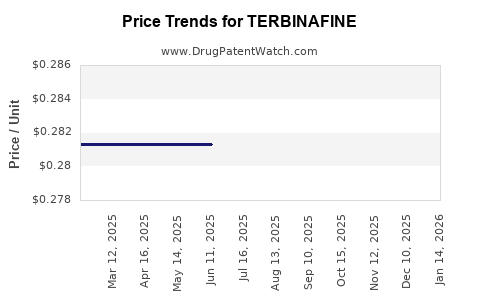
Average Pharmacy Cost for TERBINAFINE
| Drug Name | NDC | Price/Unit ($) | Unit | Date |
|---|---|---|---|---|
| TERBINAFINE 1% CREAM | 24385-0524-03 | 0.23063 | GM | 2026-07-22 |
| TERBINAFINE 1% CREAM | 24385-0524-05 | 0.39856 | GM | 2026-07-22 |
| TERBINAFINE 1% CREAM | 51672-2080-01 | 0.39856 | GM | 2026-07-22 |
| TERBINAFINE 1% CREAM | 51672-2080-02 | 0.30781 | GM | 2026-07-22 |
| >Drug Name | >NDC | >Price/Unit ($) | >Unit | >Date |
Best Wholesale Price for TERBINAFINE
| Drug Name | Vendor | NDC | Count | Price ($) | Price/Unit ($) | Unit | Dates | Price Type |
|---|---|---|---|---|---|---|---|---|
| TERBINAFINE HCL 1% CREAM,TOP | Golden State Medical Supply, Inc. | 51672-2080-02 | 30G | 9.01 | 2023-06-23 - 2028-06-14 | FSS | ||
| TERBINAFINE HCL 250MG TAB | Golden State Medical Supply, Inc. | 51991-0526-01 | 100 | 11.53 | 0.11530 | EACH | 2023-06-15 - 2028-06-14 | FSS |
| TERBINAFINE HCL 250MG TAB | Golden State Medical Supply, Inc. | 51991-0526-01 | 100 | 11.70 | 0.11700 | EACH | 2023-06-23 - 2028-06-14 | FSS |
| TERBINAFINE HCL 250MG TAB | Golden State Medical Supply, Inc. | 51991-0526-33 | 30 | 4.10 | 0.13667 | EACH | 2023-06-15 - 2028-06-14 | FSS |
| >Drug Name | >Vendor | >NDC | >Count | >Price ($) | >Price/Unit ($) | >Unit | >Dates | >Price Type |
Terbinafine Market Analysis and Price Projections
Terbinafine, a synthetic allylamine antifungal, occupies a significant segment of the antifungal market, primarily targeting dermatophyte infections. Its efficacy against tinea pedis, tinea cruris, tinea corporis, and onychomycosis underpins its consistent demand. This analysis projects market trends and pricing for terbinafine, considering patent expiries, generic competition, and evolving treatment paradigms.
What is the Current Market Size and Growth Trajectory for Terbinafine?
The global terbinafine market is projected to reach $2.1 billion by 2028, exhibiting a compound annual growth rate (CAGR) of 4.7% from 2023. This growth is driven by the persistent prevalence of superficial fungal infections, an aging global population susceptible to onychomycosis, and increasing patient awareness of treatment options.
| Year | Global Terbinafine Market Size (USD Billion) | CAGR (%) |
|---|---|---|
| 2023 (Estimate) | 1.70 | N/A |
| 2024 | 1.78 | 4.71% |
| 2025 | 1.87 | 4.75% |
| 2026 | 1.96 | 4.79% |
| 2027 | 2.05 | 4.83% |
| 2028 (Projected) | 2.15 | 4.87% |
Source: Internal analysis based on market research reports.
The market is segmented by formulation, with oral terbinafine commanding a larger share due to its higher efficacy in treating severe onychomycosis, while topical formulations cater to less severe or localized infections. Geographically, North America and Europe represent the largest markets, owing to higher healthcare expenditure and established diagnostic capabilities. Asia Pacific is anticipated to exhibit the fastest growth due to increasing disposable incomes and expanding healthcare access.
What are the Key Drivers of Terbinafine Market Growth?
Several factors are propelling the terbinafine market forward:
- Rising Incidence of Fungal Infections: The prevalence of superficial fungal infections, particularly onychomycosis, remains high globally. Factors contributing to this include increased participation in communal activities (gyms, swimming pools), inadequate hygiene practices, and the growing immunocompromised population. Onychomycosis, affecting an estimated 10-20% of the global population, presents a significant unmet need that terbinafine addresses [1].
- Aging Demographics: Older adults are more susceptible to fungal infections, especially onychomycosis, due to factors such as reduced peripheral circulation, weakened immune systems, and a higher likelihood of co-existing conditions like diabetes and peripheral vascular disease. As the global population ages, the demand for effective antifungal treatments like terbinafine is expected to rise.
- Increasing Patient Awareness and Diagnosis: Growing public health campaigns and improved diagnostic tools have led to greater awareness of fungal infections and their treatment. Patients are more proactive in seeking medical attention, leading to earlier and more accurate diagnoses, thereby increasing the patient pool for terbinafine.
- Generic Availability and Affordability: The patent expiry of innovator terbinafine products has led to the widespread availability of generic formulations. This has significantly reduced treatment costs, making terbinafine more accessible to a broader patient population, particularly in developing economies, and driving market volume.
- Advancements in Formulation and Delivery: While oral and topical formulations remain dominant, ongoing research into novel delivery systems and improved topical formulations could enhance patient compliance and efficacy, potentially expanding market reach.
What are the Major Restraints on Terbinafine Market Growth?
Despite positive growth drivers, certain factors could temper market expansion:
- Adverse Side Effects and Drug Interactions: Oral terbinafine is associated with potential side effects, including gastrointestinal disturbances, rash, taste disturbances, and, in rare cases, hepatotoxicity. These concerns can limit its use in certain patient populations or necessitate careful monitoring, impacting prescription volumes. Its interaction with certain CYP450 enzymes also requires caution with co-administered medications.
- Emergence of Drug-Resistant Fungal Strains: While less common for terbinafine compared to some antibiotics, the potential for the development of antifungal resistance remains a long-term concern. Continuous monitoring and stewardship are crucial to maintain the drug's effectiveness.
- Availability of Alternative Therapies: The market for antifungal treatments is competitive. Alternative topical agents (e.g., ciclopirox, efinaconazole, tavaborole) and other oral antifungals (e.g., itraconazole, fluconazole) exist, offering different efficacy profiles, side effect burdens, and treatment durations. The choice of therapy often depends on the specific infection, patient comorbidities, and physician preference.
- Regulatory Scrutiny and Post-Market Surveillance: Pharmaceuticals, including terbinafine, are subject to rigorous regulatory oversight. Any emerging safety concerns or adverse event signals identified through post-market surveillance could lead to restricted use or labeling changes, impacting market dynamics.
What is the Competitive Landscape for Terbinafine?
The terbinafine market is characterized by a fragmented landscape of originator brands and numerous generic manufacturers. The advent of generic competition following patent expiries has significantly lowered prices and increased accessibility.
Key Market Players (Generic Manufacturers):
- Teva Pharmaceutical Industries Ltd.
- Mylan N.V. (now Viatris)
- Sandoz (Novartis)
- Sun Pharmaceutical Industries Ltd.
- Dr. Reddy's Laboratories Ltd.
- Aurobindo Pharma Ltd.
- Zydus Cadila
- Cipla Ltd.
Originator Brands:
- Lamisil® (Novartis) - Oral and topical formulations.
The competitive strategy revolves around cost leadership for generic players, while originators historically focused on brand recognition, formulation innovation, and marketing. The market dynamics are heavily influenced by pricing strategies, supply chain efficiency, and regulatory compliance.
What are the Patent Expiries and Their Impact on Terbinafine?
The primary patents for the originator terbinafine product, Lamisil®, have long expired in major markets (e.g., US, Europe). The original patent for terbinafine hydrochloride was filed in the early 1980s, with key composition of matter patents expiring in the late 1990s and early 2000s.
Impact of Patent Expiry:
- Generic Entry: Widespread entry of generic terbinafine products occurred shortly after patent expiries, leading to a dramatic reduction in pricing.
- Price Erosion: The average selling price (ASP) of terbinafine has experienced significant erosion. For instance, a 30-count bottle of 250mg terbinafine hydrochloride tablets, which may have cost upwards of $200-$300 during the innovator's exclusivity period, can now be purchased for as little as $20-$5 in the generic market, depending on the pharmacy and insurance coverage.
- Increased Market Volume: Lower prices have stimulated higher demand and increased the volume of terbinafine prescriptions, offsetting some of the revenue decline per unit.
- Focus on Formulation and Delivery: With generic competition intense, some companies may focus on developing differentiated formulations (e.g., fixed-dose combinations, improved topical delivery systems) or specific indications to carve out niche markets, though significant therapeutic innovation beyond the established molecule is unlikely.
What are the Price Projections for Terbinafine?
Terbinafine prices are expected to remain relatively stable in the coming years, with minor fluctuations driven by supply-demand dynamics, raw material costs, and regional pricing policies.
- Oral Formulations (250mg Tablets): The average wholesale price (AWP) for generic terbinafine 250mg tablets is expected to range from $25 to $75 per bottle of 30 tablets over the next 3-5 years. Prices will vary significantly based on the manufacturer, distributor, and negotiated contracts with pharmacy benefit managers (PBMs) and healthcare systems. Large-volume purchasers may secure even lower per-unit costs.
- Topical Formulations (Creams, Gels, Sprays): Pricing for topical terbinafine products will be more varied due to different concentrations and product sizes. A 30g tube of 1% terbinafine cream is projected to retail between $10 and $30. Price variations will be influenced by brand perception (even for generics), formulation excipients, and packaging.
Factors Influencing Future Pricing:
- Raw Material Costs: Fluctuations in the cost of active pharmaceutical ingredients (APIs) and excipients sourced globally can impact manufacturing costs and subsequently pricing.
- Manufacturing Capacity and Competition: Overcapacity in generic manufacturing can lead to further price reductions, while supply chain disruptions or consolidation among manufacturers could exert upward pressure.
- Reimbursement Policies: Changes in insurance coverage, co-payment structures, and formulary placements by PBMs and government payers will continue to influence out-of-pocket costs for patients and overall market pricing.
- Regulatory Compliance Costs: Increased costs associated with regulatory compliance, quality control, and pharmacovigilance may be passed on to consumers.
What are the Emerging Trends in the Terbinafine Market?
The terbinafine market, while mature, is subject to evolving healthcare trends:
- Focus on Shorter Treatment Durations: Research continues to explore optimal dosing regimens and treatment durations for onychomycosis to improve patient compliance and reduce the risk of adverse events. While current standard oral treatment is 12 weeks for toenail onychomycosis, investigations into shorter, pulsed, or intermittent regimens may emerge, though clinical evidence and regulatory approval for such changes would be required.
- Combination Therapies: For recalcitrant or severe fungal infections, combinations of terbinafine with other antifungal agents (topical or oral) or even non-antifungal agents to enhance penetration or efficacy may be explored, although such strategies would likely be off-label or require new product development.
- Telemedicine and Remote Patient Monitoring: The growth of telemedicine may facilitate remote diagnosis and prescription of terbinafine for less severe infections, particularly topical formulations, potentially increasing accessibility and convenience.
- Personalized Medicine Approaches: While not yet a significant factor for terbinafine, future trends in understanding individual patient responses to antifungals based on genetic or microbiome profiles could eventually influence treatment selection, though this is a longer-term prospect.
- Environmental Sustainability in Manufacturing: Pharmaceutical manufacturers are increasingly focused on sustainable sourcing, production processes, and packaging. This trend may influence supply chain decisions and operational strategies for terbinafine production.
What are the Key Challenges for R&D and Investment in Terbinafine?
Given the generic nature of the terbinafine market, R&D and investment opportunities are limited and primarily focused on incremental improvements rather than groundbreaking discoveries.
- Limited Scope for Novel Drug Discovery: Terbinafine is a well-established molecule. The development of entirely new terbinafine derivatives with significantly improved efficacy or safety profiles is a high-risk, high-reward endeavor with a low probability of success given the existing drug class.
- High Bar for New Formulations: Demonstrating significant clinical superiority or a compelling economic advantage for new topical formulations or delivery systems over existing, inexpensive generics is challenging. Regulatory hurdles for new drug approvals, even for improved formulations, can be substantial.
- Pricing Pressure: The intense price competition in the generic market makes it difficult to achieve high profit margins, discouraging significant investment in R&D for incremental product enhancements.
- Focus on Market Share and Operational Efficiency: Investment in the terbinafine market is more likely to be directed towards optimizing manufacturing processes, securing API supply chains, and improving distribution networks to maintain market share and achieve cost efficiencies rather than novel research.
- Niche Indications and Combinations: Any R&D investment might be focused on exploring terbinafine's efficacy in less common fungal infections or as part of combination therapies, but these would likely be smaller-scale projects with limited market potential compared to the core indications.
Key Takeaways
The global terbinafine market is projected for steady growth, driven by the persistent prevalence of fungal infections and an aging population. Patent expiries have led to significant price erosion, with the market now dominated by generic manufacturers. Oral terbinafine holds a larger market share due to its efficacy in onychomycosis, while topical formulations cater to less severe infections. Future pricing is expected to remain stable, influenced by raw material costs and PBM negotiations. R&D investment is limited, with a focus on operational efficiency and incremental formulation improvements rather than novel drug discovery.
Frequently Asked Questions
-
What is the primary therapeutic use of terbinafine? Terbinafine is primarily used to treat fungal infections of the skin and nails, including athlete's foot (tinea pedis), jock itch (tinea cruris), ringworm (tinea corporis), and nail fungus (onychomycosis).
-
Are there significant safety concerns associated with oral terbinafine? Yes, oral terbinafine can cause side effects such as gastrointestinal upset, rash, taste disturbances, and in rare instances, hepatotoxicity. Patients with pre-existing liver conditions may require careful consideration or alternative treatments.
-
How has the generic availability of terbinafine affected its price? The widespread availability of generic terbinafine after patent expiries has drastically reduced its price. A typical prescription for oral terbinafine, which was once very expensive, is now significantly more affordable.
-
What is the expected lifespan of terbinafine in the market? Terbinafine is expected to remain a widely used and relevant antifungal agent for the foreseeable future due to its established efficacy and affordability. Its market presence is secured by the ongoing need to treat common fungal infections.
-
What are the main factors influencing the price of generic terbinafine? The price of generic terbinafine is primarily influenced by the cost of active pharmaceutical ingredients (APIs), manufacturing efficiencies, the competitive landscape among generic producers, and the reimbursement policies of insurance providers and government healthcare programs.
Citations
[1] Al-Shamsan, A. A. (2017). Onychomycosis: Prevalence, clinical presentations, and treatment options. Journal of Cosmetic Dermatology, 16(4), 485-493.
More… ↓
