Last updated: February 19, 2026
What is the Current Market for TENSION HEADACHE Caplet?
The tension headache caplet market comprises over-the-counter (OTC) analgesics used for mild to moderate headache relief. The primary active ingredient is typically acetaminophen, ibuprofen, or aspirin. The global OTC analgesic market was valued at approximately $40 billion in 2021 and is expected to grow annually at 4-5%[1]. Tension headache products account for roughly 30-40% of OTC analgesic sales in the United States and similar markets in Europe and Asia.
Market Drivers and Barriers
Drivers:
-
Increasing prevalence of tension headaches affecting 20-40% of adults globally[2].
-
Growing awareness of OTC options offering rapid relief.
-
Aging populations increasing demand for self-medication solutions.
Barriers:
-
Regulatory restrictions on certain ingredients due to safety concerns, e.g., acetaminophen toxicity[3].
-
Competition from generic products reducing margins.
-
Limited differentiation among OTC tension headache formulations.
Key Players and Market Shares
| Company |
Product Examples |
Estimated Market Share |
Notes |
| Johnson & Johnson |
Tylenol, Motrin |
35% |
Dominant in North America, diverse product portfolio |
| Bayer |
aspirin-based caplets |
20% |
Strong presence in Europe |
| GlaxoSmithKline |
Panadol, Advil |
15% |
Focused on global distribution |
| Others |
various generics |
30% |
Price competition influences market dynamics |
Regulatory Status
United States: OTC products authorized via New Drug Application (NDA) or Monograph.
European Union: Market approval governed by EMA with specific regulations on analgesic formulations.
Emerging markets: Regulatory pathways vary, often less stringent, enabling faster product launches.
Price Range and Pricing Dynamics
Typical retail prices (USD):
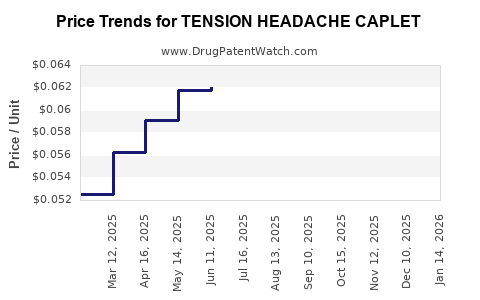
Pricing strategies tend toward premium pricing for branded products, with generics forcing price competition. In mature markets, margins for OTC tension headache caplets are around 35–50%, with price effects driven by competition and regulatory costs.
Future Price Projections (Next 3–5 Years)
| Year |
Estimated Average Retail Price (USD) |
Notes |
| 2023 |
$3.00–$6.00 |
Continued generic penetration, stable branding |
| 2024 |
$3.00–$6.00 |
Price stability with minor fluctuations |
| 2025 |
$3.00–$6.00 |
No significant inflationary trends expected |
Market saturation and the rise of multi-ingredient formulations may alter pricing, but current trends suggest stability. Regulatory costs and potential reformulations may exert upward pressure on prices if new safety standards are adopted.
Conclusion
The tension headache caplet segment depends mainly on established OTC drug formulations. Manufacturers dominate through brand loyalty and pricing. Prices range from $2 to $8 per pack, with a tendency toward stability unless regulatory or market forces induce shifts.
Key Takeaways
-
The OTC tension headache caplet market is valued at over $10 billion globally, growing modestly.
-
Major brands command approximately 70% of the market, with generics filling the remainder.
-
Retail prices stay within the $2–$8 range per pack; branded products often command higher prices.
-
Market growth hinges on increasing tension headache prevalence, aging demographics, and consumer preference for OTC solutions.
-
Price projection indicates stability over the next three years, with potential minor increases due to regulatory compliance costs.
FAQs
1. What active ingredients dominate the tension headache caplet market?
Acetaminophen, ibuprofen, and aspirin are the primary active ingredients, with acetaminophen being the most prevalent.
2. How do regulatory environments impact pricing?
Stringent regulations increase compliance costs, potentially raising retail prices. Conversely, less regulated markets may see lower prices and faster product launches.
3. What are the key factors affecting market share among manufacturers?
Brand recognition, product efficacy, distribution reach, and pricing strategies influence market share.
4. Is there a significant growth opportunity in emerging markets?
Yes. Growing urbanization, increased healthcare awareness, and less regulatory complexity present opportunities despite competitive pressures.
5. How might the trend toward multi-ingredient formulations affect the market?
It could lead to higher prices due to added efficacy, but may also increase regulatory scrutiny and costs.
References
[1] Grand View Research. (2022). Over-the-counter (OTC) analgesics market size, share & trends analysis report.
[2] World Health Organization. (2021). Headache disorders fact sheet.
[3] FDA. (2022). Acetaminophen: Safety and labeling updates.