Last updated: February 14, 2026
What is Tenormin (Atenolol)?
Tenormin, generically known as atenolol, is a beta-blocker prescribed primarily for hypertension, angina pectoris, and certain arrhythmias. Launched in the 1970s by AstraZeneca, atenolol has a long-established presence in cardioselective beta-blocker therapy. It remains available in branded and generic forms worldwide.
Current Market Position
- Global Sales: Estimated global sales of atenolol drugs are approximately $400-600 million annually[1]. The market has declined marginally in recent years due to the rise of more selective beta-blockers and fixed-dose combination drugs.
- Patent Status: The original patent for Tenormin expired in the early 2000s. Most formulations are now off-patent and produced as generics, increasing competition.
- Manufacturers: Multiple generic companies produce atenolol, including Teva, Mylan, and Sandoz. Brand sales by AstraZeneca primarily persisted until patent expiry.
Market Drivers and Constraints
Key Drivers
- Prevalence of Hypertension: Globally, 1.28 billion adults have hypertension, with increased awareness leading to consistent demand[2].
- Cost-Effectiveness: Generic atenolol remains a low-cost treatment, especially in developing countries.
- Physician Prescriptions: atenolol’s reputation as a well-understood, affordable medication sustains its prescription volume.
Constraints
- Drug Safety Profile: Atenolol's side effects, including fatigue and cold extremities, along with potential less efficacy compared to newer beta-blockers, have diminished its preference.
- Market Shift: Development of beta-blockers with additional benefits (e.g., carvedilol, nebivolol) has shifted prescriber preferences.
- Regulatory Trends: Increasing restrictions on off-patent drugs’ marketing have limited promotional activities.
Competitive Landscape
| Player |
Market Share |
Product Overview |
Pricing (per 100 mg tablet) |
Notes |
| Mylan |
~30% |
Generic Market Leader |
$0.02 - $0.05 |
Large global distributor |
| Teva |
~25% |
Generic/formulation supplier |
$0.02 - $0.06 |
Broad generic portfolio |
| Sandoz |
~15% |
Generic counterpart, biosimilars |
$0.02 - $0.05 |
Focus on biosimilar development |
| AstraZeneca |
Minor (branded) |
Original product, limited remaining patents |
N/A |
Limited branded sales post-patent expiry |
Pricing Trends and Projections
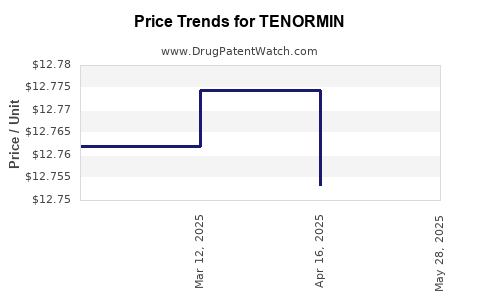
Current pricing for generic atenolol tablets at 50 mg stands at approximately $0.02 to $0.07 per tablet[3]. The price has stabilized due to high competition but remains sensitive to supply chain disruptions.
Factors Influencing Future Pricing
- Market Substitution: As newer beta-blockers with improved safety profiles increase in adoption, atenolol's market share and price stability are likely to decline.
- Supply Chain Dynamics: Raw material costs for active pharmaceutical ingredients (APIs) and manufacturing costs could drive modest price increases in specific regions.
- Regulatory and Policy Changes: Healthcare policy shifts, like price caps or increased generic drug policies in countries like India and China, may pressure prices downward.
Projected Price Trends (Next 5 Years)
| Year |
Price per 100 mg Tablet |
Key Notes |
| 2023 |
$0.02 - $0.07 |
Stable, high competition |
| 2024 |
$0.02 - $0.06 |
Slight decrease expected in mature markets |
| 2025 |
$0.02 - $0.05 |
Continued pressure from market shifts |
| 2026 |
$0.02 - $0.04 |
Prices stabilize or slightly fall further |
| 2027 |
$0.02 |
Market normalized with high generic saturation |
Potential Emerging Opportunities
- Combination Therapies: Atenolol may be incorporated into fixed-dose combinations with other antihypertensives for enhanced compliance.
- New Indications: Research into atenolol’s efficacy in conditions beyond cardiovascular uses, like tremors, may open niche markets.
- Regional Expansion: Low-cost markets in Africa and Southeast Asia may sustain demand due to ongoing hypertension management needs.
Regulatory and Patent Outlook
Most patents have long expired; no significant patent filings for core formulations are active. Regulatory shifts mainly influence marketing rather than formulation approval, with some jurisdictions enforcing stricter bioequivalence standards.
Key Takeaways
- The atenolol market is mature, heavily commoditized, and dominated by generics.
- Global sales hover around $400-600 million annually, with a declining trend influenced by competition and market preference shifts.
- Pricing has stabilized but remains sensitive to supply chain and policy factors; prices are expected to stay within current low ranges.
- Competitive barriers are low; market entry is straightforward for generic manufacturers.
- Opportunities are limited mostly to regional markets or niche indications due to the drug’s age and safety profile concerns.
FAQs
Q1. Will the price of Tenormin increase due to supply chain issues?
A1. Supply chain disruptions could temporarily lead to price increases; however, high market competition keeps prices relatively stable. Long-term effects depend on raw material availability and manufacturing costs.
Q2. Are there any patent protections or exclusivities remaining for atenolol?
A2. No; most patent protections expired in the early 2000s, allowing generics to dominate worldwide markets.
Q3. How does the market for atenolol compare to newer beta-blockers?
A3. Newer agents like carvedilol and nebivolol are preferred due to better side effect profiles and additional benefits, reducing atenolol’s market share.
Q4. Which regions offer the highest growth potential for atenolol sales?
A4. Emerging markets like India, Southeast Asia, and Africa show ongoing demand for low-cost antihypertensive agents.
Q5. Could regulatory changes threaten the continued availability of generic atenolol?
A5. Stricter bioequivalence and manufacturing standards may raise costs but are unlikely to eliminate generic availability under current policies.
References
[1] IQVIA. (2022). Global Pharmaceutical Market Data.
[2] WHO. (2021). Hypertension Fact Sheet.
[3] GoodRx. (2023). Drug Prices List.