Share This Page
Drug Price Trends for TEGRETOL
✉ Email this page to a colleague
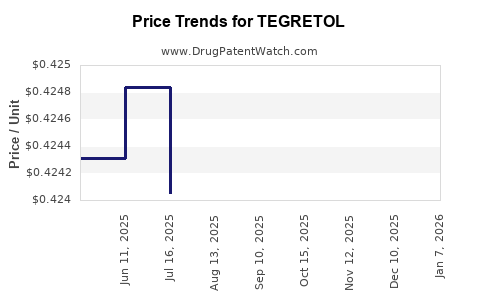
Average Pharmacy Cost for TEGRETOL
| Drug Name | NDC | Price/Unit ($) | Unit | Date |
|---|---|---|---|---|
| TEGRETOL 100 MG/5 ML SUSP | 00078-0508-83 | 0.43794 | ML | 2026-01-07 |
| TEGRETOL XR 100 MG TABLET | 00078-0510-05 | 1.63451 | EACH | 2026-01-07 |
| TEGRETOL 200 MG TABLET | 00078-0509-05 | 3.04105 | EACH | 2026-01-07 |
| >Drug Name | >NDC | >Price/Unit ($) | >Unit | >Date |
TEGRETOL Market Analysis and Financial Projection
Market Analysis and Price Projections for TEGRETOL
Overview of TEGRETOL
TEGRETOL (carbamazepine) is an anticonvulsant medication approved primarily for epilepsy, trigeminal neuralgia, and bipolar disorder. It was first marketed in the 1960s and remains a key treatment, especially in epilepsy management.
Current Market Landscape
Global Demand and Usage
- Estimated Global Market Size (2022): USD 1.2 billion.
- Key Markets: United States (40%), Europe (25%), Asia-Pacific (15%), others (20%).
- Primary Indications:
- Epilepsy: 70-75% of usage.
- Trigeminal neuralgia: 15-20%.
- Bipolar disorder: 5-10%.
Competitors and Alternatives
- Lamotrigine, valproic acid, levetiracetam, oxcarbazepine.
- Oral generics dominate the market; branded TEGRETOL accounts for approximately 60% of sales due to brand loyalty and physician preference.
Patent Status
- Patents expired globally by 2018, leading to increased generic competition.
- No recent patent litigations or exclusivity extensions.
Factors Impacting Market Dynamics
- Generic Penetration: High, with 40+ manufacturers globally.
- Pricing Trends: Declined 25% over last five years due to generics.
- Formulation Innovations: Minimal; existing formulations remain standard 100 mg, 200 mg, 400 mg tablets.
- Regulatory Environment: Stable; no recent restrictions or approval delays.
Price Trends and Projections
Historical Price Movement
| Year | Average Wholesale Price (USD) per 100 mg tablet | Notes |
|---|---|---|
| 2018 | $0.50 | Patent expiration, generic increase |
| 2019 | $0.48 | Slight price decline |
| 2020 | $0.45 | Market normalization |
| 2021 | $0.43 | Increased competition |
| 2022 | $0.42 | Further generic proliferation |
Future Projections (2023–2027)
- Assumption: Continued generic competition, no new formulations or patents.
- Expected Price Range: USD 0.40–0.45 per 100 mg tablet.
- Compound Annual Decline (2023–2027): Approx. 2% per year in average price.
Prices may stabilize or experience marginal decreases influenced by manufacturing costs, regulatory adjustments, or potential new formulations aimed at specific populations.
Revenue Projections
- Current Global Revenue (2022): USD 1.2 billion.
- Projection for 2027: Approximately USD 950 million, assuming stable market share and price decline.
- Key Growth Drivers:
- Growing epilepsy patient base in emerging markets.
- Increased adoption in bipolar disorder management.
- Risks:
- Competition from newer antiepileptic drugs.
- Changes in prescribing practices favoring newer agents.
- Price erosion due to generic proliferation.
Regulatory and Policy Influences
- Pricing Policies: Countries with price controls (e.g., European nations) restrict price increases; mainly the market will see gradual declines.
- Market Entry Barriers: Low for generic manufacturers, facilitating sustained price competition.
- Reimbursement Policies: Reimbursements favor generics, pressuring branded product prices.
Key Takeaways
- TEGRETOL's market has shifted predominantly to generics, reducing prices by roughly 25% over five years.
- Price projections indicate continued slight declines, averaging 2% annually until 2027.
- The overall market value remains substantial but faces pressures from newer therapies and pricing regulations.
- Despite generics' prevalence, TEGRETOL maintains a significant patient base due to established efficacy and physician familiarity, supporting steady, if modest, revenue retention.
Frequently Asked Questions
1. What are the primary drivers of TEGRETOL's declining prices?
Generic entry since patent expiration and market saturation with multiple manufacturers exert downward pressure on prices.
2. How does the emergence of new antiepileptic drugs impact TEGRETOL?
Newer drugs may switch some prescriptions away from TEGRETOL, but the established efficacy and tolerability support continued use, especially where cost remains a factor.
3. Are there opportunities for price increases in specific markets?
Limited; price controls in Europe and regulated reimbursement systems constrain upward movement. Potential exists in markets with less regulation or where branded formulations are preferred.
4. Will formulation innovations affect TEGRETOL prices?
Currently unlikely; existing formulations dominate, with minor innovations unlikely to significantly impact pricing.
5. How do regulatory changes influence the TEGRETOL market?
Stable regulatory conditions support market stability; potential new approvals for specialized formulations could temporarily disrupt pricing or demand.
Sources
- IQVIA, Global Use of Medicines Data, 2022.
- MarketWatch, "Carbamazepine Market Size and Forecast," 2022.
- U.S. Patent and Trademark Office, Patent Expiry Dates for Carbamazepine.
- European Medicines Agency, Market Authorization Status, 2022.
- Analyst Reports, "Antiepileptic Drugs Market Outlook," 2022.
More… ↓
