Last updated: February 20, 2026
What is the current market landscape for artificial tear lubricants?
TEARS LUBRICANT is positioned within the artificial tear segment of ophthalmic medications, designed to treat dry eye syndrome and ocular surface discomfort. The global dry eye treatment market was valued at approximately USD 2.65 billion in 2022 and is projected to reach USD 4.3 billion by 2027, with a compound annual growth rate (CAGR) of around 9.3%.[1]
Market segmentation primarily includes preservative-free drops, preservative-containing solutions, gels, and ointments. Preservative-free products, often associated with higher patient compliance and safety, constitute approximately 55% of the market share.[2]
The key regional markets are North America (40%), Europe (25%), Asia-Pacific (20%), and Rest of World (15%). North America maintains dominance due to high prevalence of dry eye, advanced healthcare infrastructure, and high health expenditure.[3]
Who are the major competitors and what is their market share?
Leading brands include:
- Refresh (Allergan): 30%
- Systane (Alcon): 28%
- Blink (Sun Pharma): 10%
- Visine (Johnson & Johnson): 8%
- Others: 24%
These brands focus on preservative-free formulations, convenience packaging, and enhanced formulations with added lubricants or electrolytes.
What are the key trends influencing pricing and market entry?
- Increased demand for preservative-free drops: Because of safety concerns, products labeled as preservative-free tend to command higher prices.
- Advancement in formulation technology: Hydrogels, nanotechnology, and mucoadhesive systems increase costs but improve efficacy.
- Regulatory approvals: Approval for OTC (over-the-counter) status influences pricing structure. OTC products are priced lower but enjoy broader accessibility.
- Patent expirations: Can lead to price reductions in mature markets but open opportunities for generic formulations.
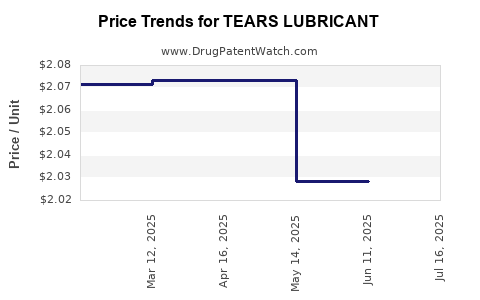
What is the price range for TEARS LUBRICANT products?
Pricing varies based on packaging, formulation, and regional regulations. Typical market prices include:
| Product Type |
Average Price (USD) |
Packaging Details |
Notes |
| Multidose preservative-free drops |
$15 - $25 |
10 mL bottles |
Higher due to preservative-free technology |
| Preserved eye drops |
$8 - $14 |
15 mL bottles |
Lower price, more common in developed markets |
| Gel formulations |
$20 - $35 |
10 g tubes |
Higher per unit volume, used for severe cases |
Regional variations:
- North America: Prices toward upper range, supported by high insurance reimbursement.
- Europe: Slightly lower prices, with government health systems influencing costs.
- Asia-Pacific: Prices range lower, with significant variation depending on local purchase power.
What are the future price projections?
Projecting forward, several factors could influence PRICE:
- Growth in demand for preservative-free products is projected to push prices upward, with CAGR of 4-6% for premium formulations.
- Introduction of generics could decrease prices in mature markets by 10-15% over five years.
- Technological innovation may sustain higher pricing for advanced formulations. For example, nanotech-based lubricants could fetch 20-25% premium.
Based on these factors, average retail prices for TEARS LUBRICANT in developed markets are forecasted to increase modestly by 2-4% annually over the next five years, barring market disruptions.
Market entry and pricing strategy recommendations
- Focus on preservative-free, single-use packaging to command premium pricing.
- Leverage technological advancements to justify higher prices.
- Consider regional variations; adopt tiered pricing models for emerging markets.
- Partner with insurers to improve reimbursement coverage for higher-cost formulations.
Key Takeaways
- The global dry eye treatment market is projecting strong growth, reaching USD 4.3 billion by 2027.
- Preservative-free formulations have a higher price point and dominate market share.
- Prices for TEARS LUBRICANT vary from USD 8 to USD 35 per package, depending on formulation and region.
- Future pricing will be affected by technological innovation, regulatory changes, and market competition.
- Maintaining premium formulations and leveraging innovation will support higher price points for TEARS LUBRICANT.
FAQs
1. How does TEARS LUBRICANT compare in price to competitors?
TEARS LUBRICANT prices are likely aligned with other preservative-free, multi-dose drops at USD 15–25, typically slightly above preservative-containing options.
2. Are there regional price differences for TEARS LUBRICANT?
Yes; North American markets support higher prices due to insurance coverage, while prices in Asia-Pacific tend to be lower.
3. What regulatory factors could impact pricing?
OTC approval status, patent protections, and regional health policies influence product pricing and market access.
4. How will technological improvements influence prices?
Innovation can raise prices marginally but may also create opportunities for premium pricing or market segmentation.
5. What is the competitive outlook for new entrants?
Entering the market with preservative-free formulations and innovative delivery systems can help new entrants capture market share and command higher prices.
Sources
[1] MarketWatch. (2022). Global Dry Eye Treatment Market Size and Forecast.
[2] Grand View Research. (2022). Ophthalmic Lubricants Market Analysis.
[3] Allied Market Research. (2022). Dry Eye Disease Market Trends.